
Last November, a homeowner in Nuneaton watched a small hairline fracture on their front drive turn into a 2-inch wide pothole after just three nights of heavy frost. It’s a frustrating sight that instantly drags down the kerb appeal of a well-kept home. You likely look at your own entrance and wonder if a quick DIY patch is enough or if you’re facing a total overhaul. Managing a driveway repair shouldn’t be a guessing game that ends in an unexpected invoice.
We understand you want a smooth, safe surface for your family without the stress of being overcharged for work you don’t actually need. Maintaining your property’s value in the Midlands requires a balance of timely maintenance and professional craftsmanship. This guide provides our expert 2026 checklist to help you identify whether you need a simple fix or a full professional restoration. We’ll break down the specific warning signs of structural failure so you can achieve a durable, seamless finish with total peace of mind.
Key Takeaways
- Learn to distinguish between minor surface crazing and the structural “Red Flag” symptoms that signal a need for urgent attention.
- Discover why Hinckley’s specific clay soil requires specialized drainage solutions to prevent standing water from undermining your home’s kerb appeal.
- Apply the “30% Rule” to determine if a targeted driveway repair is a viable fix or if a full professional restoration is the most cost-effective long-term investment.
- Master a seasonal maintenance routine for 2026, including expert tips on safe de-icing and organic debris removal to protect your surface year-round.
- Understand why local expertise is vital for navigating Midlands-specific ground conditions and achieving a high-quality, durable finish.
Essential Driveway Damage Assessment: A Hinckley Homeowner’s Checklist
A durable driveway starts with a solid foundation, but even the best craftsmanship requires a professional eye to spot early signs of wear. For homeowners in Hinckley, the local geology plays a significant role in how your driveway ages. Before you commit to a full driveway repair, you need to understand whether you are looking at minor surface weathering or a more serious structural failure. Use this checklist to walk your property and identify “Red Flag” symptoms that demand immediate attention.
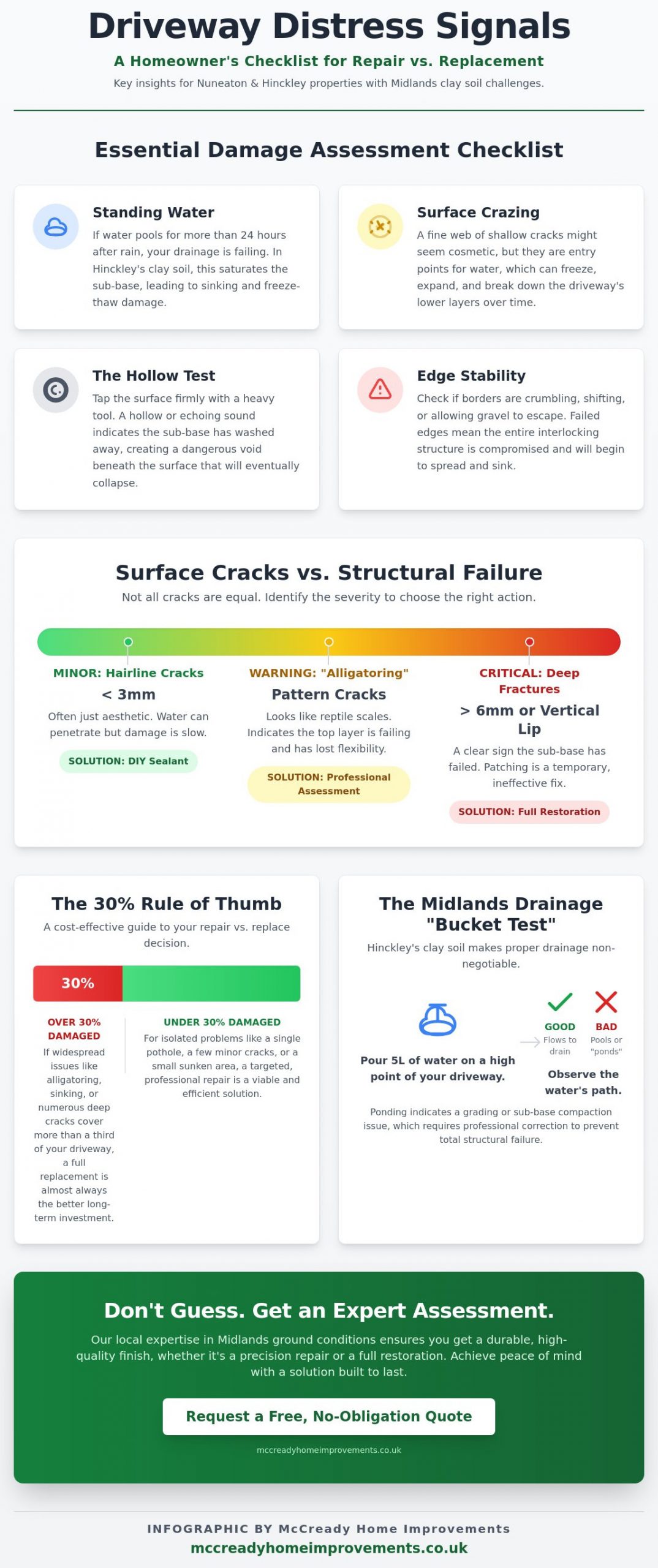
- Surface Crazing: Look for a web of fine, shallow cracks. While often aesthetic, they can allow water to penetrate the lower layers.
- Standing Water: Hinckley sits on heavy clay soil, which naturally resists drainage. If water remains 24 hours after a downpour, your sub-base is likely saturated.
- The Hollow Test: Tap your driveway surface with a heavy tool or walk firmly over suspected areas. A “hollow” sound suggests the sub-base has washed away, leaving a dangerous void.
- Edge Stability: Check if your borders are shifting or if the gravel is migrating into your garden. Crumbling edges often signal that the original restraint system has failed.
Surface Cracks vs. Structural Failure
Distinguishing between a quick fix and a professional overhaul is vital for your budget. Hairline cracks under 3mm are usually suitable for DIY sealant or minor top-ups. However, if you notice “alligatoring,” which looks like the scales of a reptile, your driveway has reached the end of its service life. This pattern indicates that the material can no longer support the weight of your vehicles. Understanding Asphalt concrete properties helps explain why these patterns form as the binder loses its flexibility over time. When a crack exceeds 6mm in width or shows a vertical “lip” where one side is higher than the other, the sub-base has failed, and a standard driveway repair will only be a temporary bandage.
The Midlands Drainage Test
Effective runoff is the only way to protect your investment from the British weather. You can perform a simple “bucket test” by pouring five litres of water on a high point and watching the flow. If the water pools rather than moving toward a drain or soakaway, you have a “ponding” issue. This is particularly damaging for tarmac and block paving, where standing water softens the underlying ground and leads to rapid sinking. The Leicestershire average rainfall of 600mm to 700mm per year, combined with Hinckley’s heavy clay soil, creates a freeze-thaw cycle that rapidly expands minor surface gaps into deep potholes. Identifying these drainage failures early prevents the water from reaching the sub-base and causing a total collapse of the structure.
Material-Specific Repair Solutions for Hinckley Driveways
Every driveway material in Hinckley faces unique challenges from the local weather and heavy vehicle use. Whether you’re dealing with the freeze-thaw cycles of a Leicestershire winter or the heavy rains of autumn, choosing the right driveway repair method is the difference between a five-year fix and a twenty-year solution. While gravel is the focus of this guide, many properties feature mixed-material entrances that require a tailored approach to maintenance.
Tarmac and Asphalt Restoration
Hinckley homeowners often face a choice between a quick patch and a lasting restoration. For isolated potholes, a cold-lay bitumen macadam works well for immediate safety. However, if the entire surface appears grey or brittle, a professional-grade tarmac restorer is superior to “paint-on” DIY alternatives. These professional products replace the essential resins and oils lost to UV damage. Following asphalt pavement maintenance best practices ensures the binder remains flexible enough to resist cracking. Before applying any seal coat, ensure the surface is scrubbed with a stiff brush and degreased to remove oil spills. You can find more details in our tarmac driveway guide.
Revitalising Block Paving
Block paving requires a different approach to driveway repair because its strength comes from the friction between individual bricks. In Nuneaton’s damp climate, moss and weeds frequently displace the jointing sand, leading to structural instability. If you notice sunken blocks, you must lift them and level the underlying sharp sand before relaying. Always use kiln-dried sand for re-sanding; it’s fine enough to penetrate deep into the joints and lock the blocks together. For a complete look at maintenance, read our block paved driveways guide. To replace a cracked block without disturbing the rest of the drive, follow this checklist:
- Clear the sand from the surrounding joints using a pressure washer or a narrow wire brush.
- Use two flat-head screwdrivers to lever the damaged block upward.
- Remove the old bedding sand and replace it with fresh, compacted sharp sand.
- Drop the new block into place and vibrate it level using a rubber mallet.
Gravel driveways often develop “thin spots” in high-traffic turning circles where the sub-base becomes visible. Don’t just pour new stone on top. Instead, rake the existing gravel back, check the weed membrane for tears, and then blend in matching 20mm aggregate. For resin-bound surfaces, physical chips or UV-related dulling can be addressed by patching with a matching aggregate-resin mix. This creates a professional finish that blends into the existing surface. For a result you can trust, consider a consultation with McCready Home Improvements.
The ‘Repair vs. Replace’ Dilemma: Calculating Long-Term Value
Deciding whether to stick with a driveway repair or opt for a full replacement is a financial crossroads for many homeowners. We use the 30% rule as a professional benchmark. If repairs cover more than a third of your total surface area, you’ve reached a point of diminishing returns. At this stage, the integrity of the entire structure is likely compromised, and you’re simply throwing good money after bad.
Age plays a critical role in this decision. In the Midlands, a professionally installed tarmac driveway typically provides a reliable service life of 20 years before the material naturally degrades. Beyond this two-decade mark, the bitumen becomes brittle. This leads to frequent cracking and “alligatoring” that no amount of driveway repair can permanently fix. Patching a 20-year-old surface is often a temporary sticking plaster rather than a long-term solution.
Looking ahead to the Hinckley property market in 2026, kerb appeal remains a top priority for local buyers. Market data suggests that a premium, well-maintained driveway can boost a property valuation by approximately 5% to 10%. For a typical £350,000 home in the LE10 area, a fresh installation represents a significant return on investment. It offers a seamless finish that a patchwork of old repairs simply cannot match.
When Repair is No Longer Cost-Effective
Deep-seated structural issues often hide beneath the surface. If you notice large depressions or areas where water pools consistently, your sub-base has likely collapsed. While you might try to repair and reseal an asphalt driveway to improve its appearance, these are often temporary fixes for a foundation problem. Hidden costs of repeated DIY efforts include the recurring price of materials and the value of your own time. Over a three-year period, these small costs often eclipse the price of a professional resurface.
Resurfacing vs. Full Excavation
An overlay is a cost-effective middle ground where we apply a new layer of material over your existing surface. This is only viable if your foundation is rock solid. Use this checklist to see if you can skip the full excavation:
- The existing sub-base shows no signs of sinking or shifting.
- The driveway has adequate drainage levels to accommodate an extra 40mm of height.
- Existing cracks are narrow and don’t indicate deep structural failure.
- The kerb edges are high enough to contain a new layer of material.
If your current setup doesn’t meet these criteria, a full excavation is the only way to ensure a durable result. You can explore more about high-quality alternatives in our stone driveways guide. We focus on providing a foundation that lasts for decades, not just a few seasons.
Preventing Future Damage: Seasonal Maintenance Checklist for 2026
Effective maintenance follows the rhythm of the British seasons. By staying ahead of the Midlands weather, you protect your investment and avoid the need for premature driveway repair. Our 2026 checklist focuses on proactive steps that keep your home looking its best year-round.
- Autumn: Clear organic debris every two weeks. When wet leaves sit on your driveway, they break down into a nutrient-rich sludge. This creates the perfect breeding ground for moss and algae, which can become slippery and unsightly by November.
- Winter: Follow our Hinckley guide to safe de-icing. Avoid using raw rock salt on decorative stone or block borders, as it can cause white staining and surface scaling. Instead, use sharp sand for grip or a urea-based de-icer to protect the integrity of your stone.
- Spring: Inspect the surface for frost heave. The Midlands often experiences rapid freeze-thaw cycles where water trapped in the sub-base expands. Check for new soft spots or areas where the gravel has shifted significantly during the February frosts.
- Summer: Watch for heat impact. During extreme heatwaves, such as the 40°C peaks recorded in recent years, tarmac components in mixed-material driveways can soften. Avoid turning vehicle wheels while stationary to prevent scuffing the surface.
The Weed and Moss Prevention Checklist
Moss is the primary threat to driveways across the Midlands due to our high humidity and damp winters. It takes root in the fine silt that settles between stones. To prevent this, we recommend a weekly sweep with a stiff broom to disrupt seed germination. If you use cleaning products, always select pH-neutral solutions. Harsh acids can react with local limestone or decorative aggregates, leading to permanent discolouration and structural weakening of the stone.
Managing Heavy Vehicle Loads
Modern driving habits have changed the way we look at driveway durability. With the rise of Electric Vehicles (EVs) and large SUVs, driveways now support significantly more weight. A typical EV can weigh 20% more than its petrol equivalent, which puts extra pressure on the sub-base. We suggest rotating your parking positions by just 30cm every few days to distribute this weight more evenly. You can spot early rutting by looking for parallel depressions where the gravel has migrated to the outer edges, often leaving the central sub-base visible after heavy rain.
Staying on top of these small tasks ensures your driveway remains a durable and beautiful entrance to your home. If you notice deep depressions or structural issues that require professional driveway repair, our team provides the expert craftsmanship needed to restore your surface to its original standard. Contact McCready Home Improvements today for a professional assessment of your driveway’s condition.
Professional Driveway Restoration: Why Local Expertise Matters
While routine maintenance keeps surface issues at bay, professional restoration is often necessary to address structural shifts or significant wear. At McCready Home Improvements, we provide a bespoke assessment for every project across Hinckley and Nuneaton. We don’t believe in a one-size-fits-all solution because every property has unique requirements based on its age and usage. National contractors frequently overlook local drainage requirements, which can lead to standing water and sub-base erosion. Our team understands the specific soil conditions in Leicestershire and Warwickshire, ensuring your driveway repair is built to handle the local environment.
Choosing a local specialist means you’re hiring a safe pair of hands. We live and work in the same community as our clients, so our reputation relies on every project’s success. We provide a local guarantee that offers genuine peace of mind, standing by the quality of our work long after the final stone is laid. This accountability is something large, faceless corporations simply cannot match. For homeowners considering a complete transformation of their outdoor space, our landscaping Hinckley driveways, paths and patios service offers a comprehensive approach to achieving a premium finish across your entire property entrance.
Our Commitment to Hinckley Craftsmanship
Our family-run values sit at the heart of everything we do. We treat your home with the same respect we’d show our own, focusing on meticulous site preparation to ensure results last for decades. Industry data suggests that 80% of driveway failures occur because of poor sub-base installation. We prevent this by using high-quality, locally sourced materials that are compatible with the existing landscape. Our team manages the entire process from the first shovel in the ground to the final sweep of the site. This dedicated focus on craftsmanship ensures your driveway repair isn’t just a temporary fix, but a long-term investment in your property’s kerb appeal.
Next Steps for Your Driveway Transformation
The process begins with a professional McCready site visit. We’ll inspect your current driveway, check for underlying drainage issues, and discuss your aesthetic goals. You won’t find any high-pressure sales tactics here. Instead, we provide transparent, fixed-price quotes with no hidden extras. We believe in clear communication, so you’ll know exactly what the project entails before any work starts. Our goal is to make the transformation as seamless as possible, providing a durable and professional finish that enhances your home’s value. If you’re ready to restore your home’s entrance, you can Book your free driveway health check with McCready today. We’ll provide a detailed, no-obligation estimate and help you choose the best path forward for your home.
Secure Your Home’s Kerb Appeal for 2026
Assessing damage early is the most effective way to avoid the high costs of a full excavation. By following the 2026 maintenance checklist, you can identify minor cracks before they compromise your property’s foundation. Whether you have Tarmac, Block Paving, or Resin, choosing material-specific solutions ensures your driveway repair lasts for years rather than months. Local expertise matters because Hinckley and Nuneaton homeowners face specific drainage and soil conditions that require a professional, experienced touch.
McCready Home Improvements is an independent family-run business serving the Midlands with pride. We specialise in high-quality transformations and offer free site surveys to give you total clarity on your project. Our transparent project-based pricing means you won’t face hidden surprises during your renovation. We treat every home with the same respect we give our own; ensuring a seamless, durable finish that stands the test of time. Our team focuses on the fine details to deliver a result that combines aesthetic excellence with long-term reliability.
Get your free, no-obligation driveway repair estimate in Hinckley & Nuneaton
It’s time to restore the entrance to your home and enjoy the peace of mind that comes with expert craftsmanship. We look forward to helping you transform your space into something truly remarkable.
Frequently Asked Questions
Can I repair a tarmac driveway myself?
You can handle minor tarmac repairs yourself using cold-lay macadam or bitumen-based filler for small cracks and potholes. Homeowners often manage patches up to 300mm in diameter with a heavy tamper and quality bagged material from a local builder’s merchant. If your driveway shows widespread “alligator cracking” over 25% of the area, you’ll need a professional assessment. Large-scale resurfacing requires specialist machinery to ensure the new layer bonds correctly with the old surface.
How much does it cost to repair a driveway in Hinckley?
Repair costs in Hinckley vary based on the material and the extent of the damage. According to 2024 industry benchmarks from Checkatrade, a professional driveway repair for small patches typically starts around £150 for basic tarmac filling. If you need a larger area of block paving re-sanded and sealed, prices often range between £5 and £10 per square metre. We provide a clear, fixed quote after a site visit to ensure you know the exact investment required for your project.
How do I fix a sinking block paving driveway?
You fix a sinking block paving driveway by lifting the affected blocks and addressing the underlying sub-base issues. We remove the sunken bricks, add a fresh layer of sharp sand or Type 1 MOT aggregate to level the area, and compact it thoroughly with a plate vibrator. Once the base is firm, we relay the blocks and sweep in new kiln-dried sand. This process addresses the root cause, usually poor original compaction, ensuring a level and durable finish that lasts.
What is the best way to fill cracks in a driveway?
The best way to fill driveway cracks is to clear out all debris and vegetation before applying a high-quality polymer-modified filler. For tarmac, use a bitumen-based pourable crack filler that remains flexible during temperature changes to prevent further splitting. Concrete cracks require a masonry-grade sealant or epoxy resin to stop water ingress. Following these steps prevents water from reaching the sub-base, which causes 90% of driveway structural failures in the UK.
Is it better to repair or replace my old driveway?
You should generally choose a driveway repair if the damage affects less than 30% of the total surface area. If structural issues like deep sinkholes or widespread foundation failure exist, a full replacement is the more cost-effective long-term solution. A professional repair can extend the life of your surface by 5 to 10 years. However, if your driveway is over 20 years old and requires constant maintenance, a fresh installation provides better value and improved curb appeal. Homeowners in the Midlands looking to upgrade their entire outdoor space can also explore our complete landscaping Hinckley driveways, paths and patios solutions for a bespoke, permeable finish that combines kerb appeal with long-term structural integrity.
How long does a professional driveway repair take to set?
Professional driveway repairs typically require 24 to 48 hours to set before they can support vehicle traffic. Tarmac repairs are often firm enough for foot traffic within 4 hours, but it’s best to wait a full day before parking a car on the new surface. Concrete patches take longer, usually requiring 48 hours to reach initial strength. During peak summer months, these times can decrease, while damp UK winters might extend the curing process by an additional 12 hours.
Will a repaired driveway look patchy compared to the original?
A new repair will initially look darker than the weathered original surface, but the contrast usually fades over 6 to 12 months. We use high-quality materials that match the original specification as closely as possible to minimize this visual difference. For the most seamless result, many homeowners choose to apply a professional sealant across the entire driveway after the repair has cured. This creates a uniform colour and provides an extra layer of protection against the elements.
Can you repair a resin-bound driveway without it being noticeable?
Repairing a resin-bound driveway without it being noticeable is challenging because UV exposure changes the colour of the original stones over time. We achieve the best results by cutting out a neat, geometric section and using the exact same aggregate blend from the initial installation. While a slight “tide mark” might be visible at first, our attention to detail and craftsmanship ensures the patch blends as naturally as possible. Choosing a professional ensures the structural integrity of the resin remains intact.
