
A garden wall is more than a boundary; it’s a structural commitment to public safety that can quickly become a legal liability if you ignore the fine print. Most homeowners want to enhance their property’s privacy, but the fear of a council fine or a dispute with a neighbour often stalls the process. You’re right to be cautious. Understanding the garden wall building regulations UK authorities enforce in 2026 is the only way to ensure your investment is both beautiful and legally sound.
We’ll help you master these requirements so you can build with total peace of mind. This guide simplifies the legal landscape, covering everything from the 1-metre height limit near highways to the critical notice periods required by the Party Wall etc. Act 1996. We’ll break down when you need to seek planning permission and how to meet the structural standards that prevent wall collapse. You’ll gain a clear, step-by-step roadmap to creating a durable brickwork feature that adds genuine value and security to your property.
Key Takeaways
- Identify the vital difference between planning permission for height and building regulations for structural integrity.
- Discover why wall thickness is essential for stability and why standard half-brick walls often fail.
- Recognize when a garden wall becomes a retaining wall and requires professional structural design.
- Master the garden wall building regulations UK homeowners must follow to avoid council fines and ensure safety.
- Understand your legal duties under the Party Wall etc. Act 1996 to maintain positive neighbour relationships.
Planning Permission vs. Building Regulations: The Vital Distinction
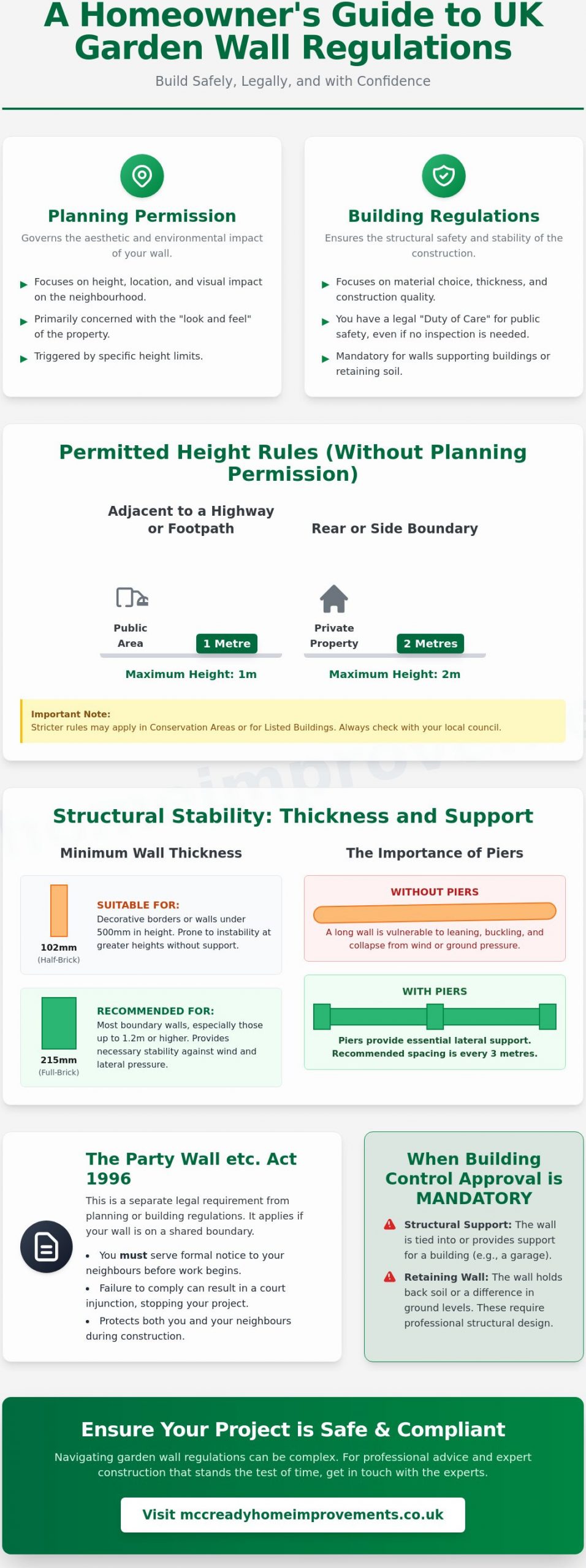
Homeowners often treat planning permission and building regulations as the same thing. They aren’t. Planning permission deals with the “look and feel” of your property and its impact on the local area. It dictates where you can build and how high the structure can go. In contrast, building regulations focus on the structural integrity and safety of the construction itself. While they serve different masters, both are essential for a successful project.
For most standard projects, the garden wall building regulations UK councils enforce are surprisingly hands-off. Usually, a standalone garden wall doesn’t require a formal Building Control inspection or a completion certificate. This lack of red tape doesn’t mean you’re off the hook for safety. You hold a legal “Duty of Care” to ensure your wall doesn’t pose a danger to the public or your neighbours. If a poorly built wall collapses and causes injury or damage, the responsibility sits squarely with the property owner.
The 1-Metre and 2-Metre Height Rules
The height of your wall is the primary trigger for planning permission. If your wall sits next to a highway or a public footpath, you’re generally limited to a height of 1 metre. For rear and side boundaries that don’t border a road, you can usually build up to 2 metres without needing a householder application. These rules change quickly if you live in a conservation area or own a listed building. In parts of the Midlands, such as Hinckley or Nuneaton, local character protections might require specific brick types or lower height limits to preserve the street scene.
Before you dig your first trench, check if your project falls under the Party Wall etc. Act 1996. This legislation is separate from planning permission but just as vital. It governs how you interact with shared boundaries and ensures your neighbours are protected during construction. Failing to serve the correct notice can lead to costly legal injunctions that stall your project indefinitely.
When Formal Building Control Approval is Mandatory
While simple boundary walls escape formal inspections, certain conditions make Building Control approval mandatory. If your garden wall provides structural support to a house or a garage, it’s no longer just a fence; it’s part of a building’s foundation system. You’ll need a professional sign-off in these cases. Local authorities in Hinckley and Nuneaton take these distinctions seriously. A wall that’s tied into a permanent structure must meet specific load-bearing standards to prevent subsidence or structural failure. We always recommend checking with your local planning office if your wall will be physically attached to any existing building.
Safe Heights and Structural Thickness Standards
Building a wall that stands the test of time requires more than just stacking bricks. Structural thickness is the most overlooked aspect of garden wall building regulations UK compliance. A standard half-brick wall, which measures approximately 102mm, is often sufficient for decorative borders. However, once a wall exceeds a height of 500mm, its susceptibility to wind and physical pressure increases dramatically. Without adequate thickness or the addition of piers, these structures can lean or buckle under their own weight.
Piers act as the backbone of a long brickwork run. They provide essential lateral support. We recommend spacing them no more than 3 metres apart for maximum stability. If you’re building on a boundary, you should also consult the official government explanatory booklet to ensure your structural reinforcements don’t encroach on a neighbour’s land.
Masonry Thickness Guidelines for Homeowners
Choosing between half-brick (102mm) and full-brick (215mm) construction depends entirely on your intended height. Modern garden designs often use 100mm or 200mm blocks for a cleaner look, but the physics remains the same. For a standard 1.2m wall, a thickness of 215mm is generally required to maintain a safe height-to-thickness ratio and resist lateral pressure. Skimping on materials here is a common mistake that leads to costly rebuilds later.
The Impact of Midlands Wind Zones
Leicestershire generally sits in a moderate wind exposure zone, but your specific garden layout dictates the real risk. A sheltered spot can become a wind tunnel if you remove a nearby hedge or building. This sudden increase in exposure can make a previously stable wall unsafe. Regional weather patterns also dictate how you apply garden wall building regulations UK standards to your project, especially in open areas where gusts are more frequent.
Soil type also plays a massive role in stability. The heavy clay common across Hinckley and Nuneaton is prone to “heave” and “shrinkage.” This means your foundations must be deep enough to reach stable ground, typically at least 600mm below the surface. If you want a structure that survives the local climate, our experts deliver high-quality garden walls and brickwork designed for the unique Leicestershire terrain.
Retaining Walls: When Regulations Become Strict
Retaining walls differ from standard boundary walls because they must withstand constant lateral pressure from soil and water. When you’re holding back a slope, the physics changes. A failure here isn’t just an eyesore; it’s a structural catastrophe. If a wall collapses and shifts soil onto a neighbour’s land, you could face significant legal claims for property damage. This is why garden wall building regulations UK authorities and insurance companies take a much firmer stance on these structures than they do on simple brick fences.
The structural integrity of a retaining wall depends on its ability to resist the weight of the earth it supports. Unlike a free-standing wall that only carries its own weight, a retaining structure acts as a dam. If the design doesn’t account for the specific soil type and moisture levels, the masonry will eventually bow or crack. Professional design is almost always a necessity to ensure the safety of your family and the protection of your property value; for those looking for expert craftsmanship in this field, check out Cascade Outdoor Services.
When to Hire a Structural Engineer
While a small decorative terrace might be a straightforward project, any wall retaining more than 1.5 metres of soil generally requires a structural engineer’s calculation. This rule of thumb ensures the wall can handle the specific weight of the earth behind it. You must also consider “surcharge,” which is the additional weight from objects on top of the retained soil. For homeowners planning block paved driveways on a sloped plot, we always conduct a thorough structural assessment. We ensure the brickwork is reinforced to handle vehicle loads without shifting over time.
Drainage Requirements for Retaining Brickwork
Water is the primary enemy of any retaining structure. Without proper drainage, rain saturates the soil and creates immense hydrostatic pressure. This pressure can easily push over even the thickest brick wall. We prevent this by installing “weep holes” and using granular backfill like crushed stone. These features allow water to escape from behind the wall rather than building up behind the masonry. It’s a simple addition that prevents a total structural failure during heavy Midlands downpours.
For larger projects, we often install perforated drainage pipes that channel water away to a suitable soakaway. It’s often effective to coordinate these drainage plans with your wider property maintenance, such as new roof installations or guttering upgrades. By managing water flow from the top of the house down to the garden boundaries, we protect the longevity of every structure on your land. Proper planning ensures your garden wall building regulations UK compliance while keeping your garden dry and stable.
The Party Wall Act and Boundary Disputes
The Party Wall etc. Act 1996 is the most significant piece of legislation affecting your project. It’s designed to prevent disputes, but many homeowners find it confusing. In a garden context, you must distinguish between a boundary wall and a party fence wall. A boundary wall sits entirely on your land. A party fence wall stands astride the boundary line. Understanding this distinction is central to following garden wall building regulations UK guidelines, as it dictates your legal obligations to your neighbour.
If you plan to build a new wall on the boundary line or excavate within 3 metres of a neighbour’s structure, you must serve a formal notice. For new walls, you need to provide at least one month’s notice. If you’re repairing an existing shared wall, the notice period increases to two months. Maintenance responsibilities usually follow ownership. If the wall is shared, the costs for repairs are typically split, provided the work is necessary due to wear and tear rather than a desire for a cosmetic upgrade.
Serving a Party Wall Notice
A valid written notice must include your name, the address of the project, a clear description of the work, and the date you intend to start. If your neighbour dissents or fails to respond within 14 days, you’re “in dispute.” At this point, you must appoint a surveyor. In the Midlands, an “Agreed Surveyor” can often handle the paperwork for both parties to keep costs down. This professional ensures the work proceeds without damaging the adjoining property or causing unnecessary friction between households.
Is Your Wall Safe? A Homeowner’s Inspection Checklist
Existing walls require regular checks to remain compliant with safety standards. Use this checklist to assess your brickwork:
- The Leaning Test: A wall is generally considered unsafe if it leans by more than 1/15th of its height. For a 1.5m wall, a lean of 100mm is a critical warning sign that the structure is failing.
- Frost Damage: Look for “spalling,” where the brick face flakes off. This exposes the soft interior of the brick to the elements, which accelerates decay and weakens the wall’s core.
- Mortar Condition: If you can scrape the mortar out with a fingernail, the chemical bond has failed. This often happens in older Midlands properties where weather and age have eroded the joints.
Cracks in garden walls are often more dangerous than cracks in house walls. Houses have the weight of a roof and internal floors to hold the walls in place. A garden wall relies entirely on its own weight and foundation. If you spot significant movement or structural decay, we provide expert garden walls and brickwork assessments to secure your boundary safely and professionally.
Professional Garden Wall Construction in Hinckley & Nuneaton
Success in brickwork depends on what happens beneath the surface. Hinckley and Nuneaton sit on heavy clay soil that presents unique challenges for any permanent structure. This type of ground expands when wet and contracts during dry spells, which can easily snap a shallow foundation. We ensure your project meets the garden wall building regulations UK authorities expect by anchoring our foundations deep enough to bypass this active soil zone. Our team takes immense pride in building walls that don’t just look good on day one but remain perfectly level for decades.
A well-built wall provides the perfect framework for other garden features. Many of our clients choose to combine traditional brickwork with high-quality fencing and gates. This hybrid approach offers the structural strength of masonry at the base with the aesthetic warmth of timber on top. It’s a practical way to achieve privacy while staying within height restrictions. We manage every stage of this process, from the initial trench to the final gate hanging, ensuring a cohesive and secure boundary.
Integrating Walls with Driveways and Patios
A garden wall should never feel like an afterthought. It works best when it’s integrated into the wider landscape of your home. We specialize in creating seamless transitions between different levels and surfaces. For homeowners installing stone driveways, we can design matching pillars that create a grand sense of arrival. If you’re upgrading to a resin bound patio, we use matching brickwork for borders and retaining steps to create a polished, uniform look.
Aesthetic choices matter just as much as structural ones. We often recommend traditional brick bonds like English Bond or Flemish Bond to help new walls blend with the local Midlands architecture. These patterns provide superior strength and a timeless quality that enhances your property’s kerb appeal. We treat every brick with the respect your home deserves, focusing on clean mortar lines and meticulous alignment.
Get a Professional Assessment Today
Mastering the garden wall building regulations UK homeowners must follow is easier when you have a local expert by your side. We’re dedicated to providing honest, reliable advice that protects your investment and your peace of mind. Our team is currently planning projects for the remainder of 2026, and we’d love to help you transform your boundaries. We offer a straightforward, no-obligation estimate process where we’ll assess your ground conditions and provide a clear plan for a compliant, durable structure. Contact McCready Home Improvements today to start your property’s next evolution with a partner you can trust.
Secure Your Property Boundaries with Confidence
Building a new boundary is an investment in your home’s security and long-term value. You’ve now mastered the essential height limits, structural thickness standards, and drainage requirements that define a successful project. Navigating the garden wall building regulations UK authorities enforce ensures your brickwork stands strong against both the elements and local council scrutiny. By respecting the Party Wall Act and accounting for the specific clay soil conditions found in the Midlands, you turn a potential legal burden into a permanent asset.
As expert local brickwork specialists serving Hinckley, Nuneaton, and the surrounding areas, we bring decades of experience to every project. Our work is fully insured and delivered with meticulous, high-quality craftsmanship, providing you with the peace of mind that comes from a job done right the first time. We treat every property with the respect it deserves, ensuring your new wall enhances your home’s character and safety.
Book your free garden wall and brickwork estimate with McCready Home Improvements today to discuss your 2026 project. Let’s work together to build a boundary that’s compliant, durable, and beautiful.
Frequently Asked Questions
Do I need planning permission for a 2-metre high garden wall?
You don’t usually need planning permission for a wall that is 2 metres high, provided it is located on a rear or side boundary. This is the standard limit for most residential properties under permitted development rights. However, if the wall borders a highway or a public footpath, the height limit drops to 1 metre. You should always check if your property is in a conservation area or is a listed building, as these factors can trigger the need for a formal application regardless of height.
How deep should foundations be for a 1-metre high garden wall?
Foundations for a 1-metre high wall should typically be at least 600mm deep. In the Midlands, our heavy clay soil requires this depth to reach stable ground that doesn’t shift with seasonal moisture changes. The concrete footing should also be at least three times the width of the brickwork to distribute the weight effectively. Getting the foundation right is the most critical step in preventing future cracks or leaning.
Can I build a garden wall right up to the pavement?
Yes, you can build a wall up to the pavement, but it must not exceed 1 metre in height without planning permission. It’s also vital to ensure that the wall and its foundations are entirely within your property boundary. You must not obstruct the sightlines of road users or pedestrians. If you’re building a retaining wall near a highway, you may also need specific approval from the local highways authority under the Highways Act 1980.
What is the maximum height for a single-skin brick wall?
A single-skin or half-brick wall should not exceed a height of 450mm to 500mm for safety reasons. For any structure taller than this, garden wall building regulations UK standards recommend a full-brick thickness of 215mm or the strategic use of piers for reinforcement. A thin wall lacks the lateral stability to resist wind pressure or accidental impact, which often leads to total structural failure over time.
Does the Party Wall Act apply to garden fences?
No, the Party Wall etc. Act 1996 does not apply to wooden garden fences. It specifically covers “party fence walls,” which are masonry structures built astride a boundary line. While timber fences don’t fall under this legislation, you should still check your property deeds to confirm ownership and maintenance responsibilities. If you plan to replace a fence with a brick wall on the boundary, the Act will then apply.
What happens if my garden wall is damaged or leaning?
You have a legal duty of care to ensure your wall is safe and doesn’t pose a risk to the public or neighbours. If a wall leans by more than 1/15th of its total height, it’s generally considered structurally unsound and requires immediate attention. Ignoring a leaning wall can lead to liability claims if it collapses. We recommend a professional assessment to determine if the wall can be repaired or needs a complete rebuild.
Can my neighbour force me to repair a shared garden wall?
Yes, a neighbour can insist on repairs if the shared wall is a “party fence wall” and has become dangerous. Under the Party Wall Act, both owners are responsible for the maintenance of a shared structure. If one party refuses to contribute to essential safety repairs, a surveyor can be appointed to resolve the dispute and allocate costs. It’s always better to reach a friendly agreement before involving legal professionals.
Do I need a structural engineer for a retaining wall under 1 metre?
You usually don’t need a structural engineer for a retaining wall under 1 metre, as standard brickwork patterns are sufficient for low heights. However, this assumes the wall is only holding back soil and isn’t supporting a heavy load like a parked car. If the wall borders a driveway or a steep slope, a professional assessment is a smart choice. Proper drainage and foundation depth are still essential to prevent the wall from bowing under water pressure.
