
Block paving isn’t just for driveways. That assumption alone has stopped thousands of Midlands homeowners from unlocking one of the most versatile, design-forward materials available for outdoor living spaces. If you’ve ever looked at a block paved area and thought “car park,” it’s time to think again.
You’re not alone in wanting a patio that works harder and looks better. The weeds pushing through the gaps, the blocks that have shifted over winter, the nagging worry that the wrong colour will clash with your brickwork; these are real frustrations, and they deserve real answers. The good news is that the right block paving patio ideas, paired with professional ground preparation and a considered design, solve all three at once.
This guide is built specifically for UK homeowners across the Midlands. It covers pattern choices, colour matching, layout strategies, and the practical details that separate a patio that lasts from one that lets you down. Whether you want a low-maintenance entertaining space, a garden that adds genuine property value, or a design that feels cohesive with your home, you’ll find exactly what you need here.
Key Takeaways
- Block paving patio ideas go far beyond driveways — the right pattern, colour, and layout can transform your garden into a cohesive, high-value outdoor living space.
- Pattern choice is about more than aesthetics; interlocking layouts like herringbone provide structural strength that decorative arrangements alone cannot match.
- Matching your paving tone to your home’s existing brickwork or render is one of the most effective ways to create a finished, intentional look rather than a disjointed one.
- Professional sub-base preparation is the single biggest factor separating a patio that stays level for decades from one that shifts, sinks, or lets weeds through within a few seasons.
- From free estimate to final completion, a comprehensive local installation service removes the guesswork and gives you a result built to last in the Midlands climate.
Why Block Paving is the Ultimate Choice for Modern Patios
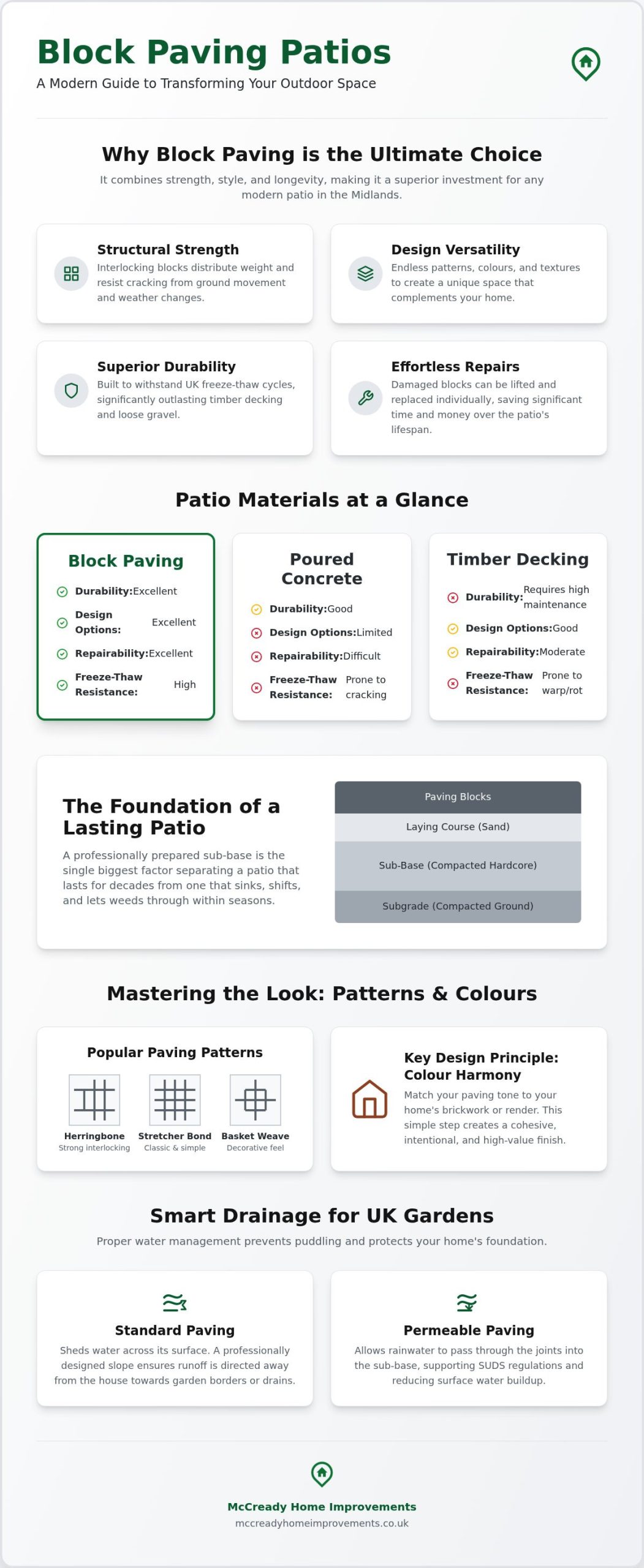
Block paving is a modular surfacing system built from individual units of concrete, clay, or natural stone, laid onto a compacted sub-base and bound together through precise jointing. Unlike a poured concrete slab, which behaves as a single rigid structure, block paving distributes load and movement across hundreds of independent units. That distinction matters enormously in practice. For a deeper grounding in the block paving materials and history that underpin modern installations, Wikipedia offers a useful overview of how the medium has evolved.
The ‘small unit’ nature of block paving is its structural superpower. When a large concrete slab expands and contracts with temperature changes, it has nowhere to go; cracking is almost inevitable. Individual blocks, by contrast, flex slightly with the ground beneath them. Each unit accommodates minor movement without transferring stress to its neighbours. The result is a surface that resists the kind of visible fracturing that makes large-slab patios look tired within a decade.
Shape variety adds another dimension. Standard rectangular blocks suit clean, contemporary layouts. Rumbled or tumbled blocks replicate the worn, organic texture of traditional cobblestones, lending a cottage-garden character that feels genuinely at home in older Midlands properties. Circular kits, fan patterns, and mixed-format designs give homeowners real creative latitude, which is exactly why block paving patio ideas have expanded so far beyond their driveway origins.
Repair is where block paving quietly outperforms almost every alternative. A cracked poured concrete area requires grinding, patching, or full replacement. A single sunken or damaged block? Lift it, re-bed it, and relay it in an afternoon. That repairability isn’t a minor convenience; over a twenty-year lifespan, it’s a meaningful cost saving.
Durability Meets Design: The Patio Advantage
The Midlands climate is demanding. Freeze-thaw cycles through winter put real stress on outdoor surfaces, as water enters small voids, freezes, expands, and forces materials apart. Quality concrete block paving, properly installed on a compacted sub-base, handles this cycle reliably. Compare that to timber decking, which absorbs moisture, warps, and requires regular treatment to stay safe and presentable, or loose gravel, which migrates, compacts unevenly, and offers no structural stability underfoot. A professionally installed block paved patio will consistently outlast both alternatives by a significant margin.
Sub-base preparation is the foundation of that longevity. Without a correctly graded, compacted hardcore base beneath the laying course, even the best blocks will sink, tip, and create the puddling problem that frustrates so many homeowners. This is precisely why professional ground preparation sits at the heart of every McCready Home Improvements patio installation; getting it right from the ground up is what separates a patio that stays level for decades from one that starts failing within a few seasons.
Permeable Paving and Drainage Requirements
UK planning policy under Sustainable Urban Drainage Systems (SUDS) guidance encourages homeowners to manage surface water on their own land rather than directing it into the public drainage network. For garden patios, this typically means designing for controlled runoff toward planted borders or installing permeable paving that allows water to pass through the surface itself.
Standard concrete blocks shed water across their surface, so grading and drainage channels become important design considerations. Permeable ‘eco’ block variants, which feature open joints or porous faces, allow rainfall to infiltrate directly into the sub-base and disperse naturally. The right choice depends on your garden’s existing drainage behaviour, soil type, and the overall layout. A professional installation team will assess these factors and design a drainage strategy that keeps your patio dry underfoot and your garden borders properly irrigated, without sending excess water toward your foundations or your neighbour’s fence line.
Exploring block paving patio ideas without factoring in drainage is one of the most common planning oversights. Getting it right from the start means no puddling, no erosion at the edges, and a surface that performs as well in November as it does in July.
Popular Block Paving Patterns to Transform Your Layout
Pattern choice does more than determine how your patio looks on a sunny afternoon. It controls the visual energy of the entire space, guiding the eye toward focal points, making narrow areas feel generous, and either reinforcing or undermining the structural integrity of the surface beneath your feet. Getting this decision right is one of the most impactful block paving patio ideas you can explore before a single block is laid.
The distinction between structural and decorative patterns matters more than most homeowners realise. An interlocking pattern, where blocks are offset and angled so that no continuous joint runs across the surface, transfers load laterally across the entire laid area. A purely decorative arrangement, where joints align in straight runs, creates fault lines that concentrate stress. For a patio that will bear the weight of garden furniture, outdoor kitchens, and regular foot traffic, structural integrity isn’t an aesthetic preference; it’s a practical requirement.
Patterns also direct attention. A strong diagonal line naturally draws the eye toward the far end of a garden, making a compact outdoor space feel longer. Concentric or circular arrangements pull focus inward, making them ideal for framing a water feature, fire pit, or statement planter as a centrepiece. Mixing two complementary patterns, such as a structured field of one design with a contrasting border or feature panel, creates a bespoke result that reads as genuinely considered rather than off-the-shelf.
The Classic Herringbone: 45 vs 90 Degrees
Herringbone is the benchmark interlocking pattern, and for good reason. At 45 degrees, the angled offset maximises load distribution across the surface, making it the strongest choice for areas that take consistent use. It also has a spatial trick built in: the diagonal lines draw the eye across the width of a patio, which makes a narrow or rectangular space feel noticeably broader. At 90 degrees, herringbone retains its interlocking strength but produces a more formal, grid-aligned appearance that suits contemporary garden designs and wider spaces where the diagonal effect isn’t needed.
Stretcher Bond and Basketweave for Traditional Homes
Stretcher bond replicates the familiar offset of a brick wall, making it a natural fit for cottage-style gardens and older Midlands properties where the patio needs to feel like an extension of the architecture rather than an addition to it. Basketweave pairs alternating pairs of blocks in a rotating square arrangement, producing a vintage, parquetry-style texture that works beautifully in defined seating areas where the pattern can be appreciated up close.
Both patterns combine particularly well with a block paved driveway at the front of the property. Using the same block format with a complementary or matching pattern front-to-back creates a cohesive design language across the whole property, which is one of the most effective ways to add genuine kerb appeal and perceived value. If you’d like to explore how these patterns could work in your specific garden layout, getting a free estimate from McCready Home Improvements is a straightforward first step.
Choosing the Best Colours and Textures for Your Backyard
Colour is where block paving patio ideas either come together or fall apart. It’s the decision that homeowners most often get wrong, not because they lack taste, but because they make the choice in isolation: looking at a brochure photograph taken in Mediterranean sunshine rather than holding a physical sample against their own brickwork on a grey Midlands afternoon. That single habit change, from catalogue browsing to on-site sampling, is the most practical advice this section can offer.
The starting point is always your home’s existing palette. Red-brick properties, which are common across Hinckley, Nuneaton, and much of the wider Midlands, carry warm undertones that clash visibly with cool blue-grey blocks. Rendered homes in cream or white sit more neutrally and can carry both warm and cool tones successfully. Stone-effect or buff-coloured render tends to pair beautifully with natural, sandy block tones. Getting this relationship right creates a patio that feels like it belongs to your home rather than one that was simply placed in front of it.
Texture adds a second layer of decision-making. Smooth, pencil-edged blocks have clean, precise arrises that suit contemporary garden designs and make jointing lines look deliberate and sharp. Rumbled or tumbled finishes, where the block edges are mechanically softened to replicate natural wear, produce an organic, aged character that genuinely suits older properties and cottage-garden aesthetics. Neither is superior; the right choice depends entirely on the architectural language you’re working with.
The Modern Grey Aesthetic: Charcoal and Silver
Charcoal is the dominant choice in contemporary minimalist gardens, and it earns that position. Dark tones ground a space visually, recede into the background, and let planting, furniture, and architectural features take centre stage. Silver-grey works differently: it reflects available light, which makes it particularly effective on north-facing or shaded patios where warmth and brightness are genuinely limited. A practical contrast technique worth considering is pairing a dark charcoal border with a lighter silver-grey infill. The result reads as considered and high-end without requiring complex pattern work.
Traditional Tones: Brindle, Buff, and Autumn Mix
Brindle, a blend of red and brown tones, is arguably the most forgiving colour in the range. Its multi-tonal nature disguises organic growth, leaf staining, and everyday dirt far more effectively than single-colour blocks. Buff and yellow-toned blocks introduce warmth that reads as almost Mediterranean in direct sunlight, softening the feel of a garden and pairing naturally with terracotta planters or warm timber furniture. Multi-tonal autumn mixes work particularly well where the patio needs to complement an adjacent surface, such as a stone driveway, where a single flat colour would create an awkward visual boundary rather than a natural transition.
Whichever direction appeals, always request physical samples and view them at different times of day in your actual garden before committing. Natural Midlands light, especially in autumn and winter, reads very differently from a showroom or a screen.
Creative Design Ideas: Borders, Circles, and Multi-Level Patios
The most memorable patios aren’t built from a single idea. They’re assembled from several considered decisions that work together: a contrasting border here, a circular focal point there, a change in level that turns a flat garden into something genuinely interesting. These are the block paving patio ideas that separate a competent installation from one that stops visitors in their tracks.
Borders are the simplest upgrade with the highest visual return. A single course of contrasting blocks laid around the perimeter of your patio functions like a picture frame, giving the whole surface a defined, intentional edge. Use a darker tone against a lighter infill, or introduce a different block format, such as a narrow soldier course running perpendicular to the main pattern, and the result reads as genuinely bespoke. It anchors the patio visually, preventing it from looking like it simply runs out at the edges.
Circular kits take this further. A pre-cut circular feature set into the centre of a paved area creates an immediate focal point, drawing the eye inward and providing a natural home for a bistro table and chairs. The geometry does the work: a circle signals “this is the destination” in a way that a rectangular field of blocks simply can’t. For larger gardens, off-centre placement often works better than a central position, leaving room for planting or a path to develop around it organically.
Multi-level design is where block paving genuinely earns its versatility. Steps built from the same block format as the patio surface create a seamless visual flow between levels, rather than the jarring contrast of timber risers set against a paved terrace. Retaining walls built in matching or complementary blocks hold back raised planting beds while reinforcing the design language across the whole space. The result feels cohesive rather than assembled from separate decisions.
Perimeter security and finish matter too. Integrating your patio design with fencing and gates from the outset, rather than adding them as an afterthought, creates a finished, enclosed outdoor room rather than an open slab surrounded by temporary barriers. A gate post set into a block-paved threshold, with the paving pattern wrapping neatly to the base of the fence panels, is the kind of detail that elevates a garden from functional to genuinely finished.
Zoning Your Garden: Dining vs Lounging
Changing the paving pattern between a dining area and a lounging zone is one of the most practical design tools available. Herringbone in the dining area signals structure and formality; a basketweave or stretcher bond in the adjacent lounging space signals ease. The shift is subtle but readable, and it removes the need for physical barriers between zones. Flush-mount block lighting, set into the paving surface itself, reinforces these zones after dark while eliminating trip hazards. Connecting paths laid in a complementary pattern tie the patio back to the wider garden without breaking the visual logic.
Integrating Features: Fire Pits and Planters
Permanent raised planters built from matching blocks create islands of greenery within a large paved expanse, breaking up the hardscape and softening the overall feel without sacrificing usable surface area. For fire pit surrounds, material choice is a genuine safety consideration: standard concrete blocks are not rated for sustained radiant heat, so specifying heat-resistant engineering blocks or natural stone for the immediate surround is a non-negotiable detail, not an aesthetic preference. Matching the surround material to the main paving field keeps the design unified while meeting that practical requirement.
Every one of these details is worth discussing before a single block is laid. Talk to McCready Home Improvements about your garden’s specific layout and get a free estimate that accounts for the full design, not just the surface area.
Professional Installation: Bringing Your Patio Vision to Life
Every block paving patio idea covered in this guide, from herringbone patterns to circular feature sets and multi-level terraces, depends on one thing above everything else: what happens beneath the surface before a single block is laid. Professional excavation to the correct depth, typically 150 to 200mm for a patio sub-base depending on ground conditions, followed by compacted hardcore and a precisely graded laying course, is what determines whether your patio stays level for twenty years or starts shifting within two. No pattern choice, colour selection, or design detail can compensate for a sub-base that’s been rushed or skimped on.
Midlands soil adds a specific layer of complexity here. Clay-heavy ground, which is common across Hinckley and Nuneaton, is particularly susceptible to seasonal movement. It swells with moisture in winter and shrinks back in summer, and a sub-base that hasn’t been designed with that behaviour in mind will transmit that movement directly to the surface. Local expertise isn’t a sales phrase; it’s a practical advantage. McCready Home Improvements works with Midlands ground conditions every day, which means the preparation approach is calibrated for the soil beneath your specific garden, not a generic national standard.
What to Expect During Your Patio Build
A standard block paving patio installation typically takes between two and four days depending on size, complexity, and access. The sequence runs from site clearance and excavation through sub-base compaction, edge restraint installation, block laying, and final finishing. Site management is taken seriously throughout: spoil is removed promptly, access to your home is maintained, and the working area is kept as contained as possible. The final pass with a plate compactor, vibrating kiln-dried jointing sand deep into the block joints, is what locks the surface together and gives it the structural cohesion that makes it genuinely durable. Skipping or rushing that step is one of the most common causes of premature joint failure.
Ongoing maintenance is straightforward once the installation is complete. Reapplying kiln-dried sand to joints every few years, and considering a penetrating block paving sealant to reduce moss growth and surface staining, will keep your patio looking sharp with minimal effort. Sealing isn’t mandatory, but it does extend the time between deep cleans and helps the colour stay true for longer.
Get Started with a Free Midlands Estimate
Turning block paving patio ideas into a finished garden space starts with a conversation. McCready Home Improvements offers free, no-obligation estimates for homeowners across Hinckley, Nuneaton, and the surrounding Midlands area. There’s no pressure and no guesswork; just a clear, honest assessment of your garden, your design ambitions, and what the installation will involve from start to finish.
Ready to revitalise your garden? Contact McCready Home Improvements for a free patio estimate today and take the first step toward an outdoor space that’s built to last.
Your Garden Deserves Better: Take the Next Step Today
A well-designed patio does more than add surface area to your garden. It creates a space you’ll genuinely use, adds real value to your property, and stays looking sharp for decades when it’s built on solid foundations. The block paving patio ideas explored throughout this guide all point toward the same conclusion: pattern, colour, and creativity matter, but professional preparation is what makes them last.
Getting it right means working with people who understand Midlands ground conditions, treat your property with care, and take the job from design to completion without cutting corners. As a local, family-run business, McCready Home Improvements brings exactly that approach to every patio project across Hinckley, Nuneaton, and the surrounding area.
There’s no pressure and no commitment required to get started. Book your free, no-obligation patio estimate with McCready Home Improvements today and find out what’s possible in your garden. The outdoor space you’ve been imagining is closer than you think.
Frequently Asked Questions About Block Paving Patios
How much does a block paving patio cost per square metre in 2026?
We don’t publish fixed prices here because the honest answer is that cost varies significantly depending on patio size, ground conditions, block specification, pattern complexity, and access. Clay-heavy Midlands soil, for example, often requires deeper excavation than lighter ground, which affects both labour time and materials. The most reliable way to get an accurate figure for your specific garden is to request a free, no-obligation estimate from a local installer who can assess the site in person.
Do I need planning permission for a block paving patio in the UK?
In most cases, a garden patio at the rear of your property doesn’t require planning permission under permitted development rights. Front garden paving is a different matter: if the total area exceeds five square metres and doesn’t drain water to a lawn or border, you’ll generally need either permeable paving or planning permission. Rules can vary depending on your property type and local authority, so it’s always worth checking with your local council before work begins if you’re unsure.
How do I stop weeds from growing between the blocks on my patio?
The most effective defence starts during installation. A properly compacted sub-base, combined with a weed-suppressing membrane beneath the laying course, removes the conditions weeds need to establish from below. Kiln-dried jointing sand, vibrated fully into the joints after laying, closes the surface gaps that airborne seeds exploit. For an existing patio, applying a polymeric jointing sand during a refresh and treating with a suitable weed killer will significantly reduce regrowth without damaging the blocks themselves.
Can block paving be laid over an existing concrete patio?
It’s technically possible but rarely advisable. Laying blocks directly over existing concrete adds height to the finished surface, which can create issues with door thresholds, damp-proof courses, and drainage falls. It also means any movement or cracking in the concrete slab below transfers directly upward. In most cases, lifting the old slab and preparing a fresh sub-base gives a far better long-term result and ensures the new surface performs as it should.
Which is better for a patio: block paving or Indian Sandstone?
Both are excellent choices, but they suit different priorities. Block paving patio ideas offer greater pattern variety, easier individual block replacement, and consistent colour across the surface. Indian Sandstone delivers a natural, unique aesthetic with inherent tonal variation that many homeowners find more characterful. Block paving tends to be more practical for high-traffic areas and is easier to repair precisely. Sandstone requires sealing to manage staining and can be more susceptible to surface wear in freeze-thaw conditions if not properly maintained.
How long will a professionally installed block paving patio last?
A professionally installed block paving patio, built on a correctly compacted sub-base with quality blocks and proper drainage, will typically last twenty-five years or more with basic maintenance. The sub-base preparation is the defining factor. Patios that fail early almost always trace the problem back to inadequate excavation depth or poorly compacted hardcore rather than the blocks themselves. Reapplying jointing sand every few years and occasional sealing extends the surface life further.
Is block paving slippery when wet or in winter?
Standard smooth-faced blocks can become slippery when wet, particularly if algae or moss has been allowed to build up. Textured or rumbled block finishes offer noticeably better grip in wet conditions and are worth specifying for any patio area that sees regular foot traffic. Keeping joints clear of organic growth through annual cleaning and applying a suitable anti-slip sealant significantly reduces winter slip risk. Permeable block variants also tend to perform better in wet conditions because standing water drains away rather than sitting on the surface.
