
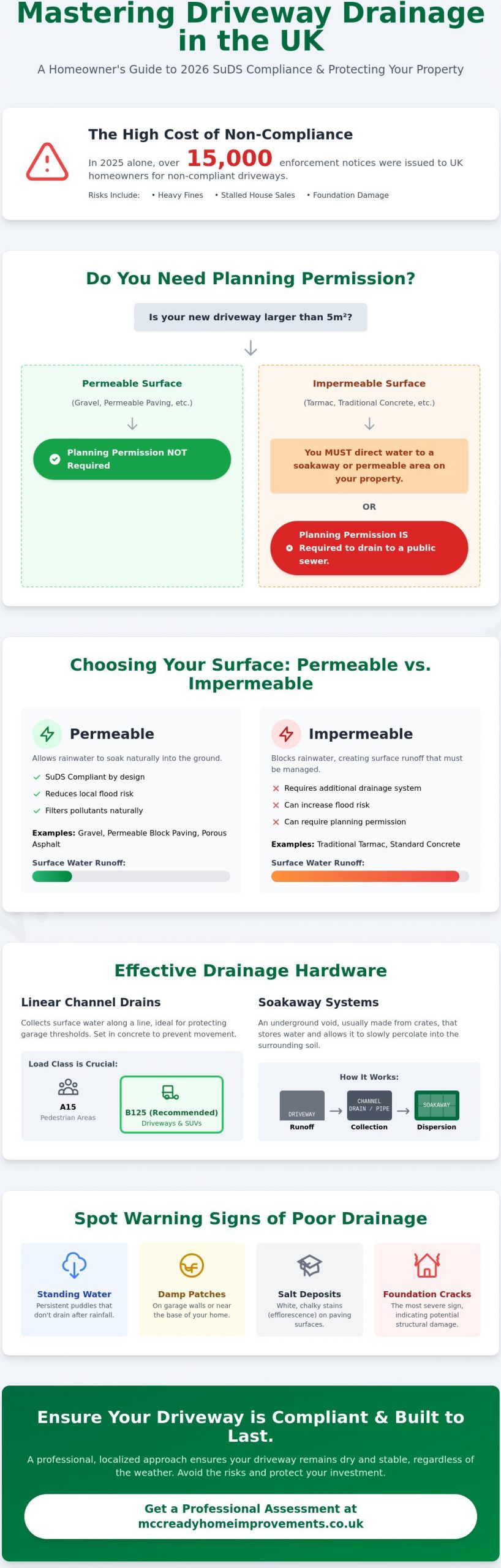
Did you know that in 2025 alone, over 15,000 enforcement notices were issued to UK homeowners for non-compliant driveways? It’s a stressful reality for many, especially when persistent puddles and standing water start threatening your property’s foundation. You want a front entrance that looks polished and stays dry, but the shifting landscape of driveway drainage solutions UK regulations can feel like a minefield. It’s frustrating to invest in your home’s kerb appeal only to worry about potential fines or surface water damage during the next heavy downpour.
We understand that your driveway is more than just a place to park; it’s a vital part of your home’s defense against the elements. This guide will help you master the 2026 SuDS requirements and discover how the right drainage system protects your investment while actually enhancing your property’s aesthetic. You’ll learn exactly when you need planning permission for surfaces over five square metres and which permeable materials, from block paving to gravel, best suit your specific soil type. Let’s look at how to turn a structural necessity into a long-term asset for your home.
Key Takeaways
- Navigate the latest 2026 SuDS regulations to ensure your new driveway remains fully compliant and avoids the need for planning permission.
- Discover how hardware like linear channel drains and soakaway crates work together to divert heavy rainfall away from your home’s foundations.
- Compare the performance of different driveway drainage solutions UK materials, including how permeable block paving and gravel act as natural filters for surface water.
- Learn to spot the subtle warning signs of poor drainage, such as salt deposits and damp patches, before they escalate into expensive structural repairs.
- Understand why a professional, localized approach to groundworks ensures your driveway remains dry and stable regardless of the Midlands weather.
Understanding Driveway Drainage Regulations (SuDS) in the UK
The rules governing how we manage water on our properties changed significantly in 2008, and the landscape has shifted again as we move through 2026. Historically, homeowners could pave over their front gardens with little regard for where the rain went. Today, the UK government strictly limits surface water runoff into public sewers to prevent urban flooding. If you’re planning a new driveway larger than five square metres, you must understand these legal obligations. Modern Sustainable Drainage Systems (SuDS) are no longer just a recommendation; they’re a structural and legal necessity for every homeowner.
The 2026 National SuDS Standards, linked to Schedule 3 of the Flood and Water Management Act 2010, have made these requirements even more stringent. New developments now face mandatory approval of drainage plans by a SuDS Approval Body (SAB). Failure to comply with these regulations carries real risks. In 2025, local authorities issued over 15,000 enforcement notices to homeowners with non-compliant driveways. Beyond the threat of fines, a lack of proper drainage can stall a house sale. Solicitors now routinely check for SuDS compliance during property surveys. If your driveway doesn’t meet the standards, you might find yourself paying for expensive remedial work before you can hand over the keys. It’s much simpler to get the driveway drainage solutions UK requirements right from the very first day of your project.
When Do You Need Planning Permission?
You generally don’t need planning permission if you use permeable materials like gravel or permeable block paving. These surfaces allow water to soak directly into the ground. However, if you choose impermeable materials like traditional tarmacadam or concrete for an area over five square metres, you must install a system that directs water to a lawn, border, or soakaway within your property boundary. If you plan to drain water directly into the public street or sewer, you must apply for planning permission. If you’ve already installed a non-compliant drive, you’ll need to seek retrospective approval or install a drainage correction to avoid legal action.
The Environmental Impact of Proper Drainage
Effective drainage does more than just satisfy a building inspector. It protects our wider community. By using smart driveway drainage solutions UK, you reduce the immediate burden on local sewer systems during heavy storms. This “sponge” effect prevents the flash flooding that currently threatens millions of UK properties. Properly designed systems also act as filters, catching pollutants like oil or rubber particles before they reach our rivers. Additionally, permeable designs help mitigate the “urban heat island” effect, keeping our local neighbourhoods cooler during the summer months by allowing the ground to breathe and release moisture naturally.
Effective Surface Water Solutions: Channel Drains, Soakaways, and Gullies
Managing water effectively requires more than just a slight slope. You need hardware that matches your property’s specific layout and soil conditions. Linear channel drains, often called Aco drains, are the primary choice for protecting garage thresholds and preventing water from entering your home. These systems collect runoff along a narrow line and move it quickly toward a discharge point. When selecting your hardware, pay close attention to the load class. For most standard block paving driveways, an A15 rating works for pedestrian areas, but we recommend B125 for driveway entrances where heavier domestic vehicles like SUVs frequently pass.
How Channel Drains Work
Installation happens at the lowest point of your driveway’s gradient. We set these channels into a concrete haunch to ensure they don’t shift or crack under the weight of your car. You have several aesthetic options to consider. Plastic gratings are cost-effective, while galvanised steel offers a more industrial, durable look. For a high-end finish, “invisible” slot gratings allow the drain to hide beneath your paving stones, leaving only a thin, discreet gap visible. To keep these systems working, you’ll need to clear the debris traps at least twice a year. Silt and leaves are the primary enemies of efficient driveway drainage solutions UK, and a simple clean-out prevents overflow during heavy winter storms.
Designing a Soakaway System
A soakaway is essentially a storage tank buried underground that allows water to percolate slowly back into the soil. According to UK Building Regulations Part H, soakaways must sit at least five metres away from your house to protect the foundations from water saturation. Modern soakaway crates have replaced the old-fashioned “pit of rubble” because they offer much higher void ratios. This means they hold more water in a smaller space. We wrap these crates in a non-woven geotextile membrane. This fabric acts as a filter, allowing water through while keeping soil and silt out of the crate system. Calculating the right size is critical; we base the number of crates on your total driveway area and the local soil’s infiltration rate.
In cases where a soakaway isn’t feasible due to heavy clay soil, we use gullies and piped drainage. These systems direct water toward existing storm drains or local watercourses, provided you have the necessary permissions. This approach ensures that even the most challenging driveway drainage solutions UK projects remain dry and compliant with national standards. By choosing the right combination of channel drains and crates, you protect your property from the structural risks of standing water.
Choosing the Right Material: Permeable vs. Impermeable Surfaces
Your choice of surface material determines the complexity of your overall drainage plan. While hardware like Aco drains provides a vital safety net, selecting a permeable surface can simplify the entire project. The UK Government guidance on permeable surfacing highlights how these materials allow rain to soak directly into the ground, reducing the need for planning permission. This is why resin-bound gravel and specific types of block paving have become the gold standard for driveway drainage solutions UK projects in 2026.
The Benefits of Permeable Block Paving
Unlike traditional blocks, permeable pavers feature slightly wider joints. We fill these gaps with a specialized 6mm grit rather than standard kiln-dried sand. This allows water to flow through the surface at an incredible rate. However, the real work happens underground. The sub-base acts as a giant sponge, using layers of open-graded crushed stone to store water before it naturally dissipates. Our guide on block paved driveways explains how this careful layering prevents shifting and sinking. Without this precise foundation, even the best pavers will fail to drain effectively.
Resin-bound gravel is another excellent option for those seeking a modern, seamless aesthetic. It’s naturally porous, meaning water flows through the resin-coated stones without the need for additional channels. It provides a smooth, puddle-free finish that remains stable even in freezing temperatures. Gravel driveways also offer high permeability, but they require a cellular grid system to keep the stones in place. These grids prevent the driveway from becoming a muddy mess during a typical UK downpour while maintaining the natural drainage properties of the stone.
Tarmac and Resin: A Comparison
Traditional tarmacadam remains a durable and cost-effective choice, but it’s fundamentally impermeable. If you choose this material, you must install supplementary drainage channels to direct runoff toward a soakaway or garden border. Many homeowners prefer the look of a tarmac driveway with borders, which combines the classic dark finish with a decorative, functional edge that can hide drainage slots. Resin systems generally cost more upfront but offer superior SuDS compliance and a longer lifespan without the risk of surface cracking from trapped water.
In the Midlands, where heavy clay soil is common, the ability to manage rainfall quickly is vital. Resin systems often handle intense storms better than tarmac because they distribute the water load across the entire surface area. Whether you prioritize the initial value of tarmac or the long-term ease of resin, matching the material to your soil type is the most effective way to implement driveway drainage solutions UK that truly last. We focus on getting the groundworks right so your chosen material performs perfectly for years to come.
How to Spot and Fix Common Driveway Drainage Problems
Checking your driveway after a heavy UK downpour is the best way to identify structural weaknesses before they become expensive repairs. If you notice standing water that remains for more than 24 hours, your current system is failing. These “puddle points” often indicate that the sub-base has compacted or the gradient was never set correctly. In regions like Hinckley and Nuneaton, the heavy clay soil often makes natural drainage difficult, requiring more robust driveway drainage solutions UK than properties built on sand or loam.
You should also look for white, powdery deposits on your paving stones or nearby brickwork. This is efflorescence. It happens when water moves through the material, dissolves minerals, and leaves salt behind as it evaporates. While it looks like a minor aesthetic issue, it’s a clear sign of persistent dampness. If left unchecked, this moisture can seep into your home’s foundations or cause “heaving” during the winter. When trapped water freezes, it expands with enough force to crack tarmac or lift heavy block pavers, ruining the level finish of your drive.
Symptoms of Poor Drainage
Keep an eye out for slippery moss or algae growth, particularly in shaded areas. These organisms thrive in damp conditions and can turn a beautiful entrance into a major trip hazard. You might also notice subsidence or sinking near the edges of your paved area. This often occurs when runoff washes away the supporting soil, leaving the driveway edges unsupported. If you see these signs, it’s time to evaluate your soil’s natural capacity to handle water.
The “Perc Test”: Checking Your Soil
A percolation test, or “perc test,” is a simple way to see how your ground handles rain. Dig a hole approximately 300mm square and 300mm deep. Fill it with water and let it drain away completely to saturate the soil. Fill it a second time and measure how long it takes for the water level to drop. If the water is still there after several hours, you’re likely dealing with the stubborn clay common in the Midlands. This result confirms that you’ll need more than just a permeable surface; you’ll likely require a soakaway or a connection to a storm drain to keep the area dry.
Simple Fixes for Minor Issues
Not every drainage problem requires a full rebuild. Sometimes, simply clearing debris from your existing channel gratings and gullies restores full function. If you have minor runoff issues, you can install a “French Drain” along the driveway border. This involves digging a trench, lining it with fabric, and filling it with perforated pipe and gravel to redirect water. You can also adjust your lawn levels. If your grass is higher than your driveway, it acts as a dam, forcing water to pool against the paving. Shaving back the turf edge can allow water to flow naturally into the soil. For more complex issues or a professional assessment, you can contact our team for expert driveway advice. We specialise in retrofitting effective systems that protect your property without always needing to start from scratch.
Professional Driveway Installation in Hinckley & Nuneaton
Choosing a local partner for your project ensures that your property is treated with the respect it deserves. In the Midlands, we face unique challenges with heavy clay soil that requires specialized excavation and sub-base preparation. We don’t just lay a surface; we engineer a complete drainage system that protects your home for decades. Our comprehensive approach to driveway drainage solutions UK starts with a deep understanding of local topography and ends with a finished product that looks as good as it performs. We take immense pride in our reputation, focusing on long-term community relationships rather than quick wins.
Our installation process begins with a meticulous site survey. We analyze the natural fall of your land and identify the best discharge points for surface water. Proper groundworks are the foundation of every successful project. We excavate to the correct depth to accommodate a robust, open-graded sub-base that acts as a reservoir during peak rainfall. This meticulous care ensures that your driveway drainage solutions UK aren’t just a surface-level fix but a deep-seated structural benefit. We manage every stage of the project, from the initial dig to the final, polished finish, ensuring no detail is overlooked.
Tailored Solutions for Local Homes
We design stone driveways that manage heavy rainfall effortlessly while maintaining a traditional aesthetic. Our team also looks at the bigger picture, often integrating drainage solutions into fencing and gates projects to ensure water doesn’t pool against your boundaries or damage your garden walls. Every project we undertake meets or exceeds Hinckley & Nuneaton council standards, giving you total peace of mind regarding SuDS compliance. We understand the local planning landscape and ensure your installation avoids the stress of enforcement notices.
Why Choose McCready Home Improvements?
McCready Home Improvements is built on family-run values. We believe in honest, hardworking service and delivering high-end results that reflect our commitment to craftsmanship. Whether we’re installing tarmacadam or block paving, we treat your residence like our own. Our service is a total solution, often looking at how your driveway interacts with your guttering and roofing to manage water holistically. We avoid overly complex jargon, opting instead for clear communication and reliable results that enhance your home’s kerb appeal.
The McCready guarantee is a reflection of our pride in our work. We use high-quality materials and meticulous skill to ensure that your investment stands the test of time. You won’t have to worry about the next storm or the risk of non-compliance fines. Our goal is to provide you with a dry, compliant driveway that elevates your property’s value. You can book your free driveway drainage consultation today to start your journey toward a beautiful, functional entrance that remains puddle-free for years to come.
Secure Your Home’s Future with Smarter Drainage
Investing in your property’s exterior is about more than just aesthetics; it’s about structural integrity and legal peace of mind. By now, you understand how modern driveway drainage solutions UK regulations protect our communities from flooding while ensuring your own home stays dry. Whether you choose the natural permeability of resin and gravel or the classic appeal of block paving, the success of your project depends on getting the groundworks right from the start. Managing surface water effectively isn’t just a recommendation; it’s a vital part of responsible home ownership in 2026.
Expert local installers in Hinckley & Nuneaton understand our specific soil challenges and how to navigate the latest SuDS standards. We specialize in high-end permeable resin and block paving installations that meet every council requirement without sacrificing kerb appeal. Don’t leave your property’s safety to chance or risk the stress of non-compliance notices. Our team provides the meticulous care and technical skill needed for a result that lasts.
Get a Free Quote for Your SuDS-Compliant Driveway today and take advantage of our free, no-obligation site surveys. Let’s work together to create a beautiful, functional entrance that stands the test of time and weather. Your home deserves a foundation that’s built to last.
Frequently Asked Questions
Do I need planning permission for a new driveway in the UK?
You only need planning permission if you’re installing an impermeable driveway larger than five square metres that doesn’t have its own drainage system. If you use permeable materials like gravel or resin, or direct the water to a lawn or soakaway within your boundary, you generally don’t need it. This rule helps prevent local sewer systems from becoming overwhelmed during heavy rain.
What is SuDS and why does it matter for my home?
SuDS stands for Sustainable Drainage Systems, and it’s a sequence of management practices designed to drain surface water naturally. It matters because it mimics natural processes to reduce flood risk and filter out pollutants. Implementing SuDS-compliant driveway drainage solutions UK ensures your property meets national standards and stays protected from water damage.
Can I drain my driveway water onto the road or pavement?
No, you cannot legally drain surface water from your private driveway onto a public road or pavement. UK law requires you to manage runoff within your own property boundaries. Allowing water to flow onto the street can cause hazards for pedestrians and motorists, and you could face an enforcement notice from your local council.
Which is better for drainage: resin bound or block paving?
Both materials offer excellent drainage when installed correctly. Resin-bound gravel is naturally porous across its entire surface, making it highly efficient. Permeable block paving uses specialized gaps and a grit-filled sub-base to act as a sponge. The best choice depends on your aesthetic preference and the specific load requirements for your vehicles.
How much does it cost to install a driveway soakaway?
The total cost for a soakaway depends on the size of your driveway and the complexity of the excavation required. Factors like soil type and the number of crates needed will influence the final price. It’s best to check with a professional installer who can assess your specific ground conditions and provide an accurate estimate for the project.
How do I stop my driveway from flooding my garage?
Installing a linear channel drain at the garage threshold is the most effective way to prevent flooding. This system catches water before it crosses the lip of your garage and redirects it to a soakaway or gully. Ensuring your driveway has a slight gradient away from the building also helps keep the interior dry during heavy storms.
Do I need a linear drain if my driveway is made of gravel?
Most gravel driveways are naturally permeable and don’t require linear drains. However, if your drive has a steep slope leading toward your house or garage, a channel drain might still be necessary at the lowest point. This provides an extra layer of protection during extreme storms when the soil might become saturated and unable to absorb water quickly enough.
How often should I clean my driveway drainage channels?
You should clean your drainage channels at least twice a year, typically in autumn and spring. Removing leaves, silt, and debris ensures that the water can flow freely without backing up. Regular maintenance is a simple task that prevents the system from failing when you need it most during heavy winter rainfall.
