
The best block paving design isn’t just a visual choice; it’s a structural engineering decision that dictates the lifespan of your driveway. While it’s easy to get lost in the sea of block paving patterns and designs, the layout you choose impacts how your home handles heavy vehicles and the UK weather for decades. You want a front entrance that looks stunning, but you’re likely also worried about weeds taking over or a complex pattern making a smaller driveway feel cluttered.
We understand that your driveway is a significant investment and should be treated with the same respect as your home’s interior. You’re looking for that perfect balance between kerb appeal and a surface that won’t shift or sink. This guide will help you discover the ideal layout for your Midlands property, ensuring your choice adds real value and remains structurally sound for 20 years or more. We’ll break down the most durable patterns, explain how to comply with 2024 SuDS drainage regulations, and match specific styles to your house type so you can move forward with total confidence.
Key Takeaways
- Learn why your choice of block paving patterns and designs is a structural decision that prevents rutting and shifting over time.
- Discover the most durable layouts for UK driveways, including the high-strength Herringbone and the traditional Stretcher Bond.
- Understand how to select a pattern that supports the weight of modern SUVs and electric vehicles without failing at the edges.
- Identify which layouts complement your specific property style, whether you own a Victorian terrace or a modern minimalist home.
- See how professional installation ensures a long-lasting result that remains structurally sound for 20 years or more.
Why Block Paving Patterns Matter: Design Meets Durability
Choosing the right block paving patterns and designs is about much more than picking a colour that matches your window frames. While kerb appeal is a major driver for Midlands homeowners, the layout you select serves as the primary structural support for your vehicles. A driveway that looks beautiful but lacks structural integrity will quickly develop “rutting,” which are those unsightly grooves formed by heavy tyres over time. By selecting a layout that distributes weight evenly, you ensure your investment remains flat and functional for decades.
In the local property market, a professionally designed driveway acts as a powerful first impression. Block paving suggests a home that’s been meticulously maintained, often providing a higher resale uplift than other surfacing materials. It’s a statement of quality that tells potential buyers you haven’t cut corners on the property’s upkeep.
The Science of Interlocking Paving
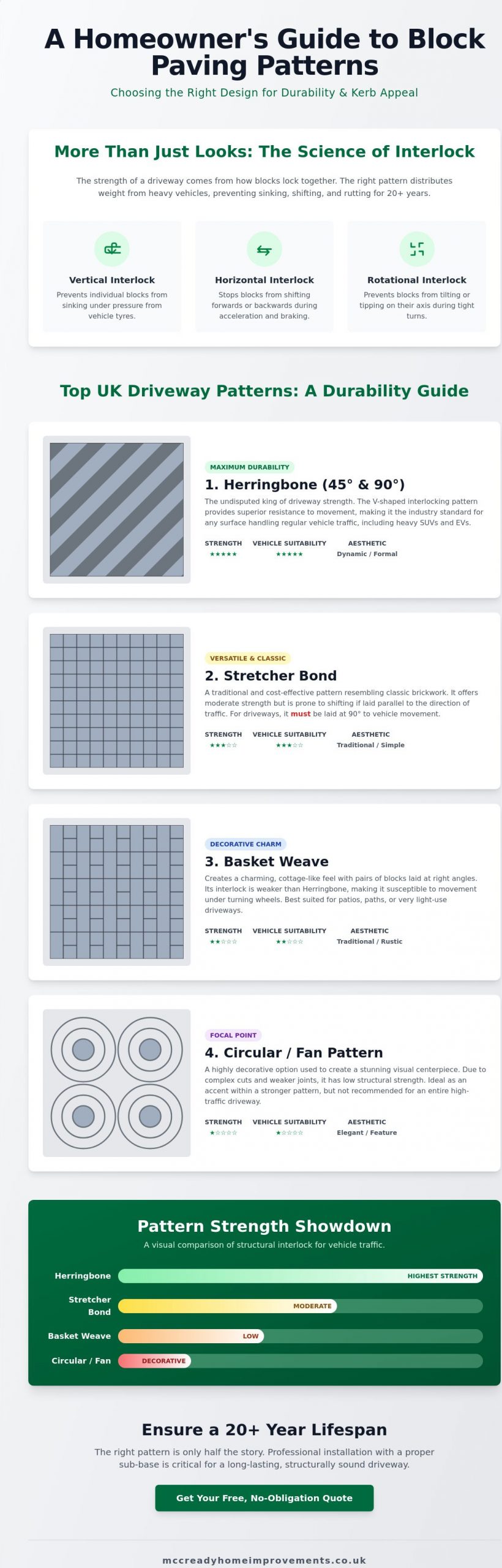
True structural strength comes from three types of interlock: vertical, horizontal, and rotational. Vertical interlock prevents individual blocks from sinking into the ground under pressure. Horizontal interlock stops blocks from shifting forward or backward when you accelerate or brake. Rotational interlock prevents the blocks from tilting or “tipping” on their axis during tight turns.
Some patterns provide superior interlock because the blocks are laid at angles that physically prevent movement in any direction. This structural bond is completed by kiln-dried sand. When swept into the joints, this sand creates the necessary friction to “lock” the blocks together. Without this combination of pattern and sand, the blocks are just individual units; with them, they become a single, solid pavement capable of supporting multi-tonne vehicles.
Aesthetic Impact on Property Perception
Smart design can physically change how people perceive your home’s exterior. For example, if you have a smaller driveway in Hinckley, laying blocks in a specific direction can trick the eye. Running a Stretcher Bond pattern parallel to the house can make a narrow space feel significantly wider, while laying it perpendicular can add a sense of length to a short entrance.
You can also use patterns to define different zones. We often use a contrasting border to frame a driveway or a different layout to distinguish a pedestrian path from a parking bay. This level of detail doesn’t just look professional; it provides a polished, high-end finish. When we consult on block paving patterns and designs, we focus on creating a layout that matches the quality of your residence while providing the specific functionality your family needs.
The 5 Most Popular Block Paving Designs for UK Driveways
Selecting the right layout involves balancing your personal taste with the practical demands of your property. While there are dozens of variations, five specific block paving patterns and designs dominate the UK market due to their proven performance. Each offers a distinct aesthetic, from the ultra-modern to the traditionally rustic. However, not every pattern is suitable for every area of your home. Some are built for the heavy weight of an SUV, while others are purely decorative and better reserved for a garden path or a patio border.
We often recommend integrating these designs with other materials to maximize your budget. For instance, a charcoal block paving border can perfectly frame one of our tarmacadam driveways, providing a high-end finish without the cost of a full-block installation. This hybrid approach is a popular choice for larger Midlands properties where kerb appeal and cost-efficiency must go hand-in-hand.
Herringbone: 45-Degree vs. 90-Degree
Herringbone is the undisputed king of driveway durability. The blocks are laid in a V-shape, creating a complex interlocking web that refuses to budge. The CMHA Pavement Design Tech Note confirms that herringbone patterns provide the highest level of interlock, making them the standard for any surface handling vehicle traffic.
The 45-degree variation is the strongest because it ensures no joint line is parallel to the direction of travel, which significantly reduces the risk of shifting. It’s more labour-intensive to lay because of the precise cuts required at the edges, but the result is a dynamic, high-energy look. The 90-degree version offers a more formal, rectangular appearance. It’s slightly easier to install but still provides excellent structural integrity for standard residential use.
Stretcher Bond and Basketweave
Stretcher Bond, often called Running Bond, mimics the classic look of a brick wall. It’s a clean, understated choice that works well for modern homes. However, because the blocks are laid in parallel rows, they can “creep” or shift over time if they aren’t supported by a professional-grade sub-base and robust edging. We always ensure these layouts are locked in with a solid concrete haunching to prevent any movement.
Basketweave is a vintage style that looks like a woven mat. It’s incredibly charming on older Victorian or Edwardian properties but lacks the interlocking strength of herringbone. We generally suggest using Basketweave for:
- Decorative circles or focal points in the centre of a drive.
- Garden paths and pedestrian walkways.
- Low-traffic areas where the aesthetic is more important than load-bearing capacity.
Stack Bond and Random Course
Stack Bond features blocks aligned perfectly in both directions, creating a grid. It’s the most minimalist option available, but it’s also the weakest structurally. We rarely recommend this for main driveway areas unless it’s used as a decorative border. On the other end of the spectrum, Random Course uses blocks of three or four different sizes. This creates a natural, cobbled effect that’s perfect for rural cottages or homeowners who want a less “manufactured” look for their property.
Load-Bearing Logic: Selecting a Pattern for Heavy Vehicles
Modern driveways face physical challenges that older installations never had to consider. While your choice of block paving patterns and designs dictates the look of your home, it also determines how well the surface survives the daily stress of heavy motoring. A pattern that stays perfectly flat under a light hatchback might begin to shift or “fan out” when subjected to the weight of a modern SUV or a heavy electric vehicle. At McCready Home Improvements, we treat every driveway as a structural unit where the pattern and the sub-base work together to resist movement.
We prioritise the 45-degree Herringbone layout for all main driveway areas because it offers the most reliable resistance to the shearing forces caused by braking and turning. Weaker patterns like Stack Bond or Stretcher Bond lack the multi-directional interlock required for high-traffic zones. If these layouts are used where heavy vehicles park, the blocks can eventually separate, allowing water to penetrate the sub-base and leading to total surface failure. Choosing the right pattern is the best way to protect your investment for 20 years or more.
The Weight of Modern Motoring
The rise of electric vehicles (EVs) has changed the requirements for domestic driveway construction. Because battery packs add significant weight, EVs exert much more pressure on individual blocks than traditional cars. This pressure often manifests as point loading. Point loading refers to the intense, concentrated weight exerted by a vehicle’s tyre on a specific area of the block surface.
When a heavy vehicle turns its wheels while stationary, it creates a twisting force that tries to rotate the blocks. In a Herringbone pattern, each block is physically restrained by its neighbours, preventing this rotation. In simpler layouts, the sand joints can become compressed or displaced, which eventually leads to the “rutting” or sinking mentioned earlier in this guide. We ensure the sand and pattern work in harmony to dissipate this weight across a wider area.
Structural Edging and Borders
No matter how strong your central pattern is, it will fail if the edges aren’t properly secured. This is known as “spreading,” where the outward pressure of vehicles pushes the blocks toward the soft ground at the sides. To prevent this, we install robust kerbs and “soldier courses.” A soldier course is a border of blocks laid end-to-end, acting like a structural frame that locks the main pattern in place.
These borders aren’t just functional; they provide a high-contrast visual finish that defines the shape of your property. Many homeowners in Hinckley and Nuneaton choose to combine these decorative edges with other materials. For example, integrating block paving borders with tarmac driveways with border creates a cost-effective hybrid look. This setup gives you the structural strength and premium aesthetic of block paving at the edges, where it’s needed most, while using tarmac for the main parking span.
Design Guide: Matching Patterns to Your Property Style
Your driveway shouldn’t look like an afterthought. It needs to feel like a natural extension of your home’s architecture. While the structural benefits of specific block paving patterns and designs are vital, the visual harmony between your home and your driveway is what truly boosts kerb appeal. A Victorian terrace requires a completely different aesthetic approach than a sleek, minimalist new build. Choosing the wrong style can make even the most expensive installation look out of place and disconnected from the rest of the residence.
For traditional Victorian or Edwardian homes, we often recommend a textured, “cobbled” look using a Random Course layout. This mimics the historic streets found across the Midlands and preserves the period character of the property. If you prefer the strength of Herringbone, the 90-degree variation offers a formal, classic line that suits period properties perfectly. Conversely, modern homes thrive on simplicity. Large-format blocks in silver or charcoal, framed by a precise Stack Bond border, create the clean lines that contemporary architecture demands.
Complementing Local Midlands Architecture
Hinckley and Nuneaton are famous for their rich, red-brick architecture. To complement this, we often use “brindle” block mixes. These contain a blend of red and charcoal tones that mirror local brickwork while providing a practical benefit: the variegated colour is excellent at hiding tyre marks and occasional oil drips. If you live in a 1960s or 70s semi-detached home, adding a sharp charcoal border can instantly modernise the exterior, giving the whole property a facelift without the need for major renovations. This simple design choice provides a polished finish that stands out in a crowded street.
Creating Visual Flow
The direction in which your blocks are laid determines how people perceive your entrance. We use “lead-in” lines to subtly guide the eye toward your front door, making the property feel more welcoming and organised. Laying patterns at a 45-degree angle to the house creates a sense of dynamic movement and space, which is ideal for shorter drives that need to feel larger. For a completely cohesive look, many homeowners are now matching their driveway patterns with resin bound patio designs in the rear garden. This creates a unified theme that flows from the front of the house to the back, treating the entire property as one coordinated project.
Ready to transform your home’s exterior? You can contact our local team today to discuss which block paving patterns and designs will best enhance your specific property style and provide the long-term durability you need.
Professional Block Paving Installation in Hinckley & Nuneaton
Even the most intricate block paving patterns and designs will fail if the foundation isn’t handled with expert care. We’ve seen many driveways across the Midlands sink or rut because the installer rushed the groundwork to save on costs. At McCready Home Improvements, we treat the excavation and sub-base as the most critical part of the project. Our local reputation is built on reliability, which is why we provide a ‘no-sink’ guarantee on our installations, giving you total peace of mind for the long term.
Our 5-step process ensures every project meets our high standards. It begins with a detailed design consultation where we help you match the block layout to your home’s unique style. We then move to deep excavation, followed by the installation of a high-density, geo-textile reinforced sub-base. Once the drainage is secured to meet SuDS regulations, we lay your chosen blocks with meticulous precision. The process concludes with a final sweep of kiln-dried sand to lock the entire structure into a single, solid unit.
Why Local Knowledge Matters
Soils in Hinckley and Nuneaton are often heavy in clay, which expands and contracts significantly with the changing UK weather. If a sub-base is too shallow, the driveway will inevitably shift or crack within just a few seasons. We’ve developed a non-negotiable depth for our foundations specifically to combat these local soil conditions. This level of meticulous care is what separates a standard driveway from a McCready installation. You can see the results of this approach for yourself in our local gallery of block paved driveways.
Your Next Steps for a Dream Driveway
Preparing for your new driveway is a straightforward process. When you meet our team for a consultation, it’s helpful to have a rough idea of your preferred block paving patterns and designs, though we’re happy to provide professional recommendations based on your car usage and house style. Most installations take between five and seven working days, depending on the size and complexity of the chosen layout. We manage the entire timeline from start to finish, keeping your property clean and organized throughout the build.
Investing in your home’s exterior should be a stress-free experience that adds tangible value to your property. We’re proud to be a proactive partner in your property’s evolution, offering the peace of mind that comes with decades of local experience. Contact McCready Home Improvements for your free driveway quote and let’s start planning a surface that will remain structurally sound for the next 20 years or more.
Secure the Future of Your Property’s Kerb Appeal
Selecting the right block paving patterns and designs is a long-term investment in your home’s structural integrity and market value. We’ve explored how a high-strength Herringbone layout protects against the weight of modern vehicles, while the right colour palette ensures your driveway complements the classic red-brick architecture common across Hinckley and Nuneaton. A beautiful surface is only as good as the groundwork beneath it; our deep understanding of Midlands clay soil ensures your installation won’t sink or shift over time.
McCready Home Improvements provides a comprehensive ‘Design to Completion’ service, taking the stress out of your property’s evolution. Whether you’re looking for a full block-paved entrance or a hybrid solution combining Tarmacadam with decorative borders, our local specialists deliver meticulous craftsmanship on every project. We treat your residence with the respect it deserves, ensuring a polished result that lasts for 20 years or more.
Take the first step toward a stunning new entrance today. Book Your Free Block Paving Design Consultation in Hinckley & Nuneaton and let’s build a driveway you’ll be proud of for decades.
Frequently Asked Questions
What is the strongest block paving pattern for a driveway?
The 45-degree Herringbone is the strongest layout for any driveway. This specific arrangement ensures that no joint line runs parallel to the path of your vehicle’s tyres, which prevents the blocks from shifting under the pressure of braking or turning. It provides the highest level of interlocking strength, making it the industry standard for surfaces that carry heavy SUVs or electric vehicles.
Can I use different patterns for my driveway and my garden path?
You can certainly use different patterns to create distinct zones within your property’s exterior. We often recommend using a high-strength Herringbone for the main parking area and a more decorative Basketweave or Stretcher Bond for garden paths. This approach clearly defines pedestrian walkways and adds visual interest without compromising the structural integrity of the heavy-traffic zones.
Does the colour of the block paving affect the pattern’s visibility?
The colour and texture of your blocks significantly impact how clearly your block paving patterns and designs are seen. Light, uniform colours like silver grey or buff make the joint lines and geometric shapes stand out sharply. In contrast, variegated “brindle” mixes or darker charcoal blocks tend to soften the pattern’s appearance, which is often preferred if you want a more subtle, natural look for your home.
How do I stop weeds from growing in the patterns of my block paving?
Weeds don’t actually grow from beneath the blocks; they sprout from seeds that land in the sand joints. To prevent this, we use high-quality kiln-dried sand during installation and recommend applying a professional sealant once the driveway has settled. Regular maintenance, such as a light sweep and occasional re-sanding every few years, will keep the joints tight and hostile to weed growth.
Is it possible to change the pattern of my existing block paving?
It isn’t possible to change the pattern of an existing driveway without lifting and relaying the blocks. Because each layout requires specific cuts at the edges and a precise sub-base preparation, you can’t simply move blocks around into a new design. If your current surface is sinking or you’re unhappy with the style, a full professional replacement is the only way to ensure a structurally sound result.
What is the best block paving pattern for a steep or sloped driveway?
A 45-degree Herringbone is the most effective choice for sloped or steep driveways. This pattern offers superior grip for vehicle tyres and provides the best resistance against the gravitational pull that can cause blocks to “creep” downhill over time. When installed with a robust concrete haunching at the bottom of the slope, it remains the most stable configuration for challenging terrain.
How much extra does a complex pattern like 45-degree Herringbone cost?
Complex block paving patterns and designs like the 45-degree Herringbone involve more labour and material waste due to the higher number of precise cuts required at the borders. While the initial installation takes longer than a simple Stretcher Bond, the increased durability and resistance to shifting usually make it more cost-effective over the driveway’s 25-year lifespan. We provide detailed estimates that reflect these specific labour requirements.
Should I choose permeable block paving for my new driveway design?
Choosing permeable block paving is a smart way to comply with UK SuDS regulations without needing extra planning permission. These blocks allow rainwater to filter through the joints into a specially designed sub-base, reducing the risk of surface water flooding on your property. It’s an environmentally responsible choice that’s becoming increasingly popular for new Midlands driveway installations to manage heavy rainfall effectively.
