
Last winter, over 15% of homeowners we spoke to in Hinckley and Nuneaton reported issues with pooling water or shifting foundations, leading many to seek more resilient block paved driveways. You likely understand that your driveway is one of the most significant investments you’ll make for your property, and you deserve a result that remains level and beautiful for decades. It’s frustrating to worry about sinking blocks or poor drainage when you simply want a reliable, high-value entrance that enhances your home’s character.
This guide shows you exactly how to secure a bespoke, low-maintenance finish that is built to last 20 years or more. We’ll help you choose the ideal materials while ensuring your project complies with current UK drainage regulations. You will discover the professional steps required to transform your kerb appeal, from selecting durable patterns to mastering the engineering needed for a stable Midlands foundation.
Key Takeaways
- Learn how to select materials and colours that perfectly complement the red-brick heritage and architectural character of Nuneaton and Hinckley properties.
- Understand why a reinforced sub-base is critical for block paved driveways to prevent sinking and rutting in the challenging Midlands clay soil.
- Discover which design patterns, such as the 90° Herringbone, offer the structural integrity required to support heavy vehicle traffic without shifting.
- Identify the essential drainage requirements and local regulations you must navigate to ensure your driveway transformation is both legal and long-lasting.
- Find out why local craftsmanship and a bespoke installation process are the best insurance against the common pitfalls of “drive-by” contractors.
What are Block Paved Driveways and Why are They the Top Choice for Hinckley & Nuneaton Homes?
Block paved driveways consist of individual bricks or blocks laid in intricate patterns to create a durable, flexible surface for residential vehicles. This system is far more than a simple aesthetic choice; it is a versatile engineering solution designed for the specific demands of UK weather and soil conditions. For homeowners in Hinckley and Nuneaton, block paving offers a perfect balance between traditional Midlands architecture and modern performance. Unlike monolithic surfaces that can crack under pressure, these individual units move slightly with the ground, preventing the structural failures often seen in large concrete slabs.
The appeal of this system lies in its unique repairability. If a single block becomes stained by oil or damaged by heavy impact, you can remove and replace it without disturbing the rest of the installation. This modular nature makes it a superior long-term investment compared to tarmac or pattern-imprinted concrete, which often require unsightly patches when repairs are necessary. In the local property market, a professional installation provides a high return on investment. By 2026, property experts estimate that a premium driveway transformation can increase a home’s market value by up to 10%, making it a strategic financial move for those looking to build equity.
The Anatomy of a High-Quality Block Paving System
A driveway is only as strong as the ground beneath it. A professional installation begins with a geo-textile membrane that prevents the sub-base from mixing with the native soil while allowing water to drain. Above this, a compacted sub-base of MOT Type 1 stone provides the structural foundation. Block paving is a modular surfacing solution known for its high compressive strength. These invisible layers dictate whether your driveway will last five years or its intended 25-year lifespan. When selecting your finish, you can choose from various types of paving materials, including kiln-fired clay or high-density concrete, to match the specific load-bearing requirements of your household.
Kerb Appeal and Property Value in the Midlands
First impressions are vital for detached and semi-detached homes across Nuneaton. A bespoke driveway transformation changes the entire character of a property, moving it from “standard” to “premium” in the eyes of a visitor. While some owners prefer the sleek look of a tarmac driveway with border, block paving offers a level of customisation that is hard to beat. You can choose from dozens of colours and textures to complement your brickwork.
- Increased Valuation: Local estate agents report that well-maintained driveways are a top priority for 75% of buyers in the Midlands.
- Buyer Psychology: A clean, organised entrance suggests that the rest of the property has been cared for with similar attention to detail.
- Longevity: High-quality blocks retain their colour and structural integrity far longer than cheaper alternatives.
Choosing this system ensures your home stands out on the street while providing a functional, hard-wearing space that handles daily traffic with ease. It is a reliable partnership between craftsmanship and high-quality materials.
Selecting the Right Blocks: A Guide to Materials, Colours, and Textures
Choosing the right materials for block paved driveways is a balance between engineering requirements and visual appeal. In the UK, your driveway must withstand heavy rainfall and frequent frost-thaw cycles. Concrete blocks are the most common choice due to their uniform strength, but natural stone options like granite, sandstone, and limestone offer a premium aesthetic that matures over time. Each material reacts differently to the Midlands climate, so your choice impacts both the kerb appeal and the long-term durability of your home.
Texture and safety go hand in hand. You should consider how the surface feels underfoot and how it performs in wet weather. There are three main options:
- Smooth: Offers a sleek, modern look but can become slippery when icy.
- Rumbled: These blocks undergo a tumbling process to give them weathered edges, perfect for a traditional “cobbled” feel.
- Textured: These have a granular surface that provides excellent slip resistance, making them a practical choice for steep inclines.
Selecting a colour palette requires a look at the local surroundings. Nuneaton is famous for its red-brick heritage, and your driveway should complement this. Multi-tonal brindle blocks or warm “autumn” hues blend seamlessly with traditional masonry. For a sharper, contemporary contrast, charcoal or silver-grey borders can frame the space and provide a crisp, professional finish.
The depth of the block is just as vital as the colour. Most domestic block paved driveways use 50mm blocks, which are perfectly adequate for standard family cars. If you own a heavier vehicle, such as a large transit van or a motorhome, you must upgrade to 60mm or 80mm blocks. Using thinner blocks for heavy loads leads to shifting and cracking over time, so we always recommend matching the block thickness to your specific usage needs.
Concrete Paving: Versatility and Value
Concrete is the primary choice for most local block pavers because it provides consistent quality at an accessible price point. Since these blocks are manufactured, dimensions are exact, which allows for intricate patterns like the 45-degree herringbone. You can choose standard blocks for a clean look or Tegula paving if you want to replicate the charm of an older property. It’s a reliable, hard-wearing solution for any busy household.
Natural Stone: The Premium Choice
Natural stone is the ultimate investment for homeowners seeking a bespoke look. No two stones are identical, meaning your driveway will have a unique character defined by natural veining and mineral tones. Materials like granite and basalt are incredibly dense and don’t fade under UV light. While they require a slightly higher initial investment, they age gracefully in the UK weather and resist moss growth better than more porous materials. A quick seasonal wash is usually all it takes to keep natural stone looking pristine for decades.
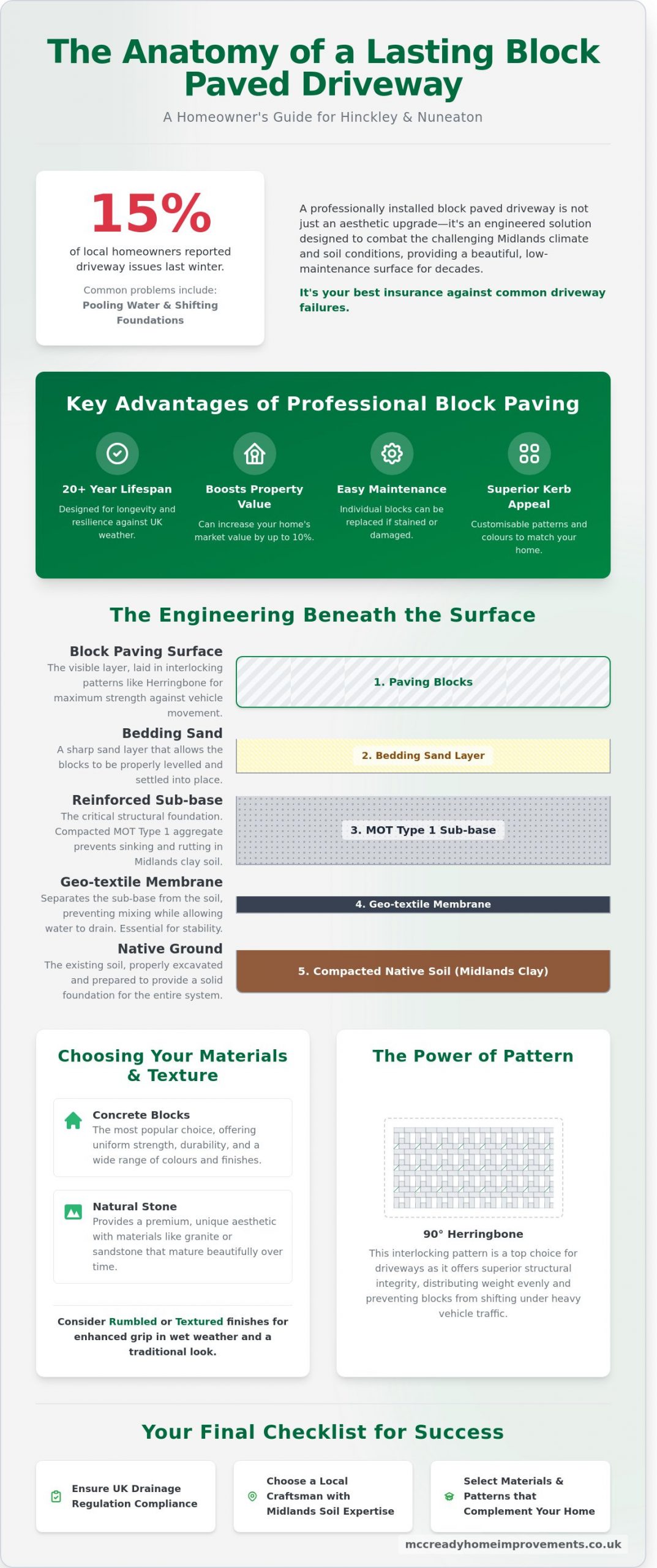
The Engineering Behind the Aesthetics: Drainage, Durability, and Sub-base Integrity
While the finish of block paved driveways often catches the eye, the real work happens deep underground. In Hinckley and Nuneaton, we frequently encounter “Midlands Clay,” a heavy soil type that expands when wet and shrinks during dry spells. If a contractor ignores these local conditions, the driveway will eventually sag or shift. We prevent this by excavating to a depth that reaches stable ground, ensuring the foundation can handle the weight of modern vehicles without flinching.
A driveway without robust edge restraints is like a picture without a frame. We install heavy-duty kerbs or concrete haunching to lock the blocks into a fixed position. This essential “frame” prevents the blocks from spreading outwards over time, which is a common cause of structural failure. Without this lateral support, the pressure from a turning car would eventually push the perimeter blocks into the surrounding soft ground, ruining the alignment of the entire surface.
Managing Water Run-off in Hinckley & Nuneaton
Poor drainage is the leading cause of driveway failure and persistent moss growth. When water sits beneath the surface, it weakens the sub-base and leads to significant shifting. Since the 2008 SUDS (Sustainable Urban Drainage Systems) legislation, homeowners must ensure surface water doesn’t discharge onto public highways. You can achieve this by choosing permeable blocks that allow water to soak through the joints, or by installing a dedicated soakaway system. Staying compliant with these rules means you won’t need to submit a planning application, which typically costs around £206 and takes weeks to process.
Combating Sinking and Movement
We don’t rely on guesswork when it involves the stability of your home. Our team conducts local soil tests to determine the exact requirements for your specific plot. A minimum 150mm sub-base of MOT Type 1 is required for most residential driveways. This layer of crushed aggregate provides the structural integrity needed to prevent “rutting,” where car tyres create permanent grooves in the surface.
- Mechanical Compaction: We use heavy-duty vibrating plates to compact the sub-base in layers, ensuring no air pockets remain.
- Precision Grading: Every sub-base is graded to a slight fall to guide water away from your property foundations.
- Quality Materials: We only use certified MOT Type 1 to guarantee the stone doesn’t break down into dust over time.
By focusing on these invisible engineering details, we ensure your block paved driveways look just as good in ten years as they do on the day we finish the installation. It’s about providing a professional finish that stands up to the specific challenges of our local Leicestershire and Warwickshire landscape.
Design Patterns and Planning: Organising Your Driveway Transformation
Choosing the right layout for block paved driveways involves more than just picking a pretty shape. The pattern you select dictates how well the surface stands up to the daily pressure of a vehicle. For any driveway handling heavy traffic, a herringbone pattern is the only technical choice. Whether set at 45 or 90 degrees, this interlocking design ensures that blocks don’t shift or “creep” when you turn your steering wheel or apply the brakes. We’ve seen hundreds of driveways where inferior patterns have failed under the weight of modern SUVs, leading to costly repairs that could’ve been avoided with proper planning.
Choosing the Best Pattern for Your Layout
The 45-degree herringbone is our top recommendation for structural integrity. The blocks lock together on all four sides, dispersing the weight of a 2-tonne vehicle across the entire sub-base. While a 90-degree herringbone offers similar strength, the 45-degree angle is often more aesthetically pleasing on larger plots. Stretcher bond and basket weave patterns look fantastic on garden paths, but they lack the multi-directional friction required for cars. If you’ve got a narrow entrance, laying blocks in a horizontal stretcher bond can create a visual trick that makes the space feel wider than its actual measurements suggest.
Borders, Steps, and Integrated Landscaping
A professional finish relies on the details that frame your property. We often use charcoal or brindle borders to provide a sharp contrast against lighter grey or buff main blocks. This framing isn’t just for show; it provides a solid edge that keeps the internal blocks tightly packed. To create a truly cohesive exterior, many homeowners choose to install matching fencing and gates at the same time. This ensures the timber tones complement the stone textures perfectly. This holistic approach to exterior styling is a hallmark of high-end firms like Helyers of Hampshire or WillsByrne Construction & Landscaping LTD, who focus on the interplay between hardscaping and garden aesthetics. We also recommend using recessed manhole covers. These allow us to lay the block paving inside the lid, hiding unsightly utility access points while maintaining full functionality.
Planning permission is a vital consideration for Hinckley and Nuneaton homeowners in 2026. Since the 2008 legislation update, any driveway over 5 square metres must use permeable materials or have a dedicated drainage system like a soakaway. If your project doesn’t meet these Sustainable Drainage Systems (SuDS) standards, you’ll need to apply for full planning permission from your local council. We manage this process for you, ensuring every installation complies with current environmental regulations to prevent surface water runoff into the public highway.
Ready to start your project? You can book a design consultation with our local team today to explore your options.
Professional Installation in the Midlands: Why Local Craftsmanship Matters
Local accountability serves as the strongest insurance policy for your home. Hiring “drive-by” contractors who lack a physical presence in the Midlands often leads to substandard results and zero aftercare. These rogue traders frequently vanish when issues arise; usually within the first 12 months when the sub-base begins to settle. Choosing a Hinckley-based specialist ensures you are working with a team that values its community reputation. We treat every project as a showcase of our local craftsmanship.
At McCready Home Improvements, we follow a rigorous, multi-stage installation process to ensure your block paved driveways stand the test of time. We don’t cut corners. Our team begins with a 200mm excavation to remove organic matter and unstable soil. We then install a heavy-duty Geo-textile membrane to prevent weed growth and sub-base migration. This is followed by a compacted Type 1 MOT aggregate base and a precision-levelled sharp sand laying course. After the blocks are meticulously laid, we apply kiln-dried sand and vibrate the surface to lock every stone into a rigid, durable structure.
Transparency is vital when reviewing a quote. A professional estimate should never contain “hidden extras” that appear halfway through the job. We ensure that muck-away and waste removal are included from the start. Disposal costs can account for up to 15% of a project’s total budget, so it is essential to know these are covered. To keep your new driveway looking pristine, we recommend a simple maintenance routine. Regular sweeping and a professional re-sanding every 24 to 36 months will prevent moss growth and maintain the structural integrity of the paving for decades.
The McCready Standard of Excellence
We believe that a high-quality finish starts with superior components. Our team sources high-grade materials from leading UK suppliers like Marshalls and Brett to ensure colour consistency and durability. We provide free, no-obligation estimates for all Hinckley and Nuneaton residents. This gives you a clear, fixed-price roadmap for your project. We pride ourselves on being a safe pair of hands for your property investment; delivering results that combine aesthetic beauty with practical longevity.
Getting Started with Your New Driveway
Booking a consultation with our Hinckley-based experts is the first step toward your property’s transformation. During our initial design visit, we assess site drainage, levels, and your specific aesthetic preferences. We provide honest advice on which patterns and colours will best complement your home’s architecture. Transform your home today with a bespoke block paved driveway from McCready Home Improvements.
Transform Your Home’s Entrance for 2026
Investing in a new driveway is about more than just kerb appeal; it’s a commitment to your property’s long-term value. Choosing block paved driveways ensures you have a durable surface designed to withstand the specific clay-heavy soil conditions found throughout Hinckley and Nuneaton. By prioritising high-quality sub-base engineering and sustainable drainage, you ensure your home stays flood-resilient and structurally sound well into the future.
McCready Home Improvements delivers a comprehensive design-to-completion service that takes the guesswork out of your home improvements. We bring expert local knowledge to every installation, backed by our status as a fully insured and 5-star rated specialist. Our team manages the entire process, from the first stone laid to the final professional finish, ensuring every project meets our rigorous standards for craftsmanship. We treat every Midlands home with the care it deserves, providing you with total peace of mind.
Get your free, no-obligation block paving estimate in Hinckley or Nuneaton today
We look forward to helping you create a beautiful, lasting entrance that you’ll be proud to drive onto every single day.
Frequently Asked Questions
Do I need planning permission for a block paved driveway in Hinckley or Nuneaton?
You won’t need planning permission for block paved driveways if you use permeable blocks or ensure water drains into a garden or soakaway. Since the 2008 legislation change, the UK government requires any new driveway over 5 square metres to manage surface water runoff. We design our installations in Hinckley and Nuneaton to meet these Sustainable Drainage Systems (SuDS) standards. This ensures your home stays compliant with local building regulations without extra paperwork.
How long does it take to install a standard two-car block paved driveway?
A standard two-car driveway typically takes between 5 and 7 working days to complete from start to finish. Our team spends the first 2 days on ground preparation, including excavation and laying the sub-base. The remaining time focuses on the precision laying of blocks and finishing the kiln-dried sand joints. While weather can impact timelines, we aim for a seamless transformation that minimises disruption to your daily routine.
Will my block paving sink if I park a heavy van or SUV on it?
Your driveway won’t sink under the weight of an SUV or van if the sub-base is installed to the correct depth. We excavate to a minimum of 200mm to accommodate a 150mm compacted Type 1 sub-base, which provides the structural integrity needed for heavy vehicles. This attention to detail prevents the rutting and shifting often seen in poorly constructed projects. Our professional finish ensures the surface remains level and durable for decades.
How do I prevent weeds from growing between the paving blocks?
You prevent weeds by maintaining the integrity of the kiln-dried sand joints and applying a high-quality sealant. Weeds don’t grow from beneath the blocks if the sub-base is properly installed; they germinate from seeds landing in the sand on top. Applying a polyurethane sealer every 3 years hardens the sand and creates a barrier against seed growth. Regular sweeping also removes organic matter before it can take root in the joints.
Is block paving better than tarmac for a sloped driveway?
Block paving is frequently superior to tarmac for sloped driveways because the individual blocks provide better natural traction for tyres. The textured surface of concrete blocks offers 15% more grip in icy conditions than smooth, worn tarmac. Additionally, we install specific drainage channels at the bottom of the slope to manage water runoff effectively. This combination of safety and functionality makes it a reliable choice for local homes with steep inclines.
What is the average lifespan of a professionally installed block paved driveway in the UK?
A professionally installed driveway in the UK has an average lifespan of 20 to 25 years. This longevity depends on the quality of the initial craftsmanship and the materials used. We use high-strength blocks that withstand the British freeze-thaw cycle without cracking or crumbling. With basic maintenance, such as occasional cleaning and re-sanding, your investment will maintain its structural integrity and aesthetic appeal for over two decades.
Can I use my driveway immediately after the blocks have been laid?
You can park your car on the driveway as soon as the final layer of kiln-dried sand is vibrated into the joints. Unlike concrete or tarmac, which require curing times of 48 hours to 7 days, block paving is a dry-lay process that provides immediate structural strength. We complete a final inspection to ensure every block is secure before we hand the project over. Your home transformation is ready to enjoy the moment our team finishes the job.
How much maintenance does block paving actually require compared to concrete?
Block paving requires slightly more maintenance than a single concrete slab but offers much easier repair options. You’ll need to sweep the surface monthly and top up the jointing sand every few years to keep the blocks locked tight. However, if a block gets stained by oil or damaged, you can replace that specific piece for under £10. Pattern-imprinted concrete often requires a full, expensive resurfacing if it cracks, making blocks a more practical long-term solution.
