
Did you know that a high-quality patio can add between 5% and 10% to your property’s total value? While that sounds like a fantastic investment, many homeowners realize too late that their chosen surface isn’t built for the British weather. Finding the best material for a patio UK gardens actually need means looking for more than just a pretty finish. You need a solution that won’t turn into a slippery hazard when it rains or crack during the first hard frost of the winter.
We understand that you want a beautiful outdoor space that’s easy to look after and safe for your family to enjoy. This 2026 guide will show you how to balance style with long-term durability. We’ll walk you through the most reliable options on the market, from the modern, low-maintenance benefits of porcelain to the timeless appeal of natural Indian sandstone. You’ll discover how to achieve a polished result that stands up to the elements and serves as a lasting asset for your home.
Key Takeaways
- Learn how to identify high slip resistance (R-ratings) to ensure your garden remains safe for the whole family during wet British winters.
- Discover why porcelain and Indian sandstone are currently the best material for a patio UK homeowners can choose for a balance of style and durability.
- Understand the long-term maintenance requirements of different surfaces, including which materials need professional sealing to prevent moss and algae growth.
- See why professional ground preparation and a solid sub-base are the most critical factors for preventing cracks and ensuring proper drainage.
- Get expert advice on selecting materials that complement local red-brick architecture while creating a seamless transition between your home and garden.
Essential Factors for Choosing Patio Materials in the UK
Selecting the best material for a patio UK homeowners can rely on starts with understanding our unique climate. We don’t just deal with rain; we deal with moisture that lingers. In the Midlands, especially around Hinckley and Nuneaton, our heavy clay soils often hold onto water longer than sandy coastal areas. This creates a challenging environment for any stone surface. Choosing a material involves looking past the initial aesthetic and focusing on how it handles these local conditions over several years.
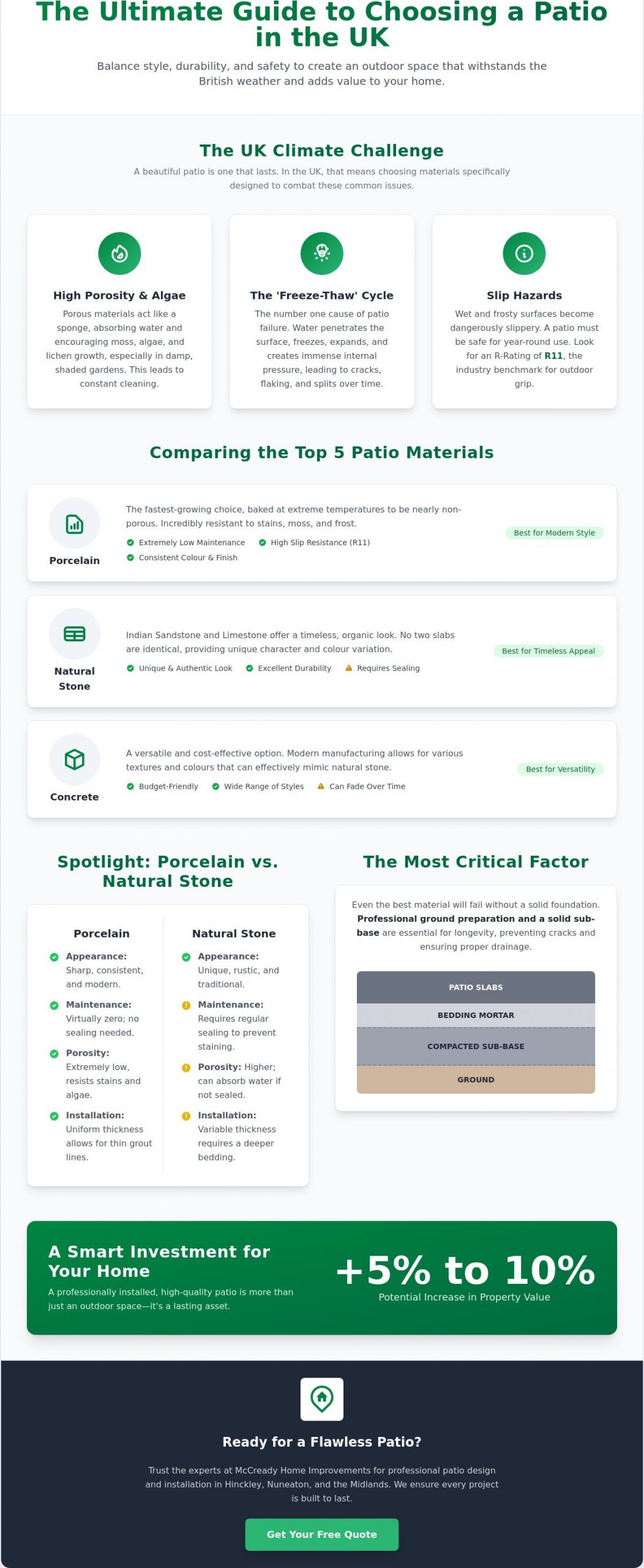
The “freeze-thaw” cycle is the primary cause of patio failure in the UK. When water penetrates a porous stone, it stays trapped inside. As temperatures drop, that water freezes and expands, putting immense pressure on the internal structure of the material. Over time, this leads to microscopic cracks that eventually turn into visible flaking or deep splits. This is why cheaper, low-density concrete or soft stones often fail after just a few seasons. We prioritize materials that can withstand these temperature swings without losing their structural integrity.
Safety is non-negotiable. Look for the “R-rating” on your paving materials. An R11 rating is the industry benchmark for outdoor surfaces. It provides enough grip to prevent slips when the surface is wet or covered in a light frost. This is a key factor when deciding on the best material for a patio UK families will use year-round. If your garden is north-facing, it won’t see much sun, meaning it stays damp and encourages algae growth. In these shaded spots, slip resistance becomes even more critical.
Weather Resistance and Porosity
High-porosity stones like some soft sandstones act like sponges. They absorb water, which then feeds moss, algae, and lichen. In shaded UK gardens, this leads to a constant battle with the pressure washer. Materials like porcelain or high-quality slate have much lower absorption rates. They stay cleaner for longer because the “greening” organisms can’t find a foothold. Selecting a low-porosity option ensures your garden looks polished with minimal effort.
Drainage and SUDS Compliance
Proper runoff is essential for longevity. We always ensure a slight “fall” or gradient in every project to move water away from your home. Standing water is the enemy of a long-lasting patio. You won’t usually need planning permission if the area is permeable or drains into a flower bed. We follow Sustainable Urban Drainage Systems (SUDS) principles to manage rainwater responsibly. This is vital in our local area where clay soil doesn’t naturally drain as quickly as other regions.
Comparing the Top 5 Patio Materials for British Gardens
Selecting the best material for a patio UK gardens require involves balancing your aesthetic vision with practical performance. There isn’t a one-size-fits-all answer. Your choice will depend on whether you prioritize a sleek modern look or a traditional, weathered feel. Here are the five most reliable materials currently leading the market for durability and style.
- Porcelain Paving: This is currently the fastest-growing choice across the country. It’s vitrified, which means it’s baked at extreme temperatures to create a nearly non-porous slab. It’s incredibly resistant to stains, moss, and frost.
- Natural Stone: Indian Sandstone and Limestone offer a timeless, organic look. No two slabs are identical. This provides a level of character and unique colour variation that manufactured materials struggle to replicate.
- Concrete Paving Slabs: A versatile and cost-effective option. Modern manufacturing allows for various textures and colours. Some high-end concrete slabs can mimic the appearance of more expensive natural stones quite effectively.
- Block Paving: While often associated with driveways, block paving is excellent for patios. It’s a fantastic choice if you want a cohesive look that wraps around your entire property.
- Resin-Bound Surfaces: These offer a seamless, modern finish. They’re highly permeable, making them a smart choice for garden paths and areas where you want to avoid standing water.
If you’re planning a full garden transformation, our team can guide you through the patio design and installation process to ensure your chosen material is fitted to the highest standard.
Porcelain vs. Natural Stone
Porcelain is the king of consistency. Since it’s factory-made, every slab matches in colour and thickness. This allows for very thin grout lines and a sharp, contemporary finish. Natural stone is the opposite. It celebrates variation. However, stone’s porous nature means it needs regular sealing to prevent water ingress. Without a professional sealant, natural stone can lose its vibrant colour and become a magnet for algae during damp winters. Porcelain requires no sealing, making it the lower-maintenance winner.
Budget Alternatives: Concrete and Gravel
You don’t always need a premium budget to get a high-quality result. Modern concrete slabs often feature textured faces that look remarkably like granite or slate. They’re durable and easy to replace if a single slab gets damaged. Decorative gravel is another affordable alternative for low-traffic areas or borders. It provides excellent natural drainage and meets permeable surfacing regulations without the need for complex drainage systems. While gravel is cheap, it does require a solid border to prevent stones from migrating. Ultimately, finding the best material for a patio UK homeowners can afford often leads back to these versatile concrete options.
Durability and Maintenance: Which Surfaces Last Longest?
Maintaining a patio in a high-rainfall region like the Midlands requires a proactive strategy. Constant dampness doesn’t just look dull; it actively degrades certain stones over time. The best material for a patio UK homeowners can choose is one that resists water penetration while standing up to the mechanical wear of daily life. We often find that durability isn’t just about the stone itself, but how that stone reacts to our local environment.
Natural stones like sandstone and limestone are beautiful but demanding. They require professional sealing every 12 to 24 months to maintain their barrier against moisture and stains. Without this protection, liquid spills or fallen leaves can leave permanent marks. In contrast, porcelain and high-quality granite are much more resilient. They easily handle heavy foot traffic and the dragging of heavy garden furniture without showing significant scratches or wear.
Low-quality materials often suffer from pitting or delamination. Pitting appears as small, unsightly holes on the surface of the slab, usually caused by salt crystallization or poor mineral composition. Delamination is even worse. This occurs when the layers of a stone slab literally peel away from each other. For more technical details on slab composition, this expert guide to patio materials provides an excellent breakdown of material properties.
The Problem with Cheap Imports
We frequently see budget-friendly sandstone imports that fail after just two UK winters. These slabs are often uncalibrated and dangerously thin, sometimes measuring less than 15mm. In a hard frost, these thin slabs lack the structural mass to resist cracking. We always recommend using calibrated slabs with a consistent thickness of at least 22mm. This ensures a level finish and provides the strength needed to survive the freeze-thaw cycles we discussed in previous sections.
Long-term Cleaning and Upkeep
Cleaning requirements vary wildly between materials. Porcelain is the undisputed king of “wipe-clean” outdoor living. A simple mop or a light hose down usually removes most dirt. Natural stone often requires more aggressive jet washing, which can accidentally damage the surface or wash out the pointing if not done carefully. We use high-quality jointing compounds that set hard. This prevents weed growth between the slabs and keeps the entire structure stable for years to come. Choosing the best material for a patio UK weather won’t ruin means thinking about these Sunday morning chores before you commit to an installation.
Matching Materials to Your Garden Style and Budget
Choosing the best material for a patio UK homeowners will actually love depends heavily on the existing architecture of the property. In Hinckley and Nuneaton, many residences feature traditional red-brick facades. You don’t want a patio that clashes with your home’s character. Instead, look for materials that either provide a sharp, modern contrast or a harmonious, tonal blend. Grey porcelain slabs offer a clean, contemporary edge against red brick, while the warm, earthy tones of multi-coloured sandstone can make a garden feel like a natural extension of a classic house.
Traditional vs. Contemporary Designs
Cottage-style gardens and older properties often benefit from the organic textures of weathered limestone or riven sandstone. These materials have a natural, uneven surface that feels established from day one. If you have a modern extension with large bi-fold doors, porcelain is the superior choice. It allows you to match your indoor flooring with your outdoor slabs, creating a seamless transition that makes both spaces feel larger. We often integrate block paved driveways with matching patio borders to create a unified aesthetic across the entire exterior. This level of detail ensures your garden looks professionally designed rather than pieced together.
Budget Planning for Your Patio Project
When planning your budget, remember that the slabs themselves are only one part of the investment. Professional labour and high-quality sub-base materials often cost more than the surface finish. We never recommend cutting corners on the foundation. A cheap slab on a perfect sub-base will last decades, but the most expensive porcelain on a poor foundation will crack in months. If you need to save money, consider using decorative gravel for borders or low-traffic zones while investing your primary budget into high-quality slabs for the main seating area.
High-quality materials don’t just look better; they also increase your property’s resale value. A well-installed, low-maintenance patio is a major selling point for future buyers. If you are ready to transform your outdoor space, contact us for a professional patio design consultation. We can help you select the best material for a patio UK weather won’t degrade, ensuring your investment pays off for years to come.
Professional Patio Installation in Hinckley and Nuneaton
Even the highest quality slabs won’t stay level if the ground beneath them isn’t prepared correctly. Many homeowners spend weeks researching the best material for a patio UK suppliers offer, but they forget that the sub-base does all the heavy lifting. In the Midlands, our heavy clay soil expands and contracts with the seasons. This movement can easily shift poorly installed slabs, leading to dangerous trip hazards and unsightly gaps. We treat every property with the same care as our own homes, ensuring the foundation is built to last a lifetime.
Our approach starts with meticulous ground preparation. We excavate to the correct depth and install a high-density, compacted sub-base that provides a rock-solid foundation. We also pay close attention to drainage. As we mentioned earlier, standing water is a patio’s worst enemy. We design every project with the necessary fall to ensure rainwater flows safely away from your house and into appropriate drainage channels. This comprehensive service often includes updating your garden’s boundaries. We can seamlessly integrate your new surface with high-quality fencing and gates to provide a total garden renovation.
The McCready Standard of Craftsmanship
We take immense pride in our work. Our team follows a strict standard of craftsmanship that goes beyond industry minimums. We use a superior sub-base depth to prevent any future sinking or shifting, regardless of the material you choose. Whether you’re interested in a modern resin bound patio or a traditional natural stone finish, our installation techniques remain consistent. We’re a local, family-run business that values our reputation in Hinckley and Nuneaton. This means we focus on long-term quality over quick wins. We provide free, no-obligation estimates for all residential projects, giving you a clear understanding of the work involved before we start.
Start Your Garden Transformation
Booking a site visit is the first step toward your new garden. We cover Hinckley, Nuneaton, and the surrounding Midlands areas. During our visit, we’ll assess your garden’s orientation, soil type, and your specific lifestyle needs. We explain the process from the initial dig-out to the final jointing. You’ll know exactly what to expect at every stage. Our goal is to provide peace of mind through clear communication and expert execution. Identifying the best material for a patio UK weather won’t destroy is only half the battle; the rest is in the professional fitting. Contact McCready Home Improvements for your free patio estimate today and let’s build a space you can be proud of.
Build a Garden Space That Lasts for Generations
McCready Home Improvements is here to turn your vision into a reality. As a family-run local business, we pride ourselves on our deep expertise across Hinckley and Nuneaton. We are specialists in resin, block paving, and natural stone, ensuring every project meets our meticulous standards for drainage and durability. We handle every detail, from the initial design to the final jointing. Get a Free, No-Obligation Patio Estimate from McCready Home Improvements today. Let’s work together to create a polished, safe, and stunning outdoor area that you’ll be proud to share with your family for years to come.
Frequently Asked Questions
Is porcelain or natural stone better for a UK patio?
Porcelain is generally superior for homeowners seeking a low-maintenance, modern finish, while natural stone is better for those who value unique, organic character. Porcelain’s vitrified surface resists the moisture-heavy UK climate more effectively. Natural stone like Indian sandstone requires regular sealing to prevent staining and algae growth. Your choice should depend on whether you prefer a consistent, contemporary look or a traditional, varied aesthetic.
What is the most low-maintenance patio material?
Porcelain is the most low-maintenance option available for British gardens. Its non-porous surface means it doesn’t absorb water, which prevents moss and lichen from taking root. You won’t need to apply sealants or use aggressive chemicals to keep it clean. A simple wash with soapy water every few months is usually enough to maintain its polished appearance. This makes it the best material for a patio UK families can choose to save time on upkeep.
How do I stop my patio from becoming slippery in the winter?
Selecting a material with a high slip-resistance rating, specifically R11 or above, is the most effective way to prevent a slippery surface. You should also keep the area clear of fallen leaves and organic debris, as these decay and create a slick film. Regular light cleaning prevents the buildup of algae, which is the primary cause of slips during damp winter months.
Do I need planning permission for a new patio in the UK?
Most patio installations fall under permitted development rights and don’t require planning permission. However, if you’re paving a front garden over five square metres, you must use a permeable material or provide a drainage area to meet SUDS regulations. It’s always a good idea to check with your local authority if your home is a listed building or located in a conservation area.
Which patio material is best for heavy garden furniture?
Porcelain and thick, calibrated natural stone are the best choices for supporting heavy garden furniture. Porcelain is incredibly dense and scratch-resistant, so dragging a heavy table won’t leave permanent marks. If you prefer stone, ensure the slabs are at least 22mm thick to prevent cracking under concentrated weight. A solid, professionally installed sub-base is equally important for preventing slabs from tilting under heavy loads.
How long should a professionally installed patio last?
A professionally installed patio should last between 20 and 30 years, depending on the material and maintenance routine. Porcelain and high-quality granite often exceed this lifespan because they don’t degrade in the face of frost and heavy rain. The longevity of any surface is directly linked to the quality of the initial ground preparation and the depth of the sub-base used during the construction process.
Can I use the same material for my patio and my driveway?
Block paving and resin-bound surfaces are excellent choices if you want to use the same material for both your patio and driveway. These materials are designed to handle the weight of vehicles while providing an attractive finish for garden seating areas. Using a consistent material across your entire property creates a unified, professional look that can significantly boost your home’s curb appeal and overall market value.
What is the cheapest way to build a durable patio?
Textured concrete slabs are the most cost-effective way to build a durable patio that still looks professional. These slabs provide a stable, long-lasting surface at a lower material cost than porcelain or premium natural stone. For the best material for a patio UK budgets can accommodate, concrete offers a reliable balance of strength and affordability. Alternatively, decorative gravel is a cheap, permeable option for low-traffic areas.
