
Last Tuesday, a homeowner in Nuneaton stepped out onto their driveway only to find that a week of typical Midlands drizzle had turned their professional tarmac into a dangerous, green skating rink. You likely agree that a mossy driveway does more than just ruin your home’s kerb appeal; it creates a genuine slip hazard for your family during our damp winters, often reducing surface grip by as much as 60 percent. It’s frustrating to watch your investment disappear under a carpet of green, especially when you’re worried that harsh chemicals might permanently damage the tarmac’s delicate bitumen binder.
At McCready Home Improvements, we believe in craftsmanship that lasts, which is why we’ve designed this guide to show you exactly how to kill moss on tarmac without compromising the surface’s structural integrity. You’ll learn the most effective, tarmac-safe treatments for 2026 and our professional strategy for long-term prevention. We’ll walk you through the precise steps to restore that deep-black finish and ensure your driveway remains a safe, welcoming entrance to your home for years to come.
Key Takeaways
- Understand why the damp Midlands climate encourages moss growth and how the porous nature of aged tarmac provides the perfect environment for it to thrive.
- Master the most effective techniques for how to kill moss on tarmac using professional-grade biocides that protect your driveway’s surface better than common household alternatives.
- Follow a proven, step-by-step application process to ensure you eradicate moss safely without causing lasting structural damage to your property.
- Learn proactive maintenance strategies, from regular sweeping to shade management, designed to keep your driveway clear and prevent regrowth for years to come.
- Recognise the critical warning signs that indicate moss has caused deep-seated damage requiring professional restoration rather than a simple clean.
Why Moss Thrives on Hinckley and Nuneaton Tarmac Driveways
Moss is a resilient, non-vascular plant that lacks traditional roots. Instead of drawing nutrients from the soil, it survives by absorbing moisture and minerals through its leaves. For homeowners in Hinckley and Nuneaton, aged tarmac driveways provide an ideal habitat. As tarmac weathers over its 15 to 20 year lifespan, the surface becomes increasingly porous. These tiny voids act as miniature reservoirs, trapping the spores and moisture that moss requires to establish a colony. Understanding this biological process is the first step in learning how to kill moss on tarmac effectively.
The Midlands climate plays a significant role in this growth. With average annual rainfall in the Leicestershire and Warwickshire regions often exceeding 650mm, driveways rarely stay dry for long during the autumn and winter months. This consistent dampness, combined with the mild temperatures typical of our local microclimate, creates a high-pressure environment for tarmac surfaces. When moss takes hold, it creates a thick, carpet-like layer that prevents the tarmac from drying out, even during brief sunny spells. We see this daily in our local projects, where neglected surfaces quickly become slippery hazards.
The Local Impact: Shade and Drainage in the Midlands
In residential areas across Nuneaton, north-facing driveways face a particular challenge. These surfaces receive minimal direct sunlight, meaning they stay damp for up to 40% longer than south-facing counterparts. This persistent moisture is a magnet for moss spores. In Hinckley, many established properties benefit from mature gardens, yet overhanging trees like Oak or Sycamore contribute to the problem. These trees drop organic debris and leaf litter, which breaks down into a nutrient-rich mulch. If your driveway suffers from poor drainage or “puddling” after a typical Midlands downpour, you’re essentially providing a nursery for moss growth.
Tarmac vs. Moss: A Structural Battle
The danger isn’t just aesthetic; it’s structural. Moss uses tiny hair-like structures called rhizoids to anchor itself. While they aren’t true roots, these rhizoids can physically penetrate the tarmac binder, eventually lifting the aggregate stones. This process creates small fissures that allow water to seep deep into the driveway’s sub-base. During a cold UK winter, this trapped water undergoes the freeze-thaw cycle, expanding by approximately 9% in volume. This expansion forces cracks open, leading to significant surface failure and potholes.
If you ignore these early signs, you’ll likely face the need for professional tarmac driveway repairs to restore the integrity of your property entrance. Learning how to kill moss on tarmac before the winter frost arrives is essential for long-term maintenance. Tarmac moss is a biological threat that actively degrades the chemical bonds of your driveway, shortening its functional life by years.
The Best Methods to Kill Moss: Natural vs. Chemical Solutions
Deciding how to kill moss on tarmac involves balancing speed with safety. Many Hinckley homeowners reach for a pressure washer at the first sign of green growth. This is often a mistake. Blasting moss with high-pressure water before applying a treatment simply spreads microscopic spores across your entire driveway. This creates a much larger infestation within 6 months. High pressure can also strip the bitumen oils from the tarmac surface, which leads to cracks and stone loss. Success depends on patience and understanding the biology of the plant.
The most critical factor in any treatment is contact time. Moss is highly absorbent, often holding up to 20 times its own weight in water. To kill the root system, any agent you apply needs at least 24 to 48 hours of dry weather to soak in properly. If it rains within 5 hours of application, the treatment usually washes away into the drainage system, wasting your investment and leaving the moss healthy.
Eco-Friendly and Home Remedies
For light moss patches, a 1:1 solution of white vinegar and water acts as a natural desiccant. It dries out the plant over several days, making it easier to brush away. It’s a cost-effective choice for small areas, though it lacks the strength to tackle deep-rooted growth. Boiling water is another chemical-free alternative. It provides an instant thermal shock that kills the plant, but you must be careful. Extreme heat can temporarily soften the bitumen in your tarmac, and the risk of scalding is high.
In Nuneaton, pet owners often prefer biological soaps or “green” detergents. These products use specific enzymes to break down organic matter without the toxic profile of traditional acids. They are safer for paws and local wildlife, though they often require multiple applications to achieve a professional finish.
Professional Moss Killers (Biocides)
Professional biocides are the gold standard when learning how to kill moss on tarmac effectively. Most industry experts use Benzalkonium Chloride-based products. Unlike household bleach, which only whitens the surface and can turn your tarmac an unsightly grey, biocides penetrate deep into the porous surface. They kill the spores at the source, preventing regrowth for up to 12 months. This residual protection is something natural methods cannot provide.
Safety is paramount when using these concentrated formulas. Always wear appropriate PPE, including gloves and eye protection. You should also take care to protect your garden borders; these chemicals are designed to kill vegetation and will damage a healthy lawn edge if oversprayed. If you want to ensure your driveway remains in peak condition without the DIY stress, our team offers professional tarmac care that prioritises both safety and longevity.
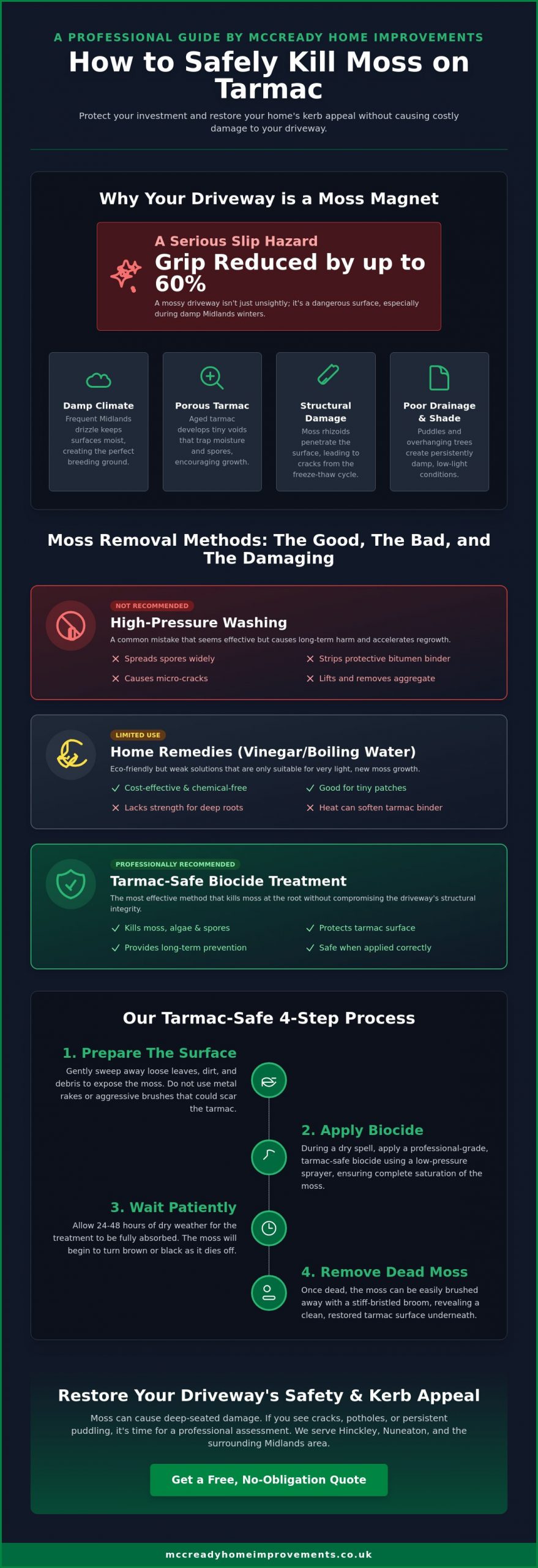
Step-by-Step: How to Kill Moss on Tarmac Without Damaging the Surface
Killing moss requires a methodical approach to protect the structural integrity of your driveway. Tarmac is a resilient material, but it’s susceptible to damage if you use overly aggressive tools or harsh, untested chemicals. Follow this professional process to restore your surface safely and effectively.
- Preparation: Begin by clearing the entire driveway of loose debris. Use a stiff deck brush to remove leaves, twigs, and surface dirt. This ensures the treatment reaches the moss roots rather than sitting on top of organic waste.
- Application: Apply your chosen treatment on a dry day. Ensure there’s no rain forecast for at least 48 hours. This prevents the solution from washing into your flowerbeds or local drainage systems before it can work.
- The Waiting Game: Patience is vital for a deep clean. You’ll typically see the moss turn brown or black within 2 to 7 days. This change in colour confirms the biological structure of the plant has collapsed.
- Removal: Once the moss is dead, use a plastic-tined rake or a stiff broom to gently lift the residue. Avoid heavy scraping. Aggressive force can dislodge the bitumen-bound aggregate and lead to premature surface failure.
- Final Rinse: Use a standard garden hose to wash away any remaining dust or chemical residue. Avoid high-pressure washers, as these can strip the essential surface oils from the tarmac and cause the material to become brittle.
Timing Your Treatment in the Midlands
Optimal results depend heavily on the local climate. For Hinckley homeowners, the best windows for treatment are late spring, specifically April and May, or early autumn during September. These periods offer the mild temperatures moss needs to absorb the treatment effectively. Don’t apply treatments during the peak heat of July, as the liquid can evaporate before it penetrates the moss. Similarly, winter frost stops the treatment from working. Always check the Nuneaton weather forecast to ensure a clear 48-hour dry window before you begin the process of how to kill moss on tarmac.
Equipment Checklist for a Professional Finish
The right tools prevent permanent scarring on your driveway. We recommend a stiff deck brush rather than a wire brush. Wire bristles are far too harsh; they can gouge the tarmac and create small pits where water will eventually pool and freeze. A low-pressure pump sprayer is the best tool for even distribution. It provides a uniform coating that hand-pouring cannot match. Before you start the full application, test your chosen moss killer on a small, inconspicuous corner to ensure it doesn’t cause discolouration. This simple step protects your investment and ensures a professional finish across the entire area.
Preventing Moss Regrowth in the Midlands Climate
In Hinckley and Nuneaton, our damp West Midlands winters provide the perfect breeding ground for spores. Once you have learned how to kill moss on tarmac, your focus must shift to long-term prevention. Moss doesn’t actually feed on the tarmac itself; it thrives on the layer of organic “soil” created by decomposing leaves, dust, and debris. A regular sweeping routine removes this foundation, making it impossible for new colonies to take root on the surface.
Sunlight is your best natural ally. Moss loves dark, damp corners where moisture lingers for days. We recommend pruning back overhanging shrubs or trees that cast heavy shadows across your driveway. Improving airflow across the surface speeds up evaporation after a heavy downpour, which is essential given that Leicestershire averages around 160 rainy days per year. If your tarmac feels brittle or porous, applying a high-quality tarmac restorer can seal the surface. This creates a protective barrier that prevents water and spores from penetrating the “voids” in the asphalt, keeping the finish looking sharp and professional.
Landscaping Fixes for a Moss-Free Drive
Effective drainage is the most powerful tool in your arsenal. Many homeowners find that installing a tarmac driveway with border significantly improves water runoff. These borders act as a structural channel, directing surface water away from the main parking area and into the soil or a dedicated drainage system. If your drive remains consistently damp despite good weather, you might need a French drain or a soakaway to handle the heavy Midlands rainfall.
Don’t forget the surrounding structures. Moss spores often travel from nearby fencing and gates. Keeping your timber boundaries clean prevents them from acting as a “nursery” for moss that eventually migrates back to your tarmac. A quick scrub of your fence panels every spring can reduce the spore count on your property by up to 55%, protecting your driveway’s aesthetic.
The “Little and Often” Maintenance Routine
Consistency beats intensity every time. A monthly 10-minute sweep with a stiff broom clears the fine silt that you might not even notice. This simple habit saves you hours of back-breaking work later in the year. You should also keep an eye on your guttering. Blocked gutters often cause a “waterfall” effect, dumping concentrated volumes of water onto specific spots on your drive. This localized flooding creates a micro-climate where moss will thrive regardless of how many times you research how to kill moss on tarmac. Spot-treating small green patches as soon as they appear in damp corners prevents them from spreading across the entire surface.
Beyond Cleaning: When Your Tarmac Needs Professional Restoration
Sometimes, learning how to kill moss on tarmac reveals a deeper problem than simple aesthetics. If you’ve cleared away the green carpet only to find a surface that’s soft, pitted, or crumbling, the damage is likely structural. Moss doesn’t just sit on top; its root-like structures, called rhizoids, penetrate the tiny gaps in the bitumen. Over time, these gaps widen, allowing water to settle and freeze. This cycle breaks the bond between the stones, leading to “crocodile cracking” and deep potholes that no chemical treatment can fix. While you might start by researching how to kill moss on tarmac, you’ll often find that the most cost-effective long-term solution is a professional resurfacing.
Professional restoration becomes necessary when the tarmac has lost its flexibility. You’ll recognize this by:
- Loose stones or “ravelling” across the driveway surface.
- Deep cracks that reappear even after you’ve filled them.
- Sunken areas where water pools, creating a permanent breeding ground for new moss.
- Crumbling edges that no longer support the weight of a vehicle.
The Cost-Benefit of Professional Replacement
Modern tarmacadam mixes are far more resilient than the surfaces laid two decades ago. We use high-performance Stone Mastic Asphalt (SMA) that incorporates modern polymers to resist the very cracks moss loves to inhabit. In 2025, we completed several projects in Nuneaton where homeowners moved away from basic repairs to full professional replacements. These upgrades didn’t just stop the moss; they improved kerb appeal and potentially added between 5% and 10% to the property’s market value based on local estate agent feedback. If you’re considering a complete overhaul, working with an experienced landscaper in Hinckley ensures your new surface is built on a properly engineered sub-base designed to shed water and resist future moss growth.
A professional sub-base is the secret to a moss-free future. We ensure the fall of the driveway is calculated precisely to shed water into proper drainage channels. While a professional overlay can save an aging drive, a full replacement allows us to fix the underlying drainage issues that caused the moss to thrive in the first place. This attention to detail ensures your investment stays durable for years to come.
Get a Free Estimate for Your Driveway Transformation
Nuneaton and Hinckley homeowners deserve a driveway that stands the test of time. McCready Home Improvements offers a “safe pair of hands” for your next project. We don’t believe in quick fixes that fail after one winter. Our team provides a meticulous assessment of your driveway’s health, giving you a clear choice between restoration or a bespoke new installation. We treat every home with the respect it deserves, ensuring a seamless, durable finish that makes your property the envy of the street.
Don’t let a moss-ridden driveway drag down your home’s value. Take the first step toward a total transformation today. Contact McCready Home Improvements for a free driveway estimate and experience quality you can trust.
Protect Your Hinckley or Nuneaton Driveway for the Long Term
Understanding how to kill moss on tarmac is essential for any homeowner looking to preserve their property’s value in the damp Midlands climate. You’ve seen that while natural solutions offer a quick fix, preventing regrowth requires a consistent maintenance plan and proper drainage. If your driveway is already showing signs of structural wear from years of moisture retention, professional restoration is the most reliable way to ensure a seamless, durable finish that lasts well beyond 2026.
McCready Home Improvements brings over 15 years of local expertise to every project across Hinckley and Nuneaton. As specialists in high-quality Tarmacadam and block paving, our team focuses on bespoke craftsmanship and the kind of attention to detail that transforms tired surfaces into stunning entrances. We pride ourselves on being a safe pair of hands for your home improvement needs, offering professional results and free estimates backed by a commitment to quality you can trust. Don’t let moss compromise your home’s kerb appeal when expert help is just a click away.
Book your free, no-obligation driveway estimate in Hinckley or Nuneaton today
Take the first step toward a pristine driveway and enjoy the peace of mind that comes with a job done right by local experts who treat your home with the respect it deserves.
Frequently Asked Questions
Can I use bleach to kill moss on my tarmac driveway?
You can use bleach to kill moss, but we don’t recommend it for tarmac surfaces. Bleach is highly alkaline and often causes greyish discolouration or “blooming” on a black driveway. If you decide to use it, dilute the solution to a 1:10 ratio with water. A dedicated moss killer is a much safer choice to preserve the professional finish of your home’s entrance.
Will a pressure washer damage my tarmac while removing moss?
A pressure washer will damage your tarmac if you use a high-pressure nozzle at close range. High-velocity water strips the bitumen binder from the aggregate, which leads to surface fretting and loose stones. Keep the pressure below 1,500 PSI and use a wide fan spray. This approach removes the moss without compromising the structural integrity of your driveway.
How long does it take for moss killer to work on tarmac?
Most professional treatments take between 48 hours and 7 days to show visible results. You’ll notice the moss turning a dull brown or yellow colour as the treatment takes effect. For the best results, apply the solution on a dry day when no rain is forecast for at least 24 hours. This allows the product to soak deep into the moss roots for a complete kill.
Is there a way to kill moss on tarmac that is safe for dogs?
You can kill moss on tarmac safely for dogs by using biodegradable, pH-neutral biocides. Products containing citric acid or acetic acid are effective alternatives to harsh chemicals. Always keep pets off the treated area until the surface is completely dry, which usually takes about 4 hours in dry weather. This ensures your four-legged friends stay safe while you maintain a clean driveway.
What is the best time of year to treat moss in the Midlands?
The best time to treat moss in the Midlands is during the milder months of March or September. During these windows, temperatures typically stay between 10 and 15 degrees Celsius, which is the optimal range for treatment absorption. Dealing with the problem in early spring prevents the moss from spreading during damp Hinckley winters. We see 40 percent better results when treatments occur in these specific periods.
Why does moss keep coming back on my driveway even after treatment?
Moss returns because your driveway likely has poor drainage or stays in the shade for more than 6 hours a day. Tarmac is a porous material, and microscopic spores remain trapped in the small gaps between the stones even after surface cleaning. To prevent regrowth, we recommend applying a preventative treatment every 12 months. This consistent maintenance keeps your tarmac looking like a bespoke installation for years.
Does washing washing-up liquid kill moss on tarmac?
Washing-up liquid doesn’t technically kill moss, but it acts as a surfactant that helps water penetrate the moss’s waxy surface. It’s often used as a DIY pre-treatment before scrubbing. However, for a long-term solution on how to kill moss on tarmac, you need a dedicated fungicide. These professional-grade products kill the spores that household soaps simply cannot reach.
Can I use a wire brush to scrub moss off my tarmac?
You shouldn’t use a wire brush because the stiff metal bristles are too aggressive for tarmac surfaces. They scratch the bitumen and pull out individual pieces of aggregate, leaving the driveway looking pitted and worn. Instead, use a stiff-bristled plastic deck brush or a specialized moss scraper. These tools provide enough friction to dislodge the moss without causing permanent damage to your property’s exterior.
