
Your lawn looks great in June. By November, it’s a waterlogged, muddy mess that the kids track through the kitchen on their boots. If that sounds familiar, you’re not alone. Nuneaton gardens sit on heavy Warwickshire clay, and no amount of lawn care effort changes what happens when the rain arrives. The lawnmower takes up half the shed, the weeding never ends, and the grass still looks tired by August.
Here’s the thing most people don’t realise: professional artificial grass installation in Nuneaton isn’t simply a case of rolling out a green carpet and calling it done. It’s a precision groundworks project. Get the sub-base and drainage wrong, and you’ll end up with the same waterlogging problems you started with, just under a synthetic surface. The right installer understands your soil, plans for Warwickshire rainfall, and builds a lawn that performs properly for years.
This guide covers everything a Nuneaton homeowner needs to know in 2026, from choosing the right product and preparing the ground correctly, to finding a local installer you can genuinely trust. By the end, you’ll know exactly what a quality installation looks like and what questions to ask before anyone lifts a spade in your garden.
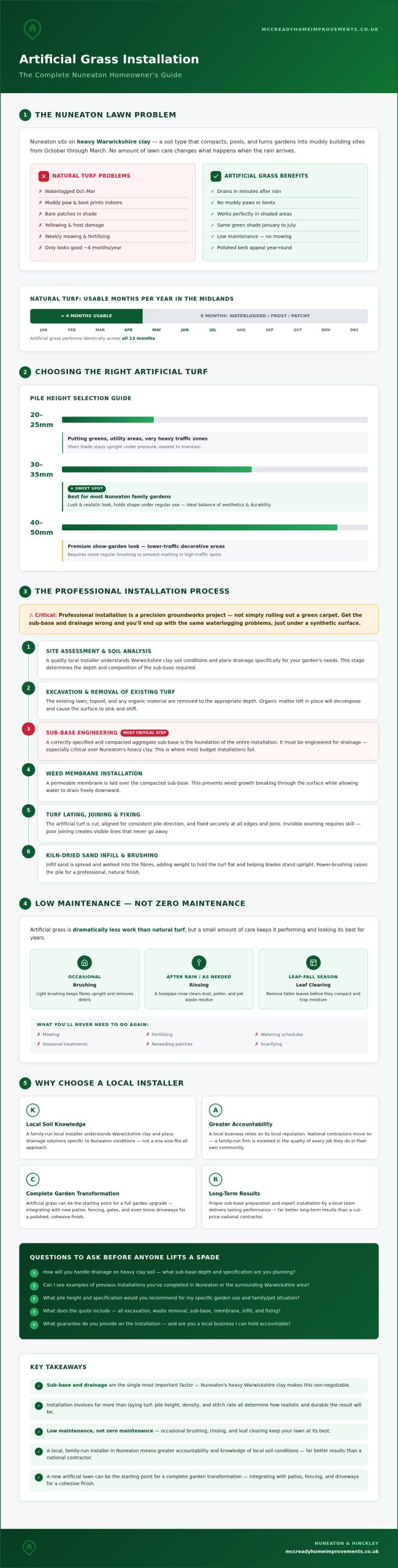
Key Takeaways
- Nuneaton’s heavy Warwickshire clay makes proper sub-base preparation and drainage the single most important factor in any artificial grass installation — get this wrong and waterlogging problems simply continue beneath the surface.
- Professional artificial grass installation in Nuneaton involves far more than laying turf: the right pile height, density, and stitch rate all determine how realistic and durable your finished lawn will be.
- Artificial grass is low maintenance, not zero maintenance — this guide explains exactly what upkeep is needed to keep your lawn looking its best year after year.
- Choosing a local, family-run installer means greater accountability and a team that understands Nuneaton soil conditions, giving you far better long-term results than a national contractor.
- A new artificial lawn can be the starting point for a complete garden transformation, integrating seamlessly with patios, fencing, and even a new stone driveway for a polished, cohesive finish.
Why Nuneaton Homeowners are Switching to Artificial Grass
The decision rarely happens overnight. It usually follows one too many mornings spent scrubbing mud off the kitchen floor, or realising the lawn you spent a weekend mowing looks exhausted again by Thursday. For Nuneaton homeowners, the switch to artificial grass is less about aesthetics and more about reclaiming time, energy, and a garden that actually works for the way they live.
Solving the Muddy Lawn Problem Forever
Heavy Warwickshire clay doesn’t drain. It compacts, it pools, and from October through to March it turns most Nuneaton back gardens into something closer to a building site than a usable outdoor space. Synthetic turf, installed over a properly engineered sub-base, breaks that cycle entirely. Rainwater drains through the surface and away from the area, leaving the grass dry and usable within minutes rather than days.
For households with dogs, this is transformative. No more muddy paw prints tracked through the house, no more brown patches worn into the grass along favourite running routes. Modern artificial grass fibres are built to handle exactly this kind of repeated, concentrated foot traffic. The pile bounces back. The surface stays consistent. And the mud-to-carpet cycle simply stops.
The same durability applies to families with young children. A garden used daily for play, sport, and general outdoor life will show it on natural turf. On a quality synthetic surface, heavy use leaves no lasting mark.
Year-Round Aesthetics in the Midlands
Natural turf in the Midlands earns its keep for perhaps four months of the year. The rest of the time it’s either waterlogged, frost-damaged, or struggling in the shade of fences and neighbouring trees. Shaded gardens, common on many Nuneaton streets, produce patchy, thin grass that no amount of overseeding fully resolves.
Artificial grass stays the same shade of green in January as it does in July. There’s no yellowing in dry spells, no frost burn, and no bare patches where the light doesn’t reach. That consistency matters for kerb appeal, particularly if you’re thinking about long-term property value. A lawn that looks polished year-round makes a strong first impression from the street, every single day.
It also creates the foundation for a genuinely cohesive garden. Pairing a new artificial lawn with updated fencing and gates gives you a boundary-to-boundary refresh that looks considered and well-planned rather than piecemeal. The result is a garden that feels finished, not just improved.
For busy professionals who don’t have weekends to spare for lawn maintenance, the appeal is straightforward. No fertilising, no watering schedules, no seasonal treatments. Quality artificial grass installation in Nuneaton removes the recurring time and cost of lawn upkeep, replacing it with a surface that simply performs, season after season.
Selecting the Perfect Artificial Turf for Your Nuneaton Garden
Choosing artificial grass isn’t as simple as picking a shade of green and ordering the longest pile you can find. The product itself has to match how you use your garden, how much traffic it takes, and whether you have dogs, children, or both. Get the specification right, and the surface performs beautifully for years. Get it wrong, and even a well-installed lawn will flatten, fade, or fail to drain properly.
Pile Height and Density: Finding the Balance
Pile height is the length of the individual grass blades, and it makes a bigger difference than most homeowners expect. Options typically range from around 20mm up to 50mm, but that full range doesn’t suit every application.
- 20-25mm: Best suited to putting greens, hard-wearing utility areas, or spaces with very heavy foot traffic. The shorter blade stays upright under pressure and is easier to maintain.
- 30-35mm: The sweet spot for most Nuneaton family gardens. Long enough to look lush and realistic, short enough to hold its shape under regular use. This range tends to offer the best balance between aesthetics and durability.
- 40-50mm: Creates a premium, show-garden look, but requires more brushing to prevent matting in high-traffic zones. Better suited to low-use decorative spaces than busy family gardens.
Density matters just as much as pile height. Measured by stitch rate, which refers to the number of fibre tufts per square metre, higher density means more fibres packed into the backing. A denser product has better bounce-back when compressed underfoot, meaning it recovers its shape after heavy use rather than lying flat. For gardens with children or dogs, prioritising density over pure pile height gives you a surface that stays looking good long after installation.
Specialist Grass: Dog-Friendly and Family-Safe Options
Not all artificial grass backings are equal, and this is where cheaper products often cut corners. A polyurethane backing offers superior drainage performance compared to standard latex, with better permeability that prevents water pooling on the surface. For Nuneaton gardens where clay drainage is already a challenge, this distinction matters.
For families with young children, look for products manufactured from non-toxic, lead-free polyethylene fibres. These are soft underfoot, safe for skin contact, and meet standard safety requirements for play areas.
Pet-friendly turf is specifically designed with an odour-resistant, antimicrobial backing that prevents bacteria from building up in the pile, keeping the surface hygienic and fresh even with daily use.
UV stabilisation is the final piece of the specification puzzle. Quality fibres are treated to resist colour degradation from sunlight, so the grass holds its natural green tone without fading to a washed-out yellow over time. In a Midlands garden that faces south or west, this isn’t optional.
Matching the shade itself is worth a moment’s thought, too. Nuneaton gardens are surrounded by mature hedgerows, established borders, and the deeper greens of Warwickshire countryside. A single-tone, bright artificial grass can look jarring against that backdrop. Products with blended tones, combining mid-green, olive, and tan thatch fibres, sit far more naturally within a typical local garden setting.
If you’d like guidance on which specification suits your garden before committing to a project, get a free, no-obligation estimate from McCready Home Improvements and talk through the options with a local team that understands Nuneaton gardens from the ground up.
The Professional Installation Process: Why Groundwork Matters
The surface you see is only half the story. What sits beneath your artificial lawn determines whether it drains properly, stays level over time, and holds its shape under years of foot traffic. Cut corners on the groundwork, and you’ll see the consequences within a season: sinking in high-traffic areas, rucking where the turf hasn’t been secured properly, and pooling water that has nowhere to go. Professional artificial grass installation in Nuneaton starts underground, and that’s exactly where McCready Home Improvements focuses its attention first.
On Nuneaton’s heavy clay soil, this preparation phase is non-negotiable. Clay doesn’t compact cleanly like sandy or loamy ground. It shifts, it swells when wet, and it creates an unstable base that causes even well-laid turf to move over time. Understanding that behaviour, and building a sub-base that accounts for it, is what separates a lawn that still looks perfect in five years from one that needs remedial work by year two.
Step-by-Step: The McCready Installation Method
Every installation follows a structured sequence, and each stage is completed properly before the next begins.
- Excavation: Existing turf and topsoil are removed to a depth of typically 50-75mm, depending on the ground conditions found on site. This creates a clean, consistent base and removes the organic material that would otherwise decompose and cause subsidence beneath the finished lawn.
- Geotextile membrane: A weed-suppressing membrane is laid across the excavated area before any sub-base material is added. This prevents weed growth from pushing up through the finished surface, which is a common failure point in cheaper installations that skip this layer entirely.
- Sub-base installation: MOT Type 1 aggregate or granite dust is spread and compacted in layers to create a firm, stable, permeable base. This is the structural heart of the installation. Proper compaction at this stage is what prevents sinking and rucking later.
- Edging and perimeter securing: The boundary of the lawn is fixed using treated timber banding or integrated with existing brickwork garden walls, giving the turf a clean, stable edge to be secured against. This step stops the turf from lifting or creeping at the edges over time.
- Precision fitting: The artificial turf is cut accurately to shape, laid with the pile direction consistent throughout, and fixed securely to the perimeter. Where joins are unavoidable, professional joining tape and adhesive are used to create a seam that’s virtually invisible once the pile is brushed up.
Managing Drainage and Surface Water Runoff
A properly installed artificial lawn should be SUDS compliant, meaning it allows rainwater to permeate through the surface and sub-base rather than running off in sheets. Achieving this on Nuneaton clay requires a deliberate approach. The sub-base is graded with a slight fall, typically around 1-2%, to encourage water to move toward existing drainage points rather than sitting beneath the surface.
Before installation begins, it’s worth identifying where your garden’s natural drainage outlets are. Existing soakaways, gullies, or boundary drainage channels should be factored into the sub-base gradient from the outset. Addressing this at the planning stage avoids surface water issues that are far more disruptive to correct after the turf is down.
Done correctly, the finished lawn drains efficiently, stays firm underfoot within minutes of heavy rainfall, and eliminates the waterlogging that makes so many Nuneaton gardens unusable through winter.
Maintaining and Protecting Your Artificial Lawn
Let’s clear something up immediately: artificial grass is low maintenance, not zero maintenance. That distinction matters. A synthetic lawn that’s ignored completely will eventually show it, through flattened pile in high-traffic zones, moss creeping into the backing, and organic debris breaking down into a layer that encourages weed germination. The good news is that what your lawn actually needs is straightforward, takes very little time, and doesn’t require any specialist equipment for most of it.
Essential Seasonal Maintenance Tips
Two seasons demand the most attention in a Nuneaton garden.
Spring is the time to reset your lawn after winter. Cold months bring frost, heavy foot traffic, and compressed pile that’s spent months lying flat. A firm brush with a stiff-bristled broom, working against the grain of the fibres, lifts the pile back to its original position and restores that fresh, upright look. If your lawn covers a large area, power brushing is worth considering: it’s a professional-grade mechanical brushing process that rejuvenates the pile more thoroughly than hand brushing and extends the working life of the surface significantly.
Autumn is the season that catches most Nuneaton homeowners off guard. Warwickshire is surrounded by mature trees, and the leaf fall from October onwards is substantial. Leaves left sitting on artificial grass decompose and create a damp, organic layer in the pile that’s exactly the environment moss needs to establish itself. A leaf blower or a plastic-tined rake clears them quickly without damaging the fibres. Make it a weekly habit through October and November rather than one big annual clear-up.
Dealing with Weeds and Minor Repairs
Weeds don’t grow through a properly installed artificial lawn, but airborne seeds can germinate in the sand infill that sits within the pile. Treat these early with a diluted weed killer that’s safe for synthetic surfaces, applied directly to the affected area. Catch them small and they pull out cleanly; leave them and the root system becomes harder to remove without disturbing the infill.
Two things genuinely damage artificial grass fibres: heat and sharp impact. Keep BBQ embers and disposable barbecues away from the surface entirely, and be aware that a magnifying glass effect from certain double-glazed windows or conservatory panels can focus enough heat to melt synthetic fibres. It’s a surprisingly common issue.
For anything more serious, including a lifting seam, a section damaged by heat, or a deep clean of a pet area that’s seen heavy use, call a professional rather than attempting a DIY fix. A botched seam repair is far more visible than the original problem.
Protecting your investment starts with the right aftercare habits from day one. Contact McCready Home Improvements for expert advice on keeping your artificial grass installation in Nuneaton looking its best year after year.
Expert Artificial Grass Installers in Nuneaton and Hinckley
There’s a meaningful difference between hiring a national contractor and working with a family-run business that has a genuine stake in the local community. McCready Home Improvements is based in the area, works in Nuneaton and Hinckley day in and day out, and builds its reputation one garden at a time. That accountability matters. When a national firm moves on to the next postcode, a local team stays answerable to the neighbours, the street, and the community it serves.
Every artificial grass installation in Nuneaton we complete is treated with the same meticulous care as if it were our own property. That means no shortcuts on sub-base preparation, no compromise on materials, and no handover until the finished result meets the standard we’d be proud to stand behind.
A Comprehensive Approach to Landscaping
A new artificial lawn is a strong starting point, but the gardens that look truly transformed are the ones where every element works together. McCready Home Improvements offers a complete range of complementary services, which means your lawn can be designed and installed alongside a new resin bound patio, updated fencing, or a fresh stone driveway as part of a single, coordinated project.
Working with one contractor across multiple trades removes the coordination headaches that come from managing separate companies. Levels align properly between surfaces. Materials are chosen to complement each other. The drainage strategy runs consistently from the lawn through to the driveway rather than being designed in isolation by two teams who’ve never spoken. The result is a property that looks considered from the front gate to the back fence, not a collection of separate improvements that don’t quite connect.
Our grounded and professional approach applies equally whether we’re laying a small back garden lawn or delivering a full boundary-to-boundary garden transformation alongside new roofing, fascias, or brickwork. The same attention to detail, the same quality of materials, and the same respect for your property runs through every project we take on.
Request Your Free Nuneaton Site Survey
A site visit costs you nothing and commits you to nothing. During the survey, we assess your existing ground conditions, identify any drainage considerations specific to your plot, and talk through the product specifications that suit your garden and how you use it. You’ll leave the conversation with a clear picture of exactly what the project involves.
Every quote we provide is transparent and fixed-price. No vague estimates that shift once work begins, and no hidden fees added at the end. What we quote is what you pay.
If you’re ready to stop managing a muddy, high-maintenance lawn and start enjoying an outdoor space that works for your family year-round, get in touch with McCready Home Improvements today. Request your free, no-obligation estimate and take the first step toward a garden you’ll actually use.
Your Garden Transformation Starts Here
A muddy, high-maintenance lawn doesn’t have to be the price you pay for living on Warwickshire clay. The right artificial grass installation Nuneaton homeowners can rely on comes down to three things: a properly engineered sub-base, a product specification matched to how your garden is actually used, and an installer with the local knowledge to get both right from day one.
McCready Home Improvements brings all three together as a family-run team with a 5-star local reputation, a complete design-to-completion service, and the groundworks expertise that Nuneaton soil genuinely demands. Whether you’re transforming a muddy back garden or planning a full outdoor refresh alongside new fencing or a patio, the work is handled with the same care and attention throughout.
Your garden should be somewhere you enjoy, not something you manage. Request your free, no-obligation artificial grass estimate today and take the first step toward an outdoor space that works for your family every single day of the year.
Frequently Asked Questions About Artificial Grass Installation in Nuneaton
How much does artificial grass installation cost in Nuneaton?
We don’t publish fixed prices because every garden is different. The total cost depends on the size of the area, the depth of excavation required, the product specification you choose, and whether any additional drainage work is needed. Nuneaton’s clay soil often requires more thorough sub-base preparation than gardens on lighter ground, which affects the overall investment.
The most reliable way to get an accurate figure is a free, no-obligation site survey. McCready Home Improvements provides transparent, fixed-price quotes after assessing your specific ground conditions, so what you’re quoted is exactly what you pay, with no surprises once work begins.
Is artificial grass safe for dogs and cats?
Quality artificial grass is safe for pets. Products made from non-toxic polyethylene fibres pose no risk to animals who dig, chew, or roll on the surface. Pet-specific turf options include antimicrobial backings that prevent bacteria from building up in the pile, keeping the surface hygienic with regular cleaning. The fibres are also durable enough to handle the kind of repeated, energetic use that most dogs put a lawn through daily.
Cats are generally fine on synthetic turf too, though some may take a short adjustment period before using it comfortably. The surface doesn’t attract fleas the way natural grass does, which is a practical bonus for pet owners.
How long does a professional artificial lawn installation take?
Most residential gardens in Nuneaton are completed within one to two days. A straightforward back garden with standard ground conditions can often be finished in a single day. Larger plots, complex shapes, or gardens requiring more extensive drainage work naturally take longer. Your installer should give you a realistic timeline during the site survey rather than a generic estimate.
The groundworks phase, covering excavation, membrane laying, and sub-base compaction, takes the most time. Rushing this stage to shorten the overall project length is where cheaper installers cut corners, and it’s the decision that causes problems months later.
Does artificial grass get hot in the summer?
Yes, synthetic fibres absorb heat and can become noticeably warm on hot, sunny days, typically reaching higher temperatures than natural grass in direct sunlight. This is a genuine characteristic of the product rather than a flaw, and it’s worth being aware of if you have young children or pets who use the garden barefoot during summer.
Watering the surface briefly with a garden hose brings the temperature down quickly. Choosing a product with a lighter green tone rather than a very dark shade also helps, as lighter colours absorb less radiant heat. Your installer can advise on product choices that balance aesthetics with heat performance for south-facing Nuneaton gardens.
Can artificial grass be installed over existing concrete or decking?
Yes, in both cases, provided the existing surface is structurally sound and drains adequately. Installing over concrete requires the surface to be clean, level, and free of significant cracks. Drainage holes may need to be added if the concrete doesn’t already allow water to escape. Over decking, the boards need to be firm, rot-free, and capable of bearing the additional weight without flexing.
Installing over an existing hard surface removes the excavation stage, which can reduce the overall project time and cost. That said, a professional assessment is essential before assuming an existing surface is suitable. Not every concrete base or deck is in the condition it appears to be from above.
Will my artificial lawn have a warranty or guarantee?
The artificial grass products used by reputable installers typically carry a manufacturer’s product warranty covering fibre performance and UV colour stability. The length and terms of these warranties vary between manufacturers, so it’s worth asking your installer specifically what the product warranty covers and for how long before you commit.
Separately, a professional installer should stand behind their workmanship. Ask directly what happens if a seam lifts, an edge pulls away, or a drainage issue emerges after installation. A local, family-run business like McCready Home Improvements has a direct reputational stake in the quality of every project completed in the area, which is a meaningful form of accountability in itself.
How do I clean pet urine from artificial grass?
Rinse the affected area with water as soon as possible after use. For a more thorough clean, a diluted solution of water and white vinegar applied to the surface and rinsed off neutralises odour effectively without damaging the fibres. Specialist artificial grass enzyme cleaners are also available and work well for regular maintenance in areas that see heavy pet use.
Avoid bleach or harsh chemical cleaners, as these can degrade the fibres and backing over time. A pet-friendly turf with an antimicrobial backing makes this routine significantly easier, as the surface resists bacterial build-up between cleans rather than requiring daily treatment to stay fresh.
Is a weed membrane really necessary?
Yes, and skipping it is one of the most common ways a cheaper artificial grass installation in Nuneaton fails within the first year or two. The membrane sits between the sub-base and the turf, blocking weed growth from pushing up through the backing from below. Without it, persistent weeds, particularly in Warwickshire clay gardens where root systems run deep, will find their way through.
A quality geotextile membrane is permeable, so it doesn’t interfere with drainage, but it creates a reliable barrier against ground-level weed growth. It’s a low-cost component relative to the overall project, and leaving it out to save a small amount at installation creates a problem that’s disruptive and costly to fix after the turf is down.
