
Did you know that the most visually striking layout for your entrance could be the very thing that leads to shifting blocks and sinking sections within just a few years? It’s a valid concern for many Hinckley and Nuneaton homeowners who want a high-end finish but worry about their investment failing under the weight of daily use. When exploring different block paving patterns for driveways, you’re likely looking for a design that enhances your property’s character without feeling cluttered or falling foul of strict drainage regulations.
We understand that choosing the right layout is about more than just picking a pretty shape. It’s about ensuring structural stability and long-term performance. This 2026 guide provides an expert breakdown of the best layouts for Midlands homes, focusing on the perfect blend of kerb appeal and durability. You’ll discover which patterns offer the maximum load-bearing strength, how to navigate the latest SUDS requirements to avoid planning headaches, and exactly what’s needed to keep your new entrance looking pristine for decades to come.
Key Takeaways
- Understand why your pattern choice is the foundation of structural integrity, ensuring your driveway handles vehicle weight without shifting or sinking.
- Explore the superior interlocking strength of Herringbone layouts and why they remain the gold standard for high-traffic Midlands homes.
- Learn how to choose block paving patterns for driveways that enhance your property’s specific architectural style, from period terraces to modern builds.
- Navigate the 2026 SUDS drainage regulations for Hinckley and Nuneaton to ensure your project is both compliant and environmentally responsible.
- Discover the essential role of a professional sub-base in achieving a high-kerb-appeal entrance that maintains its polished finish for decades.
Why Your Choice of Block Paving Pattern Matters
Your driveway is the first thing guests see when they pull up to your Hinckley home, but its pattern does much more than just look good. It’s the structural framework that keeps your entrance level and stable under the weight of several tonnes of vehicle. Choosing the right block paving patterns for driveways is a decision that balances visual style with long-term engineering. If you get the layout wrong, especially on the sloping terrain often found in parts of Nuneaton, you risk the blocks shifting or creeping over time. A well-designed pattern distributes load across the entire sub-base; it prevents individual blocks from taking the brunt of the pressure.
For smaller properties in Hinckley, the orientation of your pattern can change the entire feel of the space. Laying blocks at a 45-degree angle or using specific running bonds can create an illusion of width or depth. It’s a simple design trick that adds significant kerb appeal. Conversely, an incorrect pattern on a steep incline can lead to structural failure. Without the right interlocking design, the constant force of vehicles braking or accelerating will eventually push the blocks out of alignment.
The Balance of Aesthetics and Engineering
Design lines serve a dual purpose. They act as a visual guide, leading the eye toward your front door and enhancing the symmetry of your property. From an engineering perspective, certain block paving laying patterns create structural friction. This is vital for driveways. When you turn your steering wheel while stationary, your tyres exert a shunting force that tries to push the blocks apart. Interlocking patterns resist this movement far better than simple rows. This meticulous attention to detail ensures your driveway remains a high-value asset that appeals to future buyers who prioritize low-maintenance quality.
- Structural Friction: Interlocking designs prevent blocks from moving under tyre pressure.
- Visual Flow: Patterns can be used to highlight architectural features of your home.
- Resale Value: Professional, classic layouts provide a timeless look that doesn’t date.
Understanding the Paving Materials
The material you choose dictates the final look and how the pattern performs. Concrete blocks are the most popular choice across the Midlands because they offer incredible versatility in colour and shape. For homeowners seeking a premium finish, natural stone or granite provides a timeless, high-end aesthetic that only improves with age. However, modern 2026 regulations mean we must also consider permeable blocks. These are specifically designed to allow water to pass through the gaps into a managed sub-base, which is essential for meeting SUDS drainage rules without needing planning permission.
- Concrete Blocks: Reliable, cost-effective, and available in a vast range of textures.
- Natural Stone: Offers a unique, variegated look with exceptional longevity.
- Permeable Blocks: The smart choice for eco-conscious homeowners and flood prevention.
The Structural Powerhouse: Herringbone Patterns Explained
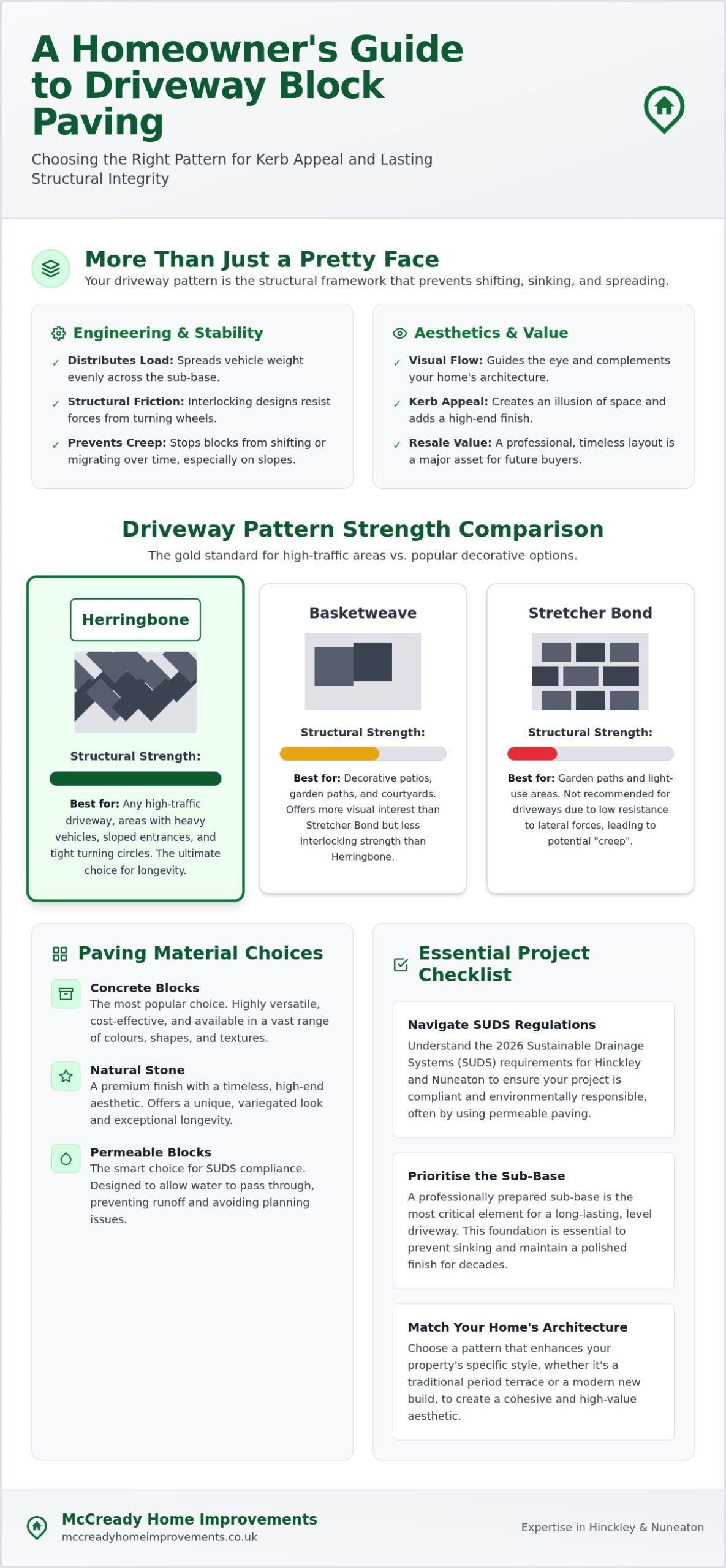
The herringbone pattern is the most resilient layout for high-traffic residential driveways because its interlocking blocks distribute weight evenly and resist shifting. While we discussed the general importance of structural friction in the previous section, herringbone is where that engineering truly comes to life. By laying blocks at alternating angles, we create a jagged, interconnected surface that acts as a single, unified slab. This makes it the gold standard for any homeowner who needs a driveway to withstand the daily pressure of heavy SUVs or multiple vehicles.
When looking at block paving patterns for driveways, strength should always be your priority. In herringbone designs, the blocks are positioned so that no four corners ever meet at a single point. This specific geometry prevents the “creep” or “spread” that often plagues simpler layouts. It’s particularly effective at resisting the lateral forces caused by cars turning their wheels while stationary. If your property has a tight entrance or a shared access point, this is the layout that will keep your blocks exactly where they were laid on day one.
45-Degree vs. 90-Degree Herringbone
The choice between a 45-degree and a 90-degree angle often comes down to the shape of your property. A 45-degree herringbone is widely considered the strongest option because the blocks are set at an angle to the direction of travel. It’s the most complex to lay and requires meticulous cutting at the edges, but it provides the highest level of structural integrity. This makes it the ideal choice for curved Nuneaton driveways where the geometry can be challenging.
A 90-degree herringbone is easier to align with the straight lines of a house or a rectangular plot. While it’s slightly less resistant to shunting forces than the 45-degree version, it’s still significantly stronger than decorative bonds. If you have a long, straight approach to your garage, the 90-degree layout offers a clean, professional aesthetic that’s easier to execute with fewer wasted materials. If you aren’t sure which angle suits your property, you can always view our recent projects to see how these patterns look on local homes.
When to Choose Herringbone
Herringbone is the essential choice for steep drives where gravity and braking forces are constant factors. In the Midlands, many multi-car households deal with limited space, meaning cars are often parked at various angles. This layout handles those multi-directional stresses without breaking a sweat. The aesthetic vibe is undeniably professional and traditional. It signals a driveway that has been built to last, providing peace of mind that your investment is protected by superior craftsmanship.
- High Traffic: Best for households with three or more cars.
- Steep Inclines: Prevents blocks from sliding “downhill” over time.
- Tight Turns: Resists the twisting force of power steering.
Popular Decorative Layouts: Stretcher Bond, Basketweave, and Random Mix
While we’ve established the structural benefits of herringbone, decorative block paving patterns for driveways serve a different purpose. These layouts prioritise clean lines and traditional brickwork aesthetics. They make your entrance feel like a natural extension of your home’s architecture. For homeowners in Hinckley and Nuneaton who prioritise a specific “vibe” over maximum load-bearing interlocking, these decorative options provide a polished and intentional look. They’re particularly effective when used in combination with other styles to create borders or unique focal points.
Choosing the right aesthetic layout requires an understanding of how lines affect the perception of space. A well-placed pattern can guide a visitor’s eye directly to your front door or make a cramped parking area feel more generous. However, it’s important to weigh these visual gains against the practicalities of daily use. Some decorative patterns are better suited to pedestrian paths or low-impact parking zones than they are to the main turning areas of a busy multi-car household.
Stretcher Bond: The Clean, Linear Choice
Stretcher bond, also known as running bond, is the most straightforward of all block paving patterns for driveways. It mimics the classic brickwork found on the walls of most Midlands homes, creating a cohesive and understated look. It’s a fantastic choice for paths and secondary parking areas. If you have a narrow property frontage in Hinckley, laying the blocks in long, parallel lines can visually elongate the space and create a sense of grandeur.
You must be aware of the structural limitations here. Unlike the interlocking herringbone we discussed previously, stretcher bond relies heavily on the quality of the edging. Without professional, heavy-duty kerbing, the blocks are prone to “spreading” or shifting under the weight of a vehicle. We ensure every stretcher bond installation is locked in with a robust perimeter to maintain that crisp, linear aesthetic for the long term. It’s a simple look, but it requires meticulous preparation to stay level.
Basketweave and Circular Features
Basketweave offers a heritage, “cottage” feel that works beautifully for period homes in the Nuneaton area. This pattern involves laying pairs of blocks at right angles to each other, creating a woven appearance. While it’s undeniably charming, it has the lowest structural interlocking of the common patterns. We typically recommend basketweave for flat, decorative areas or garden paths where heavy vehicle manoeuvring is minimal. It provides a vintage texture that concrete or tarmac simply cannot match.
For those with larger, expansive driveways, circular patterns offer a high-end focal point that screams craftsmanship. Integrating a circular feature into a main herringbone drive adds a bespoke touch that sets your property apart. These features require expert precision to ensure every cut is perfect and the drainage remains effective. Whether you’re framing a central tree or simply breaking up a large expanse of paving, a circle adds a layer of sophistication to your home’s entrance.
- Stretcher Bond: Best for visual elongation and matching house brickwork.
- Basketweave: Ideal for period properties and traditional garden aesthetics.
- Circular Features: Perfect for creating a premium focal point on large drives.
- Random Mix: Uses varying sizes for a natural, stone-paved effect.
Matching Paving Patterns to Your Home’s Architecture
Your driveway should feel like a natural extension of your home, not an afterthought that was tacked on at the end of a renovation. When selecting block paving patterns for driveways, the era of your property must guide your choice. A Victorian terrace, a 1930s semi, and a modern new build each require a different approach to colour and layout. For example, using charcoal or grey blocks can instantly modernise a traditional red-brick Midlands home without stripping away its original character. Expertly designed block paved driveways add tangible value precisely because they respect these architectural nuances.
Classic Patterns for Period Properties
Hinckley is home to many beautiful older cottages and period residences that require a delicate touch. Tumbled, ‘aged’ blocks are the perfect fit here. They feature slightly distressed edges that mimic weathered stone. A basketweave pattern in these materials provides a heritage look that feels like it has been there for decades. We often suggest brindle and red tones to match the traditional local brickwork found throughout Leicestershire. Using curved edges instead of sharp angles also helps to soften the transition between the hard landscaping and your garden.
Modern Minimalism for New Builds
For modern developments in Nuneaton, large format blocks and silver-grey palettes are the preferred choice for a contemporary aesthetic. A 90-degree herringbone pattern creates a sharp, architectural finish that complements the clean lines of 21st-century architecture. If you’re looking for a sleek alternative, you might consider a tarmac driveway with border. This combination uses block paving to frame a smooth tarmac surface, offering a high-contrast look that’s both durable and stylish.
The Power of Contrasting Borders
Borders act as the frame for your driveway. They provide the definition that makes the main pattern pop. Using a charcoal border to frame a lighter grey herringbone pattern is a classic technique that never goes out of style. If you want to add a sense of luxury, double borders using two different colours can create a bespoke feel. We frequently use soldier courses, where blocks are laid vertically side-by-side, for their technical strength and their ability to create a clean visual boundary. If you’re ready to see how these designs could work for your property, you can request a free design estimate from our local team.
Planning Your Driveway Transformation in Hinckley & Nuneaton
A successful driveway transformation relies on the elements you can’t see just as much as the blocks on the surface. While we’ve explored the aesthetic variety of block paving patterns for driveways, the long-term performance of your installation depends on a professional sub-base and effective drainage. In the Midlands, we frequently encounter heavy clay soil that requires specific handling. Without a correctly compacted foundation, even the most beautiful herringbone layout will eventually succumb to the pressure of vehicle weight, leading to ruts and shifting blocks.
Our process at McCready Home Improvements is designed to eliminate these risks. We begin with a detailed local site survey to assess your property’s specific ground conditions. From the initial excavation to the final sweep of kiln-dried sand into the joints, we manage every stage with precision. Homeowners across Hinckley and Nuneaton trust our local expertise because we treat every project with the care of a personal residence, ensuring a durable result that stands up to the British weather.
Drainage and Local Planning Regulations
Navigating planning permission is a common concern for homeowners. Since 2008, UK law requires driveways over 5 square metres to have a drainage solution. This regulation ensures that surface water is handled naturally within your property boundary rather than overwhelming local sewer systems. To stay compliant with SUDS (Sustainable Urban Drainage Systems), we often recommend permeable paving or the installation of professional soakaways. This approach prevents standing water and ensures your project meets all national and local requirements without the need for a formal planning application.
Why Professional Installation Trumps DIY
The technical demands of complex block paving patterns for driveways, such as the 45-degree herringbone, make professional installation a necessity. Achieving a perfectly level finish on a sloping site requires advanced laser-levelling equipment and years of experience. DIY attempts often struggle with the heavy clay soil found in parts of Nuneaton; it requires industrial-grade compaction to prevent future settlement. We provide a project-managed service that handles these technical challenges, giving you total peace of mind that your investment is structurally sound.
Next Steps: Getting Your Quote
Preparing for your driveway renovation is simple. We recommend taking a few rough measurements of your current entrance and saving any inspiration photos that catch your eye. This helps us understand your vision during our site visit. As a local family-run business, we take pride in offering a straightforward, honest service. We’ll provide a clear breakdown of the work required to achieve your desired look and structural goals. Contact McCready Home Improvements for your free block paving quote today and take the first step toward a high-kerb-appeal entrance that lasts.
Transforming Your Entrance with Confidence
Selecting the right block paving patterns for driveways is a significant step in enhancing your property’s value and functionality. You now understand how herringbone provides the structural backbone for heavy use and how decorative layouts can perfectly complement your home’s unique era. Whether you’re modernising a red-brick semi or restoring the charm of a period cottage, the final result depends on meticulous planning and expert execution.
Our team brings deep local knowledge of Midlands ground conditions to every project. We ensure your sub-base is as robust as the surface is beautiful. As specialists in high-quality block paving and tarmacadam borders, we’re ready to help you navigate the latest drainage requirements and choose a layout that stands the test of time. We take pride in delivering a polished finish that provides lasting peace of mind.
Book Your Free Driveway Design Consultation in Hinckley & Nuneaton today for a free, no-obligation quote with expert design advice. We look forward to partnering with you to create a high-kerb-appeal entrance that you’ll be proud of for decades to come.
Frequently Asked Questions
Which block paving pattern is the strongest for a driveway?
The 45-degree herringbone pattern is the strongest layout for any driveway. Its interlocking design ensures that the weight of vehicles is distributed across the entire surface rather than individual blocks. This specific geometry resists the shunting forces caused by tyres turning while stationary. It’s the most reliable choice for multi-car households in Hinckley and Nuneaton where durability is the priority.
Do I need planning permission for a block paved driveway in Hinckley?
You won’t usually need planning permission if your driveway is made of permeable materials or includes a drainage system that handles water within your property boundary. UK law requires any new or replacement driveway over five square metres to have a SUDS-compliant drainage solution. We always check local nuances for Leicestershire and Warwickshire to ensure your installation meets all current 2026 standards without legal issues.
What is the best colour for block paving to hide dirt?
Brindle and multi-tonal charcoal blocks are the most effective colours for hiding tyre marks and general road dirt. These variegated shades blend different tones together, making small stains or dust less visible than on a solid, light-coloured surface. Many Midlands homeowners choose charcoal or grey borders to frame their driveways, as these darker edges naturally resist the appearance of wear and tear over time.
Can you lay block paving in a circular pattern?
Yes, we can integrate circular patterns to create a high-end focal point on larger driveways. These features require precision cutting and expert placement to maintain structural integrity and proper drainage. While a circle is largely decorative, it can be combined with a robust herringbone main pattern to provide a bespoke look that sets your property apart from the rest of the street.
How long does it take to install a block paved driveway?
A standard double driveway usually takes between five and seven working days to complete from start to finish. This timeframe includes the essential excavation, the installation of a compacted sub-base, and the final application of kiln-dried sand. Larger projects or those with complex block paving patterns for driveways may take slightly longer, but we always provide a clear project schedule during our initial site visit.
What is the difference between 45-degree and 90-degree herringbone?
The primary difference lies in the orientation of the blocks relative to the direction of travel and the house. A 45-degree pattern is the strongest because the blocks are set at an angle that best resists the forces of braking and turning. The 90-degree version is often easier to align with the straight lines of a modern property, though it offers slightly less structural friction than the 45-degree layout.
How do I stop weeds from growing in my block paving patterns?
Weeds don’t actually grow from beneath the blocks if the sub-base is installed correctly; they sprout from seeds that land in the sand joints. To prevent this, we use high-quality kiln-dried sand and recommend applying a professional sealant after the initial installation. Regular sweeping and occasional top-ups of jointing sand will keep your block paving patterns for driveways looking clean and weed-free for years.
Is block paving better than tarmac for a Midlands home?
Both materials have distinct advantages for Midlands properties. Block paving offers superior kerb appeal and is easier to repair if you ever need to access underground pipes or cables. Tarmac is a highly durable and cost-effective solution for larger areas. Many homeowners choose a combination, such as a tarmac main drive with block paving borders, to get the perfect balance of longevity and style.
