
The most expensive driveway choice today might actually be the cheapest one you ever buy. When you weigh up block paving vs tarmac pros and cons, it’s easy to focus on the immediate quote rather than the twenty-year result. You want a surface that stands up to the unpredictable Midlands weather without cracking in a summer heatwave or becoming a haven for weeds. Whether you’re modernising a new build or restoring a period property, the right choice ensures your home makes a lasting first impression while remaining functional for decades.
It’s frustrating to invest in a major home improvement only to worry about surface “melting” in July or constant maintenance. We understand that you need a balance of aesthetic polish and rugged durability that adds genuine value to your property. This guide provides a definitive comparison of the UK’s two most popular materials to help you choose the perfect match for your lifestyle. We’ll explore lifespan, maintenance requirements, and the latest 2026 drainage regulations to ensure your new driveway is a stress-free investment that stands the test of time.
Key Takeaways
- Understand the fundamental block paving vs tarmac pros and cons to determine whether the high-end design of pavers or the cost-effective speed of tarmac suits your property’s needs.
- Discover how your home’s architectural era, from traditional Victorian to contemporary new builds, dictates which material provides the best curb appeal.
- Learn about the “McCready Hybrid” approach, a professional technique that combines tarmac’s value with decorative block paving borders for a bespoke finish.
- Evaluate the long-term maintenance requirements of each surface, including how to prevent weed growth and manage surface integrity over two decades.
- Compare the upfront investment against the potential resale value to make a confident, reliable decision for your specific budget.
The Great Driveway Debate: Understanding Tarmac and Block Paving
Choosing a new driveway is a significant investment for any Midlands homeowner. Understanding the block paving vs tarmac pros and cons starts with knowing exactly what you’re putting under your tyres. These two materials have dominated the UK market for decades, but the technology behind them continues to evolve. In 2026, the choice usually comes down to a balance between bespoke aesthetics and practical, hard-wearing performance.
Block paving consists of individual bricks or blocks made from concrete or clay. These are laid in specific patterns, such as herringbone or basketweave, on a meticulously prepared bed of sharp sand. This creates a flexible surface that can move slightly without cracking. Tarmac, or tarmacadam, is a different beast entirely. It is a mixture of crushed stone and a bituminous binder. To understand the technical composition and what tarmac is made of, you have to look at how it creates a durable, flexible crust that is laid hot and levelled to a smooth finish. Both materials require a high-quality sub-base of compacted Type 1 MOT stone. Without this foundation, any driveway will eventually sink, regardless of the surface material.
Why Driveway Choice Matters for Property Value
In local markets like Hinckley and Nuneaton, first impressions are everything. A driveway isn’t just a place to park; it’s the frame for your entire home. A professionally installed entrance suggests a property that has been maintained with care and attention to detail. This “curb appeal” can have a tangible impact on resale value. Prospective buyers often form an opinion before they even step through the front door. A clean, well-edged driveway provides immediate confidence in the structural integrity of the rest of the residence.
This emphasis on quality is a standard shared by reputable specialists; for instance, Oxford Driveways And Roofing Ltd. focuses on these same principles of durability and aesthetic appeal to help homeowners maximize their property’s value.
The Role of SUDs and Drainage Regulations
Modern driveway installation is governed by Sustainable Urban Drainage Systems (SUDs) regulations. Since 2008, UK law has been strict about surface water runoff to prevent local flooding. If your driveway is larger than five square metres, you must ensure water drains into a permeable area within your property boundaries. Block paving can be installed with permeable gaps to allow water to soak through naturally. Standard tarmac is non-permeable, which means we must design and install integrated drainage channels or soakaways to remain compliant. Getting this wrong doesn’t just cause puddles; it can lead to legal issues with the local council if you don’t have the correct planning permission.
The Aesthetic Appeal and Durability of Block Paving
When you weigh up block paving vs tarmac pros and cons, the visual impact of paving is often the biggest selling point. It is a premium choice that offers a level of customisation other materials simply can’t match. Every block is laid by hand. While this manual process contributes to higher initial labour costs compared to machine-laid surfaces, the result is a bespoke finish that reflects your personal style. A professionally installed block paved driveway doesn’t just look good; it’s a long-term asset with a lifespan of 25 years or more.
The “weed” objection is a common concern for homeowners. In the past, gaps between bricks were prone to unwanted growth. Modern installation techniques have solved this. We use specialised kiln-dried sand or polymeric jointing compounds that create a firm, resilient barrier. This significantly reduces the opportunity for seeds to take root. It keeps your driveway looking sharp and clean with minimal effort. It’s a smart, durable solution for busy Midlands households who want maximum curb appeal without constant weeding.
Design Versatility: Herringbone, Stretcher, and Borders
Your choice of pattern isn’t just about the look. It’s about structural integrity. A 45-degree herringbone pattern, for example, provides superior interlock between the blocks. This makes it the best choice for driveways handling heavy SUVs or multiple family cars because it spreads the weight more effectively. You can also use contrasting borders to frame the main area or highlight the architectural lines of your property. If you’re looking for inspiration on colours and textures, our buying guide for block paved driveways covers the most popular 2026 trends for local homes.
Maintenance and Individual Block Replacement
One of the most practical pros of block paving is its modular nature. If you ever need to access underground utilities like water pipes or internet cables, we can lift individual blocks and relay them once the work is finished. This is impossible with a continuous surface like tarmac. To keep the structure stable, you’ll need to top up the jointing sand every few years. Applying a high-quality sealant also helps. It protects against oil stains and inhibits moss growth, ensuring the colours remain vibrant for decades. If you want a driveway that grows with your home, we can help you design a custom block paving installation that stands the test of time.
Why Tarmac Remains a Practical Powerhouse for UK Driveways
While block paving is often praised for its intricate patterns, tarmacadam remains a dominant force for a reason. It is the practical choice for homeowners who value efficiency and a clean, understated finish. One of the most significant advantages of tarmac is the speed of installation. Unlike the manual, stone-by-stone process of paving, tarmac can often be laid and levelled in a fraction of the time. For many Midlands families, this means less disruption to daily life and a driveway that is ready for use much sooner. When evaluating block paving vs tarmac pros and cons, the immediate cost-effectiveness of tarmac for large surface areas is a factor that simply cannot be ignored.
The smooth, seamless finish of a modern tarmac driveway offers practical benefits that go beyond just aesthetics. It provides a perfectly level surface that is ideal for children playing on scooters or for households that require the use of mobility aids and prams. There are no gaps for wheels to catch on and no trip hazards from slightly settled blocks. Modern tarmacadam has also come a long way in terms of durability. High-quality bituminous binders used in 2026 are designed to withstand the UK’s increasingly fluctuating temperatures. This prevents the surface from becoming too soft in the summer or brittle during a harsh Midlands frost.
The Evolution of Tarmac: Beyond Basic Black
The common “con” associated with tarmac is a perceived lack of style. However, the days of being restricted to basic black are over. Red tarmac is a popular alternative that adds a warm, traditional feel to a property without the price tag of clay pavers. You can also significantly elevate the look of a standard black surface by adding a decorative border. Using block paving edges to frame a tarmac centre provides a high-end, bespoke appearance. It creates a crisp, professional finish that complements both modern and period homes while maintaining the practical benefits of a smooth surface.
Resurfacing vs. Full Excavation
Tarmac offers a unique advantage when it comes to renovation. If your existing driveway foundation is still structurally sound and free from major subsidence, we can often perform a “resurfacing” or overlay. This involves laying a fresh layer of tarmac over the old one. It is a fantastic way to achieve an instant transformation at a lower cost than a full “dig-out.” For long, winding rural drives in areas like Hinckley and Nuneaton, this approach is often the most sensible way to maintain a massive surface area. If the sub-base has failed, a full excavation is necessary to ensure the new surface lasts its intended 15 to 20 years.
Head-to-Head: Cost, Maintenance, and Long-Term Value
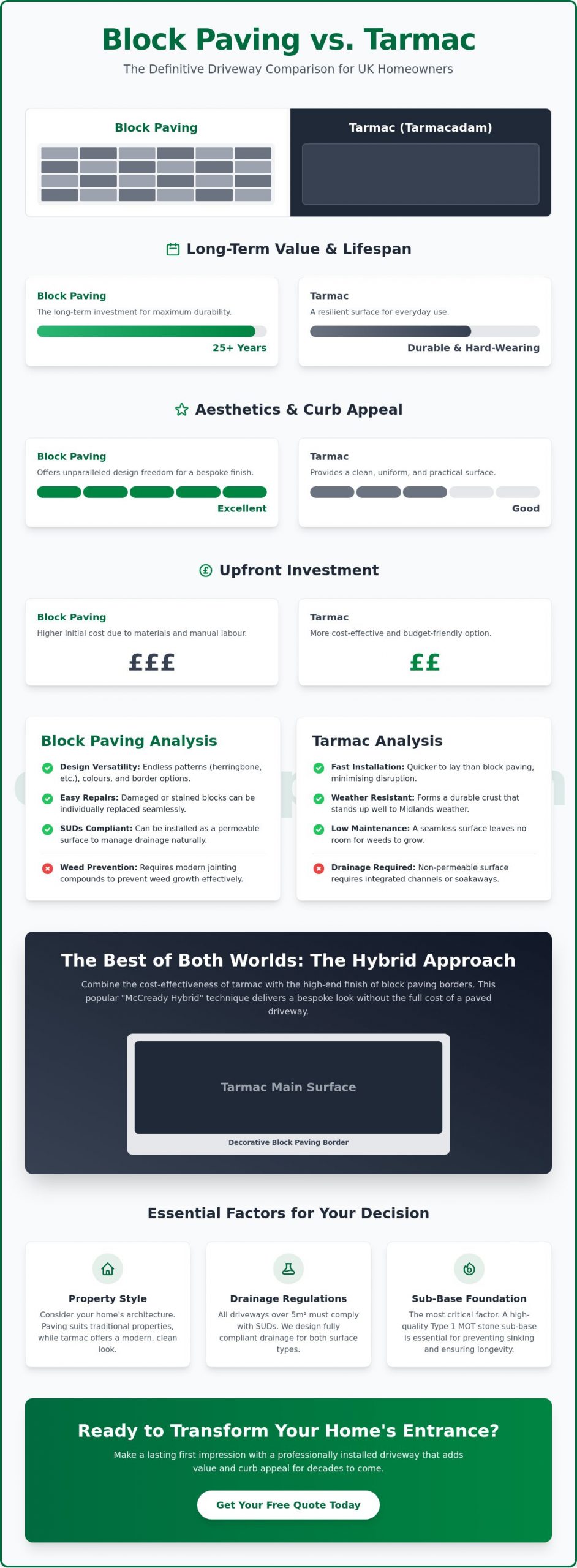
Choosing between these materials often comes down to a simple question: do you want to save money now or save effort later? When we break down the block paving vs tarmac pros and cons, the upfront investment is usually the first hurdle. Tarmac is almost always the more budget-friendly option initially because it requires less manual labour to install. However, block paving typically offers better long-term value. While a tarmac driveway might last 15 to 20 years with proper care, a well-laid block paving surface can easily exceed 25 years. This longevity, combined with the ability to replace individual blocks rather than patching the whole area, often makes it the more resilient choice for a family home.
Maintenance is a trade-off. Paving requires you to stay on top of weeding and occasional re-sanding to keep the structure sound. Tarmac is lower maintenance in the early years but requires a professional reseal every few years to prevent the surface from drying out and cracking. If a tarmac driveway does crack or need a repair, the patch is usually visible. With block paving, we can lift and replace specific bricks so the repair is completely invisible, maintaining that polished look indefinitely. This “repairability” factor is a massive benefit if you ever have a minor oil spill or need to fix a small sunken area.
The “Clay Soil” Factor in Hinckley and Nuneaton
Local ground conditions play a massive role in how your driveway performs over time. Much of Hinckley and Nuneaton sits on heavy clay soil. This type of earth is prone to significant expansion and contraction during seasonal weather shifts. For a tarmac driveway, this movement can lead to surface ripples or “heaving” if the sub-base isn’t deep and robust enough. Block paving is often more forgiving in these conditions. The individual blocks and sand joints allow for a tiny amount of natural movement without the surface splitting. We always recommend a professional site survey to ensure your sub-base is engineered specifically for the Leicestershire clay.
Long-Term ROI: Resale Value and Appeal
If you’re planning to sell your home in the next decade, block paving often carries more weight with estate agents. It’s perceived as a premium upgrade that adds significant curb appeal. However, tarmac is the clear winner for larger properties or long rural drives where the cost of paving would be prohibitive. Over a 10-year period, the cost of ownership for both materials is surprisingly similar when you factor in repairs and maintenance. For an expert opinion on which material suits your specific plot, you can book a professional driveway assessment with our local team.
Making the Right Choice for Your Property in Hinckley & Nuneaton
Your home’s architectural era is often the best starting point for your final decision. Victorian and Edwardian properties across Hinckley typically demand the texture and character of block paving. It mirrors the intricate brickwork of period architecture and maintains the historical integrity of the street. Conversely, for modern new builds in Nuneaton, the clean, minimalist lines of a tarmac surface offer a sharp finish that complements contemporary design. When you weigh up the block paving vs tarmac pros and cons, remember that your driveway should feel like a natural extension of your residence, not an added-on afterthought.
Choosing a local specialist is vital because they understand the specific challenges of the Midlands landscape. From managing the local clay soil to ensuring every project meets the latest 2026 drainage requirements, a local expert ensures your investment is legally compliant and structurally sound. Before you request a quote, use this final checklist to narrow down your needs:
- Does your house style suit a traditional pattern or a modern, smooth finish?
- Do you need a dropped kerb application from the local highways authority?
- Is the area larger than five square metres, requiring a SUDs-compliant drainage plan?
- Will the driveway need to support heavy vehicles, necessitating a reinforced sub-base?
The Hybrid Solution: Best of Both Worlds
Many homeowners find themselves torn between the premium look of pavers and the practical value of tarmac. We often recommend a “hybrid” approach to bridge this gap. By installing a high-quality tarmac centre framed by a decorative block paving border, you achieve an “expensive” bespoke look while keeping the core costs manageable. This combination provides superior edge restraint, which prevents the tarmac from fraying or cracking at the boundaries. It’s a smart way to get the design flexibility of paving and the speed of tarmac in one project. You can explore our tarmacadam driveway services to see how this layout elevates local homes.
Why McCready is the Midlands’ Trusted Choice
We’re a dedicated, family-run business that takes immense pride in every project we undertake. We don’t believe in cutting corners, especially when it comes to the meticulous site preparation that ensures your driveway lasts 20 years or more. Our team treats your property with the respect of a personal residence, focusing on the small details that create a polished, high-end result. We’re proud to be a reliable partner for Hinckley and Nuneaton residents, providing free, no-obligation estimates that help you make an informed choice without any sales pressure. We believe in honest work and long-term community relationships, ensuring your new driveway provides total peace of mind from the first day of excavation to the final sweep of the brush.
Transform Your Midlands Home Entrance Today
Deciding on the right driveway material depends on balancing your property’s architectural style with your daily practical needs. We’ve weighed the block paving vs tarmac pros and cons to help you see that both options offer distinct advantages for the Midlands climate. While block paving provides a premium, modular finish that often lasts over 25 years, tarmacadam remains a powerhouse for speed and cost-effectiveness. The secret to a successful installation always lies in the meticulous groundwork and a deep understanding of local soil conditions.
Our expert local team brings decades of Midlands experience to your project. We are specialists in both high-quality tarmacadam and intricate block paving, treating every property with the respect it deserves. We offer free site surveys and transparent, fixed-price quotes to provide you with total peace of mind. Your home is your most valuable asset; it deserves a professional finish that stands the test of time. Get your free, no-obligation driveway estimate in Hinckley or Nuneaton today. We look forward to helping you evolve your property with a result you’ll love for years.
Frequently Asked Questions
Is block paving or tarmac cheaper per square metre?
Tarmac is typically the more cost-effective choice per square metre for the initial installation. This price advantage exists because tarmac can be laid quickly using specialized machinery, whereas block paving requires each stone to be positioned by hand. However, for very small driveways, the cost difference often narrows because the fixed expenses of bringing heavy tarmac equipment to a site remain the same regardless of the area size.
How long does a tarmac driveway last compared to block paving?
A professionally installed tarmac driveway usually lasts between 15 and 20 years before it requires significant renovation. In contrast, high-quality block paving can easily last 25 years or more if maintained correctly. This longer lifespan is a vital factor when weighing up block paving vs tarmac pros and cons, as the durability of paving often offsets its higher initial investment over two decades of use.
Do I need planning permission for a new tarmac or paved driveway?
You won’t usually need planning permission if your new driveway uses a permeable surface or ensures water drains into a lawn or border within your property. These rules follow the Sustainable Urban Drainage Systems (SuDS) regulations. If you install non-permeable tarmac and the water runs directly onto a public road, you must apply for planning permission from your local Midlands council to ensure local drainage systems aren’t overwhelmed.
Which driveway surface is best for steep slopes?
Tarmac is often the superior choice for steep inclines because it creates a single, continuous bonded surface. This provides excellent grip and prevents the individual movement that can occasionally occur with blocks under the heavy pressure of a vehicle braking on a hill. While a herringbone block pattern offers great interlock, tarmac remains the most stable and practical option for the most challenging Midlands gradients.
Can you lay block paving over an existing tarmac driveway?
While laying blocks over old tarmac is technically possible, we generally advise against it for long-term reliability. Any hidden cracks or soft spots in the old tarmac will eventually cause the new paving to sink or shift. It also raises the height of your driveway, which can interfere with your home’s damp proof course or garage thresholds. A full excavation ensures a stable, guaranteed foundation for your project.
How do I prevent weeds from growing in my block paving?
Preventing weeds starts with using high-quality kiln-dried sand or modern polymeric jointing compounds that harden to block out seeds. Most weeds actually grow from seeds falling into the joints from the air rather than pushing up from the soil. Regular sweeping and applying a professional sealant every few years will keep the joints firm and significantly reduce the opportunity for moss or weeds to take root.
Does a tarmac driveway add as much value as block paving?
Block paving is typically perceived as a premium upgrade and often adds more immediate curb appeal to a standard residential home. It suggests a higher level of craftsmanship to potential buyers. Tarmac is still a valuable asset, especially for larger properties where a neat, smooth finish is preferred, but it rarely commands the same price premium as a bespoke patterned brick installation in the Leicestershire market.
How long do I have to wait before driving on a new tarmac surface?
You should wait at least 48 hours before driving a vehicle onto a fresh tarmac surface. In very hot summer weather, it’s wise to wait even longer as the bitumen takes more time to fully cool and harden. While walking on the surface is fine after a few hours, turning car wheels while stationary can scuff the new material before it has completely cured and reached full strength.
