
In the UK’s notoriously damp climate, a roof doesn’t just fail during a single dramatic storm; it often fails through invisible ageing-out that turns minor leaks into expensive structural rot. You’ve likely spent time staring at a persistent damp patch on the upstairs ceiling, wondering if a few replaced tiles will fix the issue or if you’re facing a much larger project. It’s completely normal to feel overwhelmed by technical jargon like flashing or EPDM, especially when you’re worried about being overcharged for work you might not actually need. Understanding the specific signs you need a new roof UK weather conditions cause is the first step toward regaining your peace of mind.
We know you want to protect your home without the stress of unreliable contractors or hidden costs. This guide identifies the critical warning signs that your roof is failing and explains exactly when to choose a repair over a full replacement. We will walk you through the non-negotiable failure signs, the lifespan of common UK materials, and how the 2026 Future Homes and Buildings Standards affect your insulation requirements. By the end, you’ll have a clear roadmap for your project and the confidence to partner with a local roofer who treats your property with the respect it deserves.
Key Takeaways
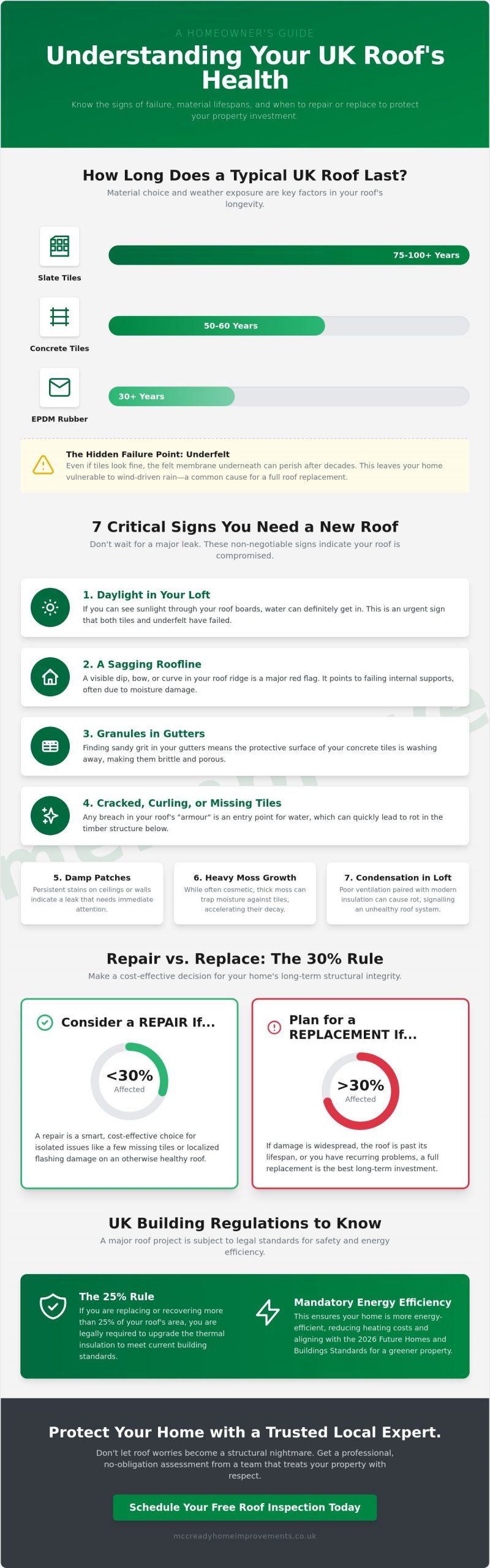
- Learn the typical lifespan of UK roofing materials, from 100-year slate to 50-year concrete tiles, to determine if your property is overdue for an upgrade.
- Use our comprehensive checklist to identify the non-negotiable signs you need a new roof UK, including daylight visible in your loft or a sagging roofline.
- Apply the 30% rule to decide if a quick repair is a smart investment or if a full replacement is more cost-effective for long-term structural integrity.
- Understand your legal obligations under UK Building Regulations, including the 25% rule and mandatory thermal insulation upgrades for major projects.
- Discover why partnering with a local specialist in Hinckley or Nuneaton provides better reliability and accountability than national call-centre alternatives.
How Long Does a Typical UK Roof Last?
The average lifespan of a UK roof depends heavily on the materials used and its exposure to our unpredictable weather. While your home feels like a permanent sanctuary, its most vital protection has a finite shelf life. Understanding how long a roof lasts helps you plan for the future and avoid the panic of a sudden failure. Traditional slate roofs are the gold standard, often lasting 75 to 100 years. Modern concrete tiles typically reach 50 to 60 years before they require significant attention. For flat extensions, EPDM systems have revolutionised longevity, often providing 30 years or more of reliable service.
There is a clear tipping point in every roof’s life. This is the moment where ongoing maintenance costs begin to exceed the actual value of a replacement. If you’re constantly paying for minor repairs, you might be throwing good money after bad. Recognising the signs you need a new roof UK homeowners often miss is essential for protecting your property’s structural integrity and long-term value.
Understanding Material Lifespans in the Midlands
In areas like Hinckley and Nuneaton, the local environment plays a massive role in wear and tear. Clay tiles are beautiful; however, they can be more susceptible to the UK’s frost-thaw cycle than their concrete counterparts. Concrete tiles handle these temperature swings well, though they eventually become porous after several decades of service.
The real hero of your property is often the material you can’t see: the underfelt. Even if your tiles look perfect, the felt beneath can perish over decades. This leaves your home vulnerable to wind-driven rain. High winds in the Midlands can lift older tiles, putting immense pressure on these hidden layers. We often find that while the tiles are salvageable, the perished felt underneath necessitates a full strip and recover to ensure the building remains watertight.
When Does an ‘Old’ Roof Become a ‘Failing’ Roof?
It’s easy to confuse cosmetic issues with structural failure. Moss growth is common and often harmless, but if it’s trapping moisture against degrading tiles, it becomes a problem. Once a roof hits the 25-year mark, it deserves a professional inspection. Even if it looks fine from the street, internal components may be reaching the end of their functional life.
Modern energy efficiency standards add another layer of complexity. If you’ve recently upgraded your loft insulation to meet 2026 standards, you’ve changed how your roof breathes. Older roofing ventilation systems weren’t designed for this level of heat retention. This can lead to condensation and rot in the timber structure, which are clear signs you need a new roof UK experts look for during a thorough assessment. We treat every property with the respect of a personal residence, ensuring your ventilation matches your insulation for a healthy, long-lasting home.
7 Critical Signs You Need a New Roof: The Homeowner’s Checklist
Identifying the signs you need a new roof UK weather has caused shouldn’t wait until you’re placing buckets in the hallway. Some indicators are subtle, while others are immediate calls to action. We believe in providing homeowners with the knowledge to spot these issues before they escalate into structural damp or timber rot. Here are the non-negotiable failure signs that suggest your home’s primary protection is compromised.
Daylight visible through your loft boards is perhaps the most urgent warning. If sunbeams are piercing through the roof structure, water definitely follows. This suggests the external tiles and the internal felt have both failed. Similarly, a sagging roofline is a major red flag. If you stand across the street and notice a dip or curve in the ridge, it often indicates that the internal supports are failing or the roof has been overloaded with moisture-heavy materials.
Check your gutters for more than just leaves. If you find a build-up of sandy granules, your concrete tiles are literally washing away. These granules provide the UV protection for your tiles; once they’re gone, the tiles become brittle and porous. Finally, look for curling, cracking, or missing tiles. These are the armour of your home, and any gap allows the elements to begin attacking your property’s wooden bones.
Internal Red Flags: What Your Attic is Telling You
Your loft is a diagnostic tool for your home’s health. Tracing damp patches can be tricky, as they don’t always appear directly under the leak. You must distinguish between a roof failure and poor ventilation, which often causes surface-level condensation. Look for ‘Dark Spots’ on the rafters, as these indicate active rot that requires immediate intervention. To find elusive pinhole leaks in the underfelt, turn off the loft lights during a sunny day and use a high-powered torch to scan the felt for any glints of light or water stains. If the damage is extensive, you may need to consider professional roof repairs to secure your home.
External Visual Cues: Assessing Damage from the Ground
The most common cause of ‘repairable’ leaks is damaged flashing around chimneys and valleys. These lead or metal seals are vital, and any lifting or cracking creates a direct path for water. While a bit of moss is cosmetic, widespread growth can lead to ‘blown’ tile faces during the frost-thaw cycle. This biological growth holds moisture against the tile, accelerating degradation.
Always check the condition of your fascias and soffits. These boards support the guttering and provide essential ventilation. If they appear rotten or are pulling away from the building, it’s often a sign of wider drainage issues. All roofing work must adhere to UK Building Regulations to ensure structural safety and long-term reliability. Recognising the signs you need a new roof UK properties display helps you stay ahead of costly damage and maintain the polished nature of your final result.
The Repair vs. Replace Dilemma: Making the Right Financial Choice
Every homeowner eventually faces the same difficult question when a leak appears: do I patch the problem or start over? Identifying the signs you need a new roof UK weather has left behind is only half the battle; the other half is deciding how to spend your budget effectively. We use the 30% Rule as a professional benchmark to help our clients make this choice. If the cost of your repairs exceeds 30% of the price of a full replacement, investing in a new system is usually the wiser financial move. Continuing to patch an ageing structure often leads to a ‘patchwork’ effect. This is where new, heavy materials pull against old, brittle ones, which can weaken the overall structural integrity of your home.
Beyond the immediate invoice, you should consider the peace of mind factor. A new roof eliminates the persistent anxiety that accompanies every winter storm. In the 2026 UK property market, a certified new installation significantly boosts home value. Buyers are increasingly wary of ageing properties with potential maintenance backlogs. A replacement acts as a powerful selling point that guarantees a dry home for decades. It’s a proactive step that transforms your property from a liability into a high-quality asset.
When a Repair is Sufficient
Sometimes, the signs you need a new roof UK homeowners worry about are actually just isolated issues that don’t require a total overhaul. A single high-wind event might displace a few tiles or damage a small section of ridge capping without compromising the whole system. Minor flashing problems around a chimney or a valley are often quick fixes that can save you thousands if you catch them early. We believe in honest, hardworking advice, which is why we’ve developed the essential homeowner’s checklist for roof repairs in Leicester 2026 to help you identify these manageable tasks. If the rest of the roof is in good health, a targeted repair is a perfectly valid way to extend its lifespan.
When a Full Replacement is Unavoidable
There are moments when a repair is simply a temporary sticking plaster on a major wound. If you find multiple leaks appearing in different rooms, your underfelt has likely perished throughout the entire structure. As we discussed earlier, structural sagging or daylight in the loft are non-negotiable indicators that the bones of the roof are failing. Upgrading to modern new roof installations is a long-term investment in your home’s thermal efficiency. This ensures your property meets the 2026 energy standards while providing a polished, professional finish that protects your family for the next fifty years.
UK Building Regulations and the Hidden Costs of Delay
Delaying a major project often feels like a way to save money in the short term. In reality, it usually leads to much higher expenses down the line. If you ignore the signs you need a new roof UK weather has exposed, you risk secondary damage to your home’s structure. Damp seeps into the rafters, leading to timber rot that requires expensive chemical treatments. It also destroys bedroom ceilings, adding the cost of plastering and decorating to your initial roofing bill. Insurance providers are also increasingly strict. If they determine that a leak was caused by general wear and tear on a roof that was already past its prime, they may refuse to pay out for any internal damage.
This financial risk extends to the efficiency of your home. A failing roof is often a poorly insulated one. By the time you notice damp patches, you’ve likely already spent hundreds of pounds on wasted heating. We believe in proactive maintenance that treats your property with the respect of a personal residence, ensuring you avoid the mounting costs of inaction.
Navigating Planning Permission and Building Control
Many homeowners don’t realise that major roofing work is subject to legal oversight. If you are replacing more than 25% of your roof’s surface area, you must notify your local Building Control department. This ensures the work meets current safety and efficiency standards. It’s vital to work with a contractor who understands the specific requirements of councils in the Midlands, such as Hinckley and Bosworth or Nuneaton and Bedworth. Under UK Building Regulations, if you renovate more than 25% of a roof’s surface, you are legally obligated to inform your local authority to ensure the structure remains safe and compliant.
The Cost of Inaction: Damp, Rot, and Mould
A small leak in October can easily become a full-blown structural crisis by February. The high humidity of the UK winter means that once water enters your loft, it rarely dries out. This creates the perfect environment for black mould, which poses genuine health risks to your family. Recognising the signs you need a new roof UK properties exhibit helps avoid these secondary costs. Beyond health, there’s the financial impact on your EPC rating.
A new roof allows you to meet the 2026 Thermal Upgrade rule. If you replace more than 50% of the roof, you must upgrade insulation to a U-value of 0.16 W/m²K for pitched roofs. With 0% VAT on insulation until March 31, 2027, acting now is a smart financial move that lowers energy bills. If you’re worried about your home’s protection, we can provide expert new roof installations that meet all current legal standards and provide long-term peace of mind.
Choosing a Professional Roofing Partner in Hinckley and Nuneaton
Once you’ve identified the signs you need a new roof UK weather has created, the next step is finding a partner you can trust. Choosing a local specialist in Hinckley or Nuneaton is about more than just proximity; it’s about accountability. National call-centre roofing companies often outsource their labour to the lowest bidder, which can leave you with little recourse if issues arise later. A local business relies on its reputation within the Midlands community. We treat every property with the respect of a personal residence because we live and work in the same streets as our clients. This local connection ensures we are deeply invested in the final outcome of every project.
When you’re comparing quotes, always look for a detailed written breakdown rather than a vague verbal estimate. Transparency is the hallmark of a professional. You should check for valid insurance and ask to see previous work in the local area. A reliable contractor will be proud to show you their portfolio, demonstrating a high-level skill and a commitment to aesthetic excellence. We believe in building immediate trust through reliable, experienced communication that makes the project process feel manageable and stress-free.
What to Look for in a Local Roofer
Avoid ‘doorstep’ roofers who appear after a storm with quotes that seem too good to be true. These are major red flags that often lead to substandard work and hidden costs. A reputable roofer will have a visible presence in your neighbourhood. You might have already seen our work on local block paved driveways or recent roof replacements. Always ask about the specific brands of tiles or EPDM systems being used. High-quality materials are essential for the longevity and polished nature of the final result.
The McCready Approach: Quality You Can Trust
We balance expert craftsmanship with a friendly, local service that focuses on the peace of mind provided to the client. Whether you need a full re-roof or expert roof repairs, we position ourselves as a proactive and capable partner. We understand that a roofing project can be disruptive. Our ‘Total Solution’ promise means we handle everything from the initial design and scaffolding to the final site clearance. This meticulous care ensures a steady and reassuring rhythm to the work, mirroring the progression of a well-managed project.
We take clear pride in our work, focusing on long-term community relationships rather than quick wins. If you’ve noticed the signs you need a new roof UK homeowners should never ignore, it’s time to act to protect your property’s value. Get your free roofing estimate from McCready Home Improvements today and let us help you secure your home for the future.
Protect Your Home and Your Investment
Your roof is the single most important barrier between your family and the unpredictable British elements. By identifying the critical signs you need a new roof UK weather has left behind, you’ve taken the first step toward securing your property’s future. We’ve discussed how to apply the 30% rule to your finances and the importance of staying compliant with 2026 Building Regulations. Taking action now prevents the secondary costs of timber rot and damp, ensuring your home remains a polished and safe sanctuary.
Our expert team is based right here in Hinckley, specializing in everything from traditional tile work to modern EPDM systems. We take immense pride in our comprehensive property maintenance, handling projects from high-quality roofs to block paving driveways with meticulous care. We are ready to partner with you to ensure your home’s evolution is managed with professional skill and a personal touch. Book your free, no-obligation roof health check with McCready Home Improvements to get a clear, honest assessment of your home’s most vital protection. Let’s work together to give you total peace of mind for the years ahead.
Frequently Asked Questions
How much does a new roof cost in the UK for 2026?
Total costs for a replacement vary significantly based on the property size, chosen materials, and site complexity. While industry averages provide a broad baseline, every project requires a bespoke assessment to account for current material availability and labour rates. Factors such as the roof pitch and the need for structural repairs also influence the final investment. We recommend checking with local specialists who can provide a detailed, written quote tailored to your specific home.
Can I just lay new tiles over my old ones to save money?
No, you should never lay new tiles over old ones because it adds excessive weight and hides underlying structural issues. This practice, often called overlaying, puts immense stress on your rafters and can lead to a collapse. It also prevents the inspection of the underfelt, which is often where the real signs you need a new roof UK homeowners miss are located. A full strip and recover is the only way to ensure a watertight, professional finish.
How long does it actually take to replace a roof on a standard semi-detached house?
A standard semi-detached house usually takes between five and ten working days to complete, depending on the weather. This timeline includes the initial scaffolding setup, stripping the old materials, and installing the new system. Complex roofs with multiple valleys or chimney work may take slightly longer. We manage every step of the process to ensure the rhythm of the work remains steady and minimizes disruption to your daily life.
Does a new roof always require scaffolding?
Yes, scaffolding is almost always a legal and safety requirement for any significant roofing project in the UK. It provides a stable platform for our team to work efficiently and ensures we comply with health and safety regulations. Scaffolding also protects your property and the public from falling debris. While it adds a temporary visual impact to your home, it is a non-negotiable part of delivering a high-quality and safe installation.
Is it possible to replace a roof in the winter, or should I wait for summer?
You can replace a roof at any time of year, provided the weather is dry and safe for the team. We monitor local forecasts closely to find suitable windows of time, even during the colder months. Waiting for summer isn’t always practical if your home is actively leaking and suffering internal damage. We use protective coverings to keep your property watertight throughout the project, regardless of the season.
What is the best roofing material for a flat roof extension in the UK?
EPDM rubber is widely considered the best material for modern flat roof extensions due to its exceptional durability and long lifespan. Unlike traditional felt, EPDM doesn’t crack or rot under UV exposure and handles the UK’s temperature swings with ease. It is a seamless system that provides a polished, professional look. We frequently recommend this for homeowners looking for a low-maintenance, long-term solution for their flat roofing systems.
Will a new roof help stop the condensation in my loft?
A new roof will significantly reduce condensation if it is installed with modern breathable membranes and adequate ventilation. Many older properties suffer from damp because they lack the airflow required to balance modern insulation. When we install a new system, we ensure the ventilation meets current standards to prevent moisture buildup. This proactive approach protects your timbers from rot and improves the overall health of your home.
How do I know if my roof rafters are rotting?
You can identify rotting rafters by looking for dark, water-stained wood or soft spots that feel spongy when pressed. If you notice a musty smell in the loft or see white fungal growth on the timbers, these are clear signs of advanced decay. Rotting rafters often cause the roofline to dip, which is one of the visible signs you need a new roof UK experts look for during a thorough inspection.
